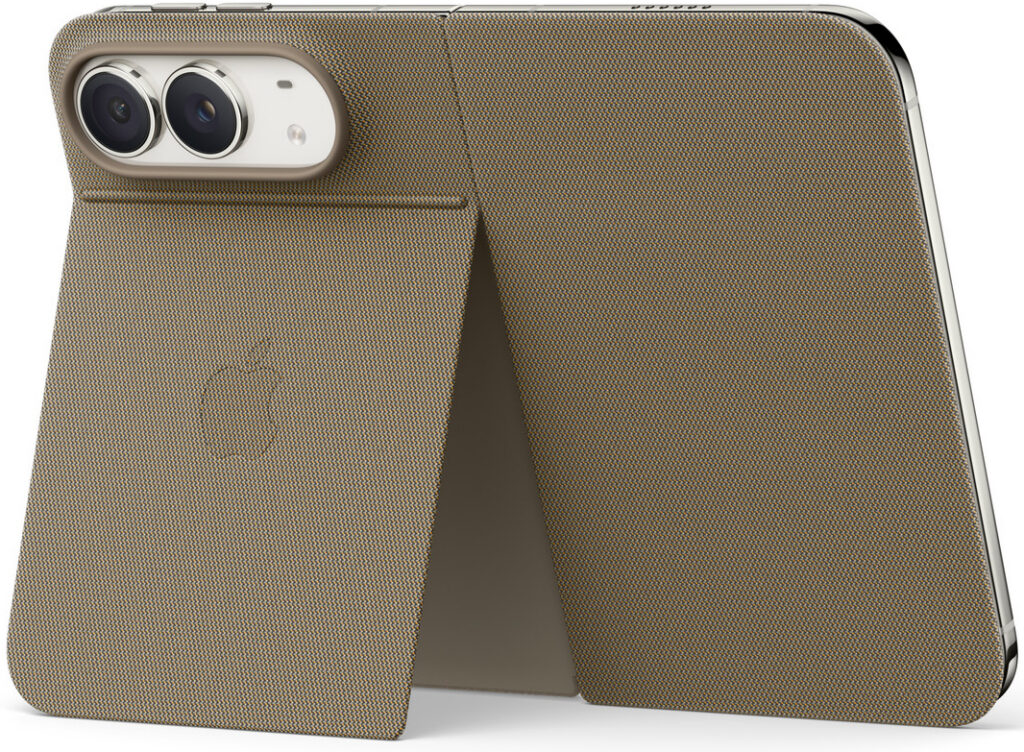
The curtain has been raised on the iPhone Duo.
As Apple’s first foldable smartphone, it carries hardware and software characteristics that are unique to this model and not found elsewhere in the lineup. That doesn’t mean it has all the features of the other iPhones—for instance, not all functionalities of the 18 Pro and 18 Pro Max are present. Here are a few examples.
A featherweight
The iPhone Duo weighs 254 g, a new record for Apple. It isn’t a whole lot heavier than the iPhone 18 Pro Max (249 g).
Apple lists an thickness of 5.2 mm when the iPhone Duo is unfolded and 11.3 mm when folded. This does not take the camera module into account.

The inner screen measures a diagonal of 7.58 inches, with a display ratio close to 1:1.42. It’s a form factor reminiscent of the iPad mini (8.3 inches at 1:1.52). The resolution comes in at 430 ppp (1878 x 2670).
The external display is proportioned similarly (1:1.45) at 5.36 inches, with a resolution of 460 ppp (1398 x 2034), the same as the iPhone 18 models.
Apple has adapted iOS to the foldable format. In particular, it introduces, for the first time on iPhone, its multitasking feature Split View (side-by-side viewing of two apps or two windows of the same app). Zoom, Slack, and Netflix are among third‑party apps that have also adapted.
A visible crease… according to Apple
“Is there a visible crease on the iPhone Duo’s internal screen?”
Apple poses the question directly in the FAQ on the product page. It answers—halfway, describing a screen that is “remarkably flat and smooth.” It also mentions optically transparent adhesives that “[minimize] the mechanical constraints and the bending.”
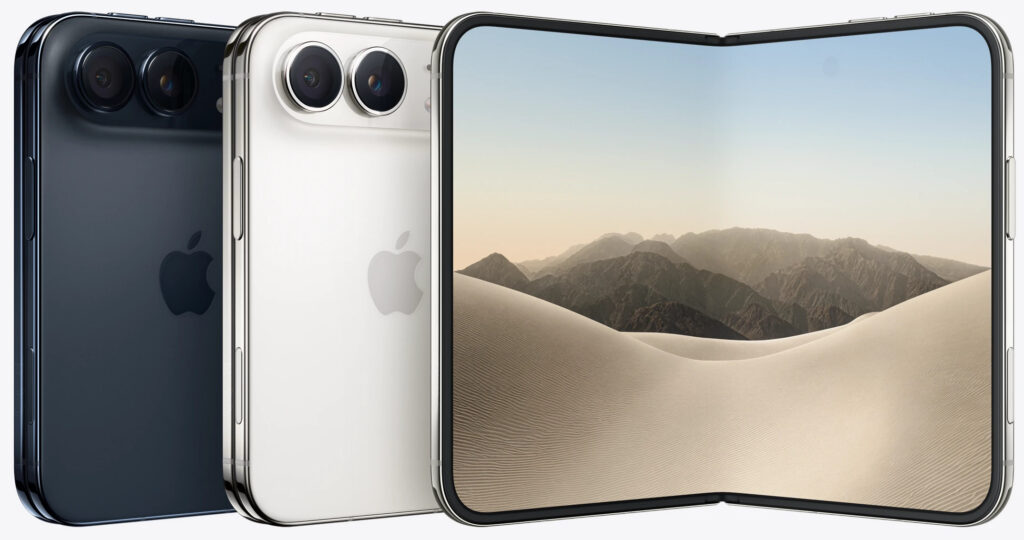
A physical SIM card
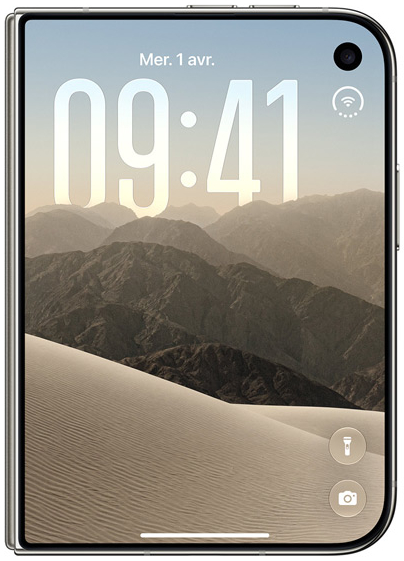
The iPhone 18 Pro and Pro Max distributed in France will come with a physical SIM slot. The iPhone Duo does not. It accepts only eSIMs (8 maximum; 2 active at once).
This frees up space for the battery, Apple says. Or rather for batteries, since there are two cells, for a total capacity of 4700 mAh.
Based on a representative usage profile of iPhone owners, Apple estimates 24 hours of battery life. That’s about the same as the iPhone 18 Pro and a little less than the iPhone 18 Pro Max (30 hours).
Apple also shares endurance figures based on looping HDR movie playback, with all settings at their default except for:
- Bluetooth connected to headphones
- Wi‑Fi connected to a network
- Neither True Tone display nor auto-brightness enabled
| Local | Streaming | |
| iPhone Duo – internal screen | 31 | 26 |
| iPhone Duo – external screen | 44 | 37 |
| iPhone 18 Pro | 36 | 33 |
| iPhone 18 Pro Max | 45 | 40 |
Official RAM capacity
It’s a habit: Apple does not openly disclose the amount of RAM inside its phones.
With the iPhone Duo, as with the iPhone 18, it appears to be 12 GB. A capacity that seems to be the minimum to fully leverage Apple Intelligence.
All these smartphones use the same SoC: the A20 Pro, featuring 6 CPU cores, 7 GPU cores, and 16 Neural Engine cores.
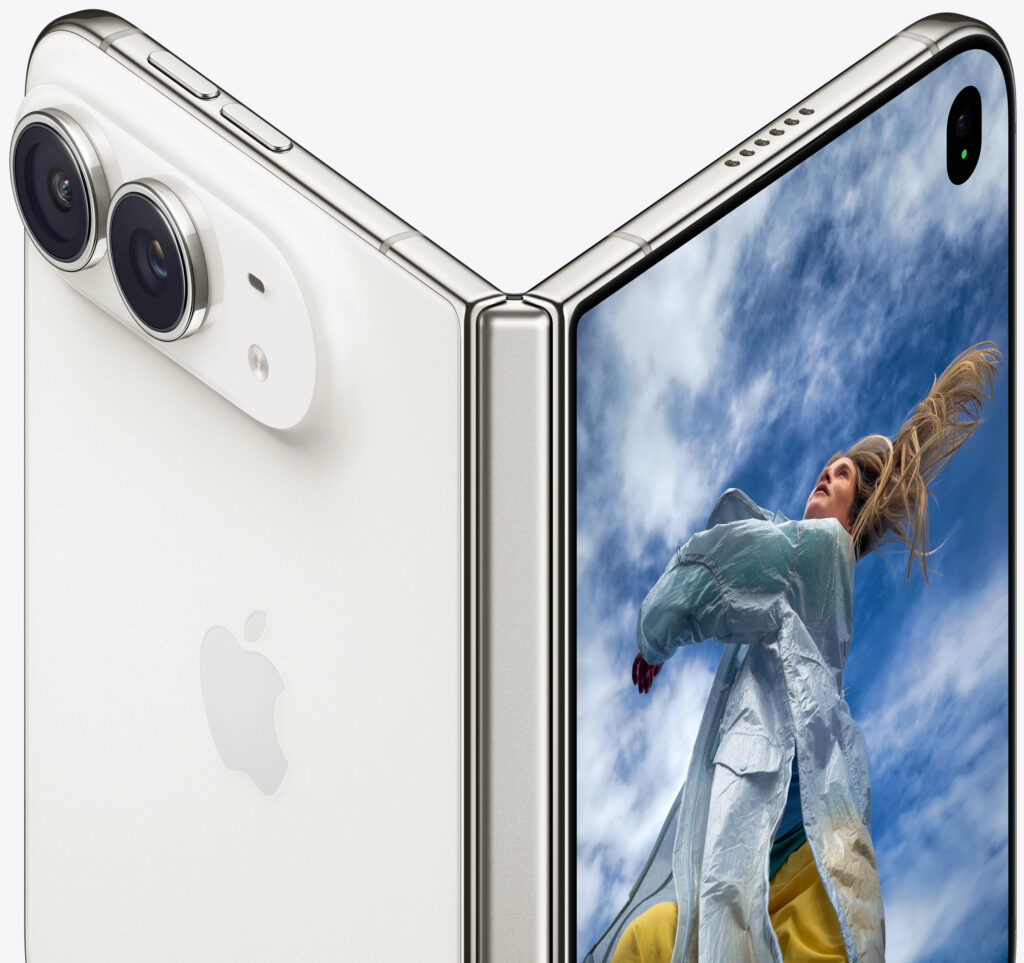
The camera modules of the iPhone 18
The iPhone 18 Pro and 18 Pro Max carry a telephoto lens (200 mm, 8x, f/2.8). Not the iPhone Duo. Its main camera (48 MP, 26 mm, f/1.6) does indeed include optical zoom, but limited to 2x and 12 MP.
There are also differences on the front camera: 18 MP f/1.9 for the iPhone 18, versus 12 MP f/2.2 for the iPhone Duo. The latter does not have Face ID (Apple chose Touch ID on the side button). It does, however, feature a FaceTime camera (1080p, 60 fps) hidden under the display. It also includes features such as:
- Smart Take (“intelligent capture”; automatically fires when all subjects are in frame)
- Duo Preview (preview on the external screen for the people being photographed)
- Duo FaceTime (someone nearby can join, on the external screen, an ongoing call)
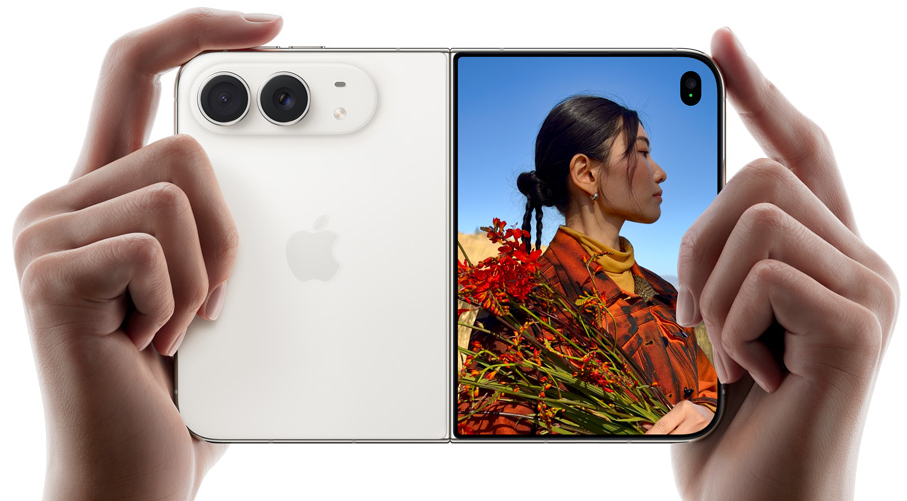
A headphone jack
This is not an exception: it’s been a decade since Apple removed the headphone jack from iPhones.
The sole physical connector on the iPhone Duo is its USB-C 3.2 port. On wireless, Apple has integrated Wi‑Fi 7, Bluetooth 6, and 5G.
Apple Intelligence on open access
Here too, this isn’t unique to the iPhone Duo: certain Apple Intelligence features that rely on server-side models are subject to daily usage limits. This includes photo retouching tools, the image generator, and the AFM 3 Cloud models used for automations via the Shortcuts app.
Apple notes that daily limits can vary by feature. It also says that broader access could be offered in the future as a paid option. It’s worth noting that this relies on Google providing access to Gemini to power the “new Siri.”
Siri AI in the European Union
This “new Siri,” showcased at the latest WWDC, will arrive with iOS 27. It will be usable starting with the iPhone 11 generation. However, it won’t be available in the EU. In an ongoing dispute with the European Commission over regulatory obligations (DMA foremost), Apple has not committed to a date.
A default power adapter
Also under the EU regulations, Apple does not include a power adapter with the iPhone Duo.
To obtain the official charger, it costs €45. It delivers up to 60 W, which is enough to support fast charging. With it, you can reach up to 50% battery in about 20 minutes, according to Apple. It’s a tad slower than the iPhone 18’s 15 minutes.
Wireless charging is rated at 25 W.
A price below €2,000
Excluding any potential trade-in, the entry price is €2,339 including tax for the iPhone Duo 256 GB. Expect €2,589 for the 512 GB version; €3,089 for 1 TB; and €3,839 for 2 TB. This price includes a USB charging cable.
Expect to pay €89 for the official case. And €149 for the folio case with a retractable stand. Both are magnetic to allow wireless charging.
Pre-orders will begin on October 16, with availability starting on the 23rd.