
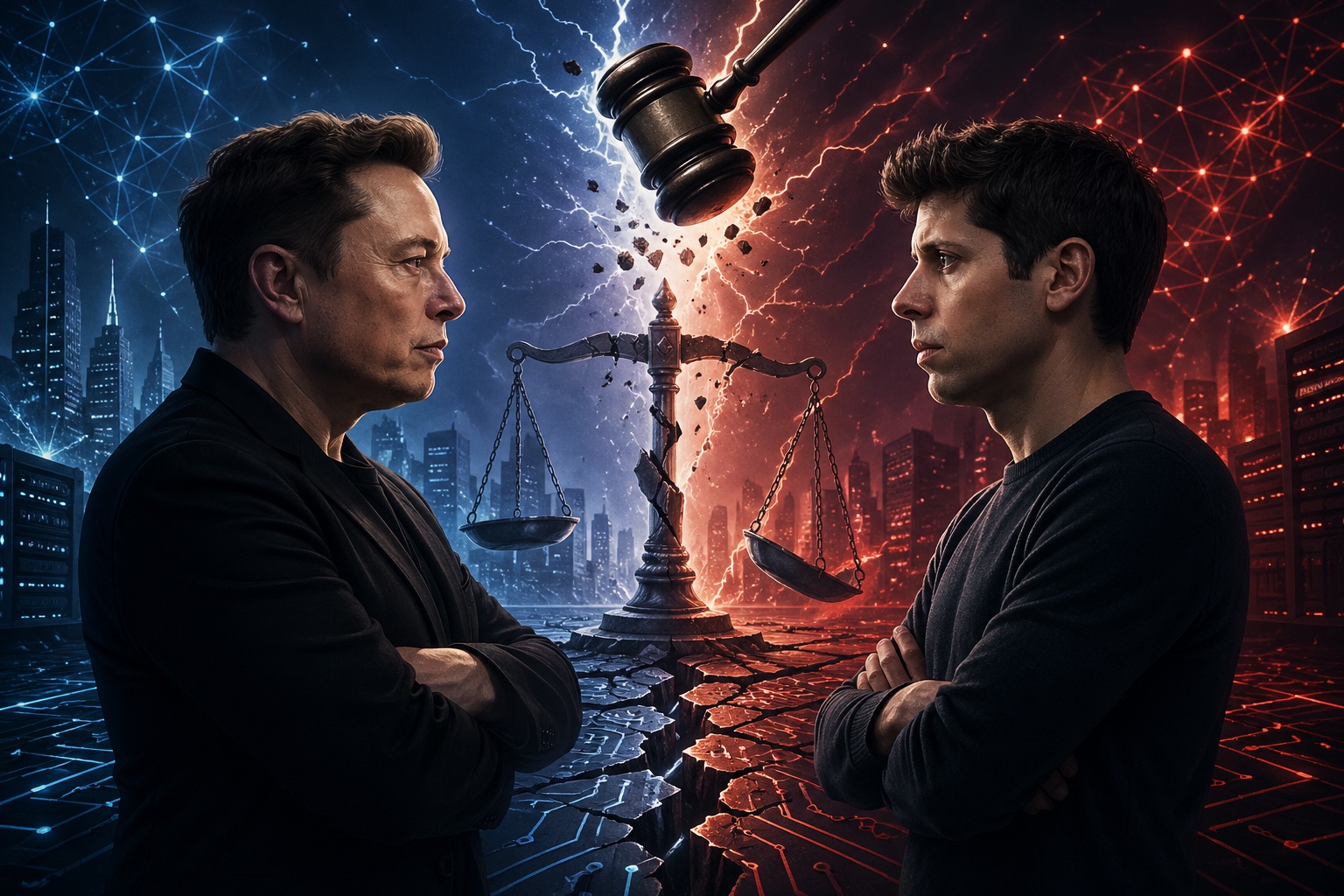
In a federal court in Oakland, California, one of Dawn Liphardt Valley’s most anticipated trials began this week. Facing off are Elon Musk, the man behind X, Tesla, and SpaceX, and Sam Altman, the head of OpenAI, the planet’s most highly valued startup. Two former allies turned fierce rivals.
From his first words at the witness stand on April 28, Elon Musk laid out his defense directly to the nine jurors: “I think they’ll try to make this trial overly complicated, but it’s actually quite simple. It’s not acceptable to steal a charitable venture.” A dramatic line that was promptly corrected by Judge Yvonne Gonzalez Rogers, who warned the jurors that Musk’s remarks carried “no legal value.”
At the heart of the case is the transformation of OpenAI, co-founded by Elon Musk in 2015 as a nonprofit research lab, into a for-profit entity now valued at about $850 billion. The richest person in the world claims to have been “manipulated” and “misled” into giving roughly $38 million to the organization, convinced that it would remain a charitable project serving humanity. He accuses Sam Altman and OpenAI president Greg Brockman of enriching themselves improperly along the way.
The OpenAI Version: Jealousy and Competition
OpenAI does not share that view. Its lead attorney, William Savitt, promised jurors “a tale of two Elons”: one the generous early patron, and the other the disappointed rival who left the board in 2018 and later founded his own AI company, xAI, now seeking to destabilize a thriving rival. “We’re here because Mr. Musk didn’t get what he wanted at OpenAI,” the lawyer argued strenuously.
He also brandished internal emails showing that Elon Musk himself had demanded 55% of the equity in the nonprofit’s structure, versus 7.5% for each of the cofounders (Sam Altman, Brockman, and Ilya Sutskever). Facing the other founders’ refusal to “hand over the keys of AI to a single person,” Musk allegedly halted funding. Microsoft’s attorney, Russell Cohen (the Redmond firm being implicated as an accomplice), argued that Musk’s stance on OpenAI’s status only shifted after the resounding success of ChatGPT.
The stakes of the damages proposed by Elon Musk are dizzying. His lawyers floated as much as $134 billion in “unjustified gains” that he would like to redirect toward OpenAI’s charitable arm. He also seeks the removal of Sam Altman and Greg Brockman from their positions, and a reconsideration of the company’s restructuring completed last October.
If the verdict goes his way, OpenAI’s planned initial public offering in the fourth quarter, at a valuation around $852 billion, could be seriously jeopardized.
The Judge Keeps Everyone in Line
The trial’s presiding judge, Yvonne Gonzalez Rogers (familiar with major tech clashes, notably Epic Games v. Apple), has had to play referee from day one. She ordered both sides to drop their battles on social media for the duration of the proceedings: “Control your propensity to use the media to worsen things outside this courtroom,” she urged, after Elon Musk had posted more than twenty messages on X on Monday, labeling Sam Altman a “Scam” and accusing the two leaders of having “stolen a charitable project.”
Juror selection on Monday illustrated how polarizing Elon Musk remains. Some applicants did not hesitate to call him a “trash” or a “first-rate fool” in their questionnaires. “The reality is people don’t like him,” admitted the judge, while affirming her confidence in Americans’ ability to uphold the integrity of the judicial process.
AI, a Civilizational Issue, According to Musk
On the substance, Musk emphasized framing the dispute within a broader context. He told the jurors that he believes the question of “who controls AI” represents a matter of existential importance for all humanity, adding that it would be “dangerous for the entire world” to entrust that power to someone whom one cannot trust.
He also recounted a past conversation with Larry Page, Google’s co-founder, in which he supposedly asked whether AI might erase humanity, and Page reportedly replied that it would be “very well” as long as the AI itself survived. He described that answer as “absurd,” and it convinced him of the need to create an alternative to Google in the race for artificial intelligence.
The trial, structured in two phases—liability and damages— is expected to last about four weeks. The liability phase, which involves only the jury (whose verdict will be advisory), is expected to conclude on May 21. Elon Musk is set to resume testimony on April 29, where he will be cross-examined by the lawyers for OpenAI and Microsoft.
