
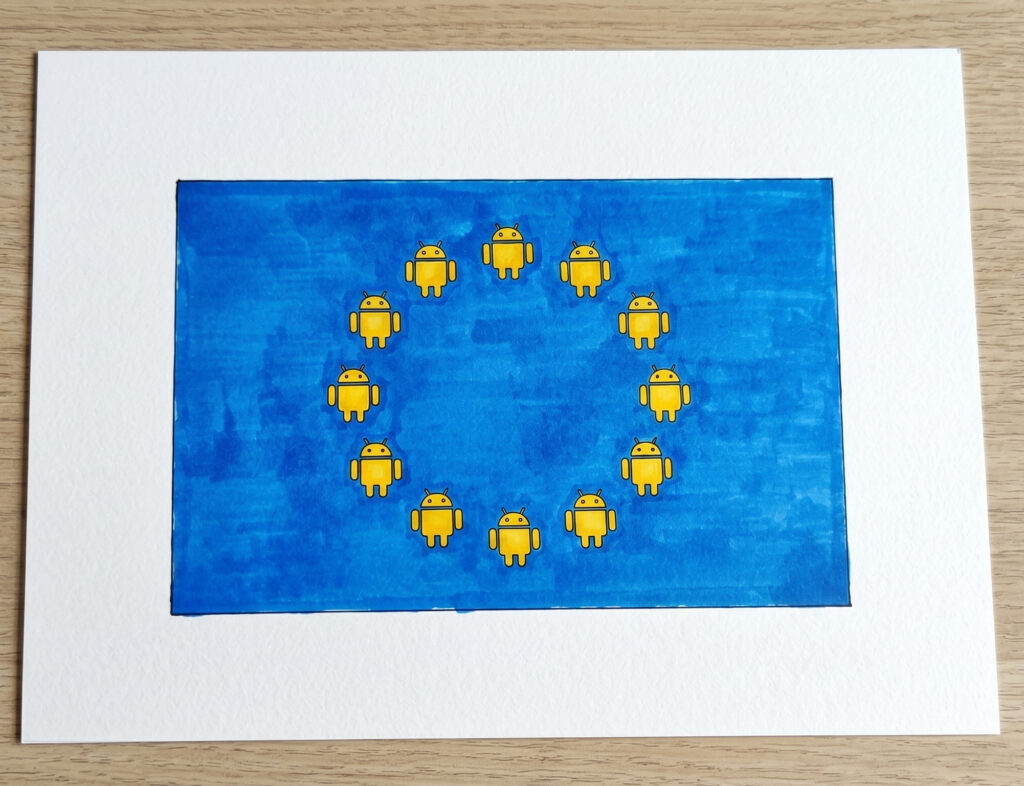
App Functions, Circle to Search, System Intelligence… These are just some of the Android components the European Commission wants opened up. The DMA (Digital Markets Act) backdrop sets interoperability requirements.
In this arena, Brussels first turned its attention to Apple. The case against Google was opened in January 2026. It yields proposed measures, open to public consultation until May 13, 2026. Here is a summary.
Google Invited to Open Circle to Search
Android allows users to call up Google Search by long-pressing the Home button or the navigation bar. The search interface overlays other apps and can leverage context, including what is on the screen. Google implements this feature under the name Circle to Search.
Google would be required to give third‑party apps the same level of access to this feature as its own services. This specifically means publishing the Circle to Search APIs and not reserving the use of the Home button, the navigation bar, or any other access point, whether technically or contractually.
Brussels Demands a More Interoperable “Hey Google”
Android enables invoking services—starting with Google’s voice assistant—by speaking a keyword. This works even when the screen is off and when the device is in battery saver mode.
The European Commission asks Google to open this mechanism to third‑party apps. This includes recording and running audio models, designing custom pipelines to train these models, and allowing third‑party developers to test them on their own devices without prior agreement. It also covers the keyword validation and app invocation system, on an ongoing basis.
Brussels also wants users to be able to customize the keyword without leaving the concerned app. And for third‑party developers to suggest keywords. Invoked apps must also be able to access the same context as Google’s services.
Guaranteeing Fair Access to App Data…
Supported by local databases or sharing platforms, Android enables centralized access to app data. The AppSearch feature, for example, takes advantage of this, but only for the app designated as the default assistant.
The European Commission wants third‑party apps to have the same level of access to this functionality as Google’s services.
… and Contextualized Suggestions
Android allows apps to provide context‑based suggestions. On Pixel smartphones, the Magic Cue feature leverages this. Brussels gives two use cases: displaying a flight number when calling an airline, and recommending opening the calendar when you receive a dinner invitation by text.
For third‑party apps, there are two challenges: serving as both an entry point and an output surface.
On the first point, Google must ensure that third‑party apps can provide data, screen context, and the actions they are capable of performing. They should also supply additional information at the moment suggestions are generated. For example, sending the number dialed— which, as above, can allow an app to determine that the user is contacting an airline and thus suggest the flight number.
On the second point, third‑party developers must be able to display suggestions both within their apps and outside them. These apps should also be able to execute suggested actions (Magic Cue could, for instance, recommend searching for restaurants with Gemini). And receive the data produced by the suggestions (for example copying text into a messaging app).
The “Smart Experiences” Also in Brussels’ Crosshairs
In addition to suggestions, Android can deliver “smart experiences.” That is, contextual features, among other things thanks to the device’s sensor data. From real‑time translation to music recognition, these are mainly implemented via the Android System Intelligence component.
Google is asked to give third‑party apps the same level of access to physical context (sensors) and digital context (audio, screen, notifications, contacts, shortcuts, etc.) as it provides to its own services. The same requirements apply to access to processing resources, both hardware and software (local and cloud models). And to the channels for presenting these experiences, which must be customizable (branding, icon, links to source apps).
Opening Integration and Automation Channels
On Android, an AI service can perform actions in other apps. This capability is implemented through integration channels such as App Actions and App Functions.
The European Commission wants third‑party apps to be able to discover all integrations, execute them, and report back to the user, all with the same access level as Google’s services.
Android also lets Google services automate tasks in certain apps. Gemini leads this effort, capable of mimicking user actions, even in the background.
Brussels demands that third‑party apps have access to this feature at the same level as Google’s services. This includes the ability to display execution indicators at the OS level. And for users to regain control at any time. The Computer Control API may need to be opened in this context.
Android allows services to read and write data in other apps. Reading access can serve semantic search (the European Commission provides this example, describing an assistant that, in response to the question “When is my trip to Spain?”, can infer, by looking in the calendar, that an event “Flight to Barcelona” relates to it). Write access is what lets Gemini edit notes in Keep and send SMS on the user’s behalf.
Brussels also seeks interoperability for OS integrations. This includes changing settings and controlling functions such as reboot, screenshots, or alarm management.
Ensuring Non-Discriminatory Access to Local Models
More broadly, Google is urged to allow third‑party apps, under the same conditions as its services, access to the local models embedded in Android—and to customize them.
Third‑party developers should also be able to implement their own local models. They should benefit from both the centralized system that exposes them and the background execution capabilities.
This interoperability implies fair access to resources (memory, compute) and to the allocation mechanism, as well as to the means to launch or resume background tasks based on context.
