
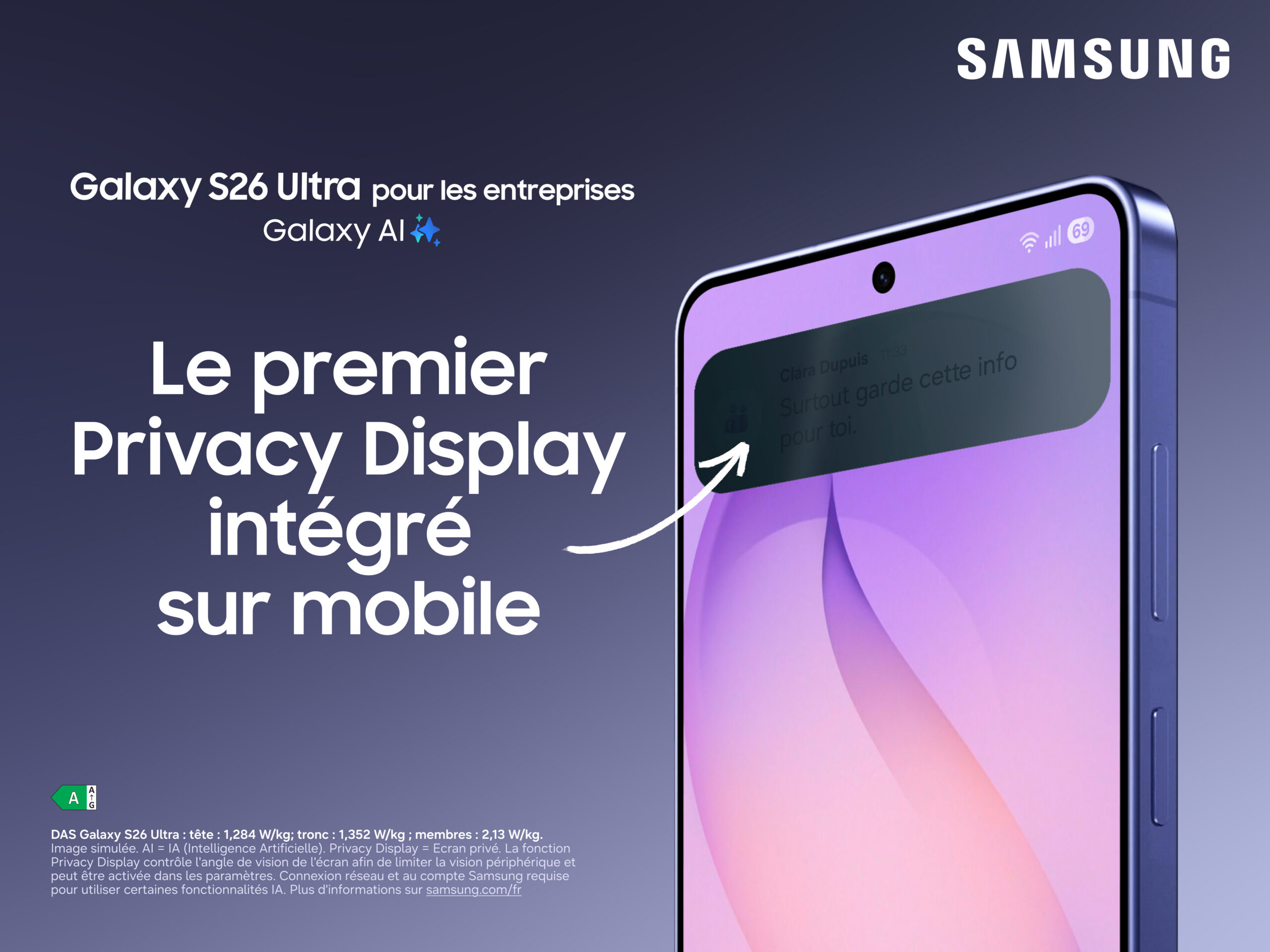
Cybersecurity is no longer limited to passwords, encryption, or firewalls. Another threat has emerged: shoulder surfing, or visual eavesdropping. The principle is simple: a person nearby can read or glimpse confidential information directly on the screen of a device. A quick, discreet glance can capture a sensitive email, an identifier, a strategic document, or a confidential notification.
For businesses, these micro-exposures represent a real risk: information leaks, unauthorized access to internal data, or disclosure of confidential items. Yet professional smartphone usage has never been more important; the phone’s screen has become a true extension of the workstation.
The Vulnerability of Data on the Move
The issue is particularly acute during travel. Many professionals today refrain from consulting certain sensitive documents on a train or during a flight, for fear of being observed. This constraint reduces efficiency and can slow down decision-making processes.
For a long time, the only solution was to use a physical filter stuck onto the screen, limiting the viewing angle. But these accessories come with several drawbacks: reduced brightness, loss of image quality, and a constant constraint, even when confidentiality is not required.
A Technological Innovation, Not a Simple Filter
In this context, Samsung introduces a world first: the Privacy Display integrated into the Galaxy S26 Ultra.
Unlike traditional physical filters, this is not an accessory but a native technological innovation. The system acts directly on the screen to dynamically restrict the viewing angle. Concretely, the user sees their content clearly from the front, while people on the sides perceive a heavily darkened or unreadable screen.
This approach offers several major advantages:
- No permanent degradation of screen quality,
- Activation or deactivation on demand,
- Adjustable to the user’s preferences,
- And the possibility to apply protection only to certain apps.
The objective is clear: tailor confidentiality to the usage context, rather than impose a constant constraint.
With this technology, the smartphone evolves into a more strategic player in the professional environment. This approach introduces a new dimension of cybersecurity: the physical protection of data displayed. Because even with perfectly secure IT systems, information visible on a screen remains potentially exposed.
Sensibiliser aux risques invisibles
One of the major challenges now is to fully integrate visual confidentiality into overarching security policies. If organizations invest heavily in cybersecurity, the risks related to the physical environment remain insufficiently addressed, even though they directly expose sensitive data.
In a mobility-driven context, these practices must align with structural requirements such as GDPR, standards like ISO 27001, and internal BYOD and COPE policies. Data protection no longer ends at systems and networks: it now includes exposure in public spaces.
For organizations with mobile fleets, the question is no longer only whether data is encrypted, but whether it is visible.
From this perspective, the ability to limit the viewing angle becomes a tangible lever to reduce the risk of accidental disclosure, while contributing to compliance goals.
With the Privacy Display integrated into the Galaxy S26 Ultra, Samsung extends the security perimeter to the screen itself—where information becomes visible and therefore vulnerable.
Confidentiality no longer rests solely on user behavior or on add-on solutions: it becomes a native capability of the device. A shift that marks a turning point, fully integrating the physical dimension into the overall data protection strategy.
To learn more, contact a Samsung expert.
