
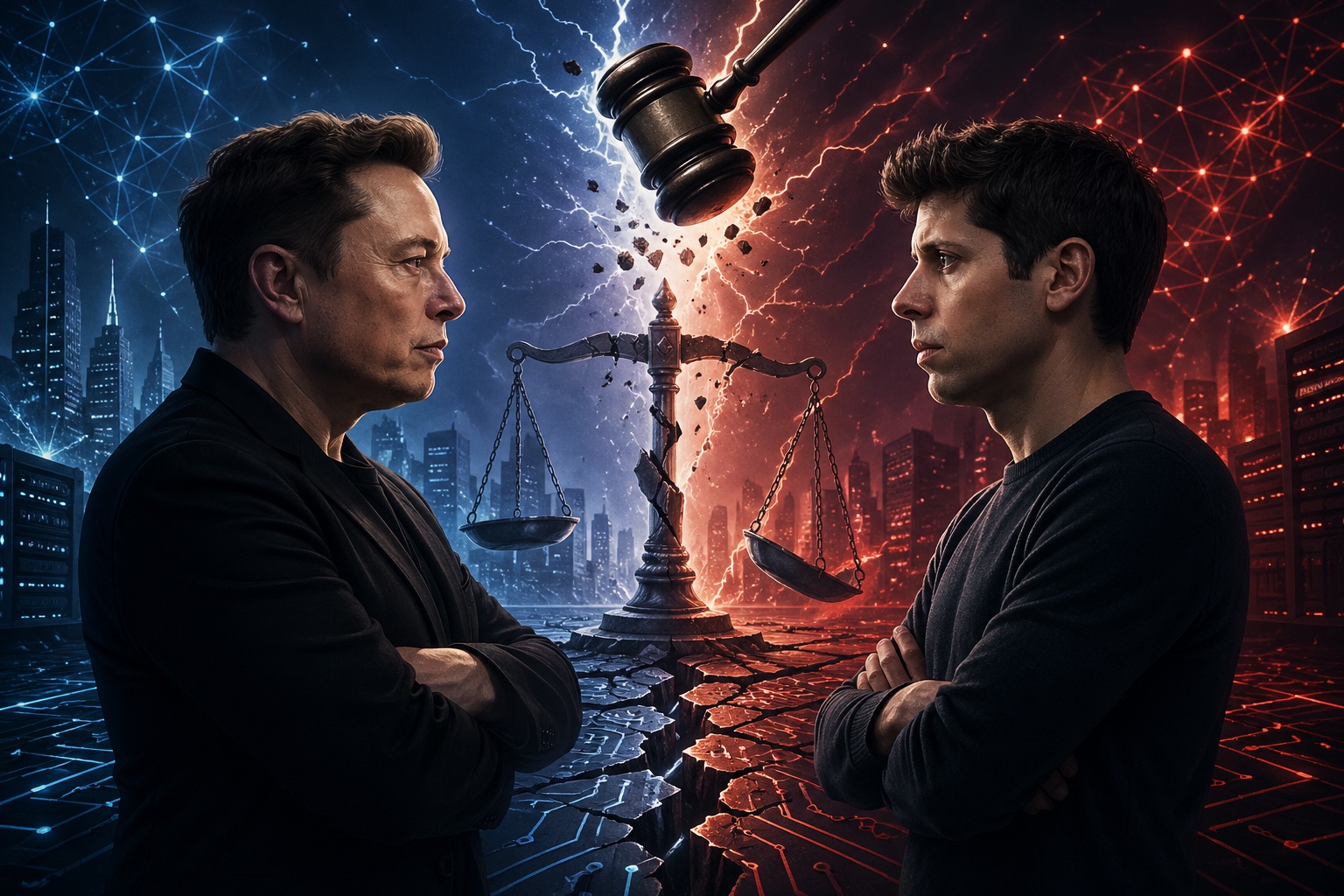
In the federal courthouse in Oakland, a few miles from the San Francisco headquarters where OpenAI sits, two of the most powerful figures in the tech world will come face to face.
On one side, Elon Musk, head of Tesla, SpaceX and xAI, the richest man on the planet. On the other, Sam Altman, CEO of OpenAI, the startup that put generative AI on the map with ChatGPT. Between them lies a fractured friendship, millions of dollars, late-night agendas, compromising text messages, and a question that goes beyond their personal feud: who owns the future of AI?
A multi-year war
It all began in 2015, when the two men co-founded OpenAI, a nonprofit artificial intelligence research lab.
The vision: to develop AI “for the benefit of humanity,” far from the grasp of giants like Google. Sam Altman had approached Elon Musk about the idea in May 2015, calling it the “Manhattan Project for AI,” according to documents filed in the case.
The backing of Elon Musk allowed OpenAI to recruit leading researchers, including Ilya Sutskever, its former chief scientist.
But by mid-2017 tensions erupted. Musk questioned OpenAI’s viability, withheld promised funds after clashes with Altman and Greg Brockman, and demanded the CEO post; a move that unsettled the other co-founders. In January 2018, he bowed out in an email with no reply: “OpenAI is on track for certain failure against Google.” He left the board soon after.
The rest, as they say, is history. In 2019, OpenAI restructured into a for-profit entity backed by its nonprofit arm. In 2022, ChatGPT took the world by storm. In 2023, Musk founded xAI, his own rival. And in 2024, he sued OpenAI in court.
$150 billion at stake
The amount of damages sought by Elon Musk is dizzying. His lawyers pegged the claim at around $150 billion, calculated by multiplying OpenAI’s valuation (now exceeding $850 billion) by the share of the nonprofit portion attributed to his contributions, estimated between 50% and 75% of that portion. The sums would go not into the billionaire’s pockets, but to OpenAI’s charitable arm.
Elon Musk also contributed roughly $38 million of his own funds to OpenAI between 2016 and 2020. His lawyers contend that he was misled about the nature and destination of these contributions.
Legally, four counts remained after pruning: breach of charitable trust, fraud, constructive fraud and unjust enrichment. In a strategic move, Elon Musk proposed dropping the two fraud charges to streamline the proceedings. The court accepted this.
The trial thus centers on the breach of charitable trust: the argument that Musk supplied assets intended for a nonprofit, open-source organization, which were diverted to a for-profit entity.
A parade of tech leaders to the stand
The trial’s lineup rivals a Hollywood blockbuster. Musk and Altman will testify in person. Greg Brockman, cofounder and president of OpenAI, will also testify. Satya Nadella, Microsoft’s CEO (OpenAI’s lead investor) and co-defendant in the case, is expected to take the stand. Microsoft is accused of aiding and abetting the actions alleged against OpenAI.
Another key witness: Shivon Zilis, former OpenAI board member and mother of four of Elon Musk’s children. OpenAI contends she served as a conduit for information to Musk from within the company. Text messages filed in the record show that in 2018 she asked him whether it would be better for her to stay “close and friendly” with OpenAI “to maintain the flow of information.”
Judge Yvonne Gonzalez Rogers deemed her relationship with Elon Musk “highly relevant” to assessing his credibility.
Intimate remarks at the heart of the case
The case owes part of its explosive character to a diary. Greg Brockman’s diary, excerpts of which have become central exhibits. In fall 2017, the cofounder writes: “This is our only chance to free ourselves from Elon. Is he the ‘glorious leader’ I would have chosen?” He further questions his own financial motives. In another excerpt, he acknowledges that transforming OpenAI without Elon Musk would be “morally questionable” because “it would be wrong to steal the nonprofit from him.”
The billionaire’s lawyers seized on these notes to argue that OpenAI’s leaders were driven more by greed than by mission. Brockman, in his deposition, said those lines reflected a personal contemplation of his hypothetical motivations, not a deliberate plan.
Nevertheless, several legal obstacles undermine Musk’s position. First comes standing. In California law, it is typically the state attorney general who has the authority to monitor the use of charitable donations rather than the donors themselves. Judge Gonzalez Rogers, however, allowed Musk to pursue the case, drawing on a 1964 precedent that creates an exception when the attorney general is too busy to intervene.
Elon Musk: outsider in his own trial
Meanwhile, the California attorney general has spent months negotiating with OpenAI and has signed a memorandum approving the company’s restructuring.
For OpenAI, the stakes are equally dizzying. The company is preparing an initial public offering that could value it at more than $1 trillion by year’s end. The trial is explicitly listed as a risk in documents shared with potential investors. Even a partial ruling in Musk’s favor—such as removing Sam Altman or Greg Brockman—could cast doubt on the company’s governance.
The inventor of ChatGPT is pushing back by challenging Musk’s motives. According to his lawyers, Musk is simply aiming to handicap a direct rival. His own company, xAI (now a subsidiary of SpaceX), lags far behind OpenAI in user adoption.
Judge Gonzalez Rogers has structured the proceedings into two phases: a first on liability and a second on damages, scheduled for May 18 if OpenAI is found liable. The nine-person jury will have only an advisory role on damages; it is the judge who will render the final decision.
