
To build a hybrid HPC/quantum computing platform around the Joliot-Curie supercomputer, that was the objective of France’s Hybrid Quantum Initiative (HQI) at its launch in January 2022.
The total budget was €72.3 million. Half of it funded hardware acquisitions under GENCI’s supervision. The other half supported a research program led by the CEA and Inria.
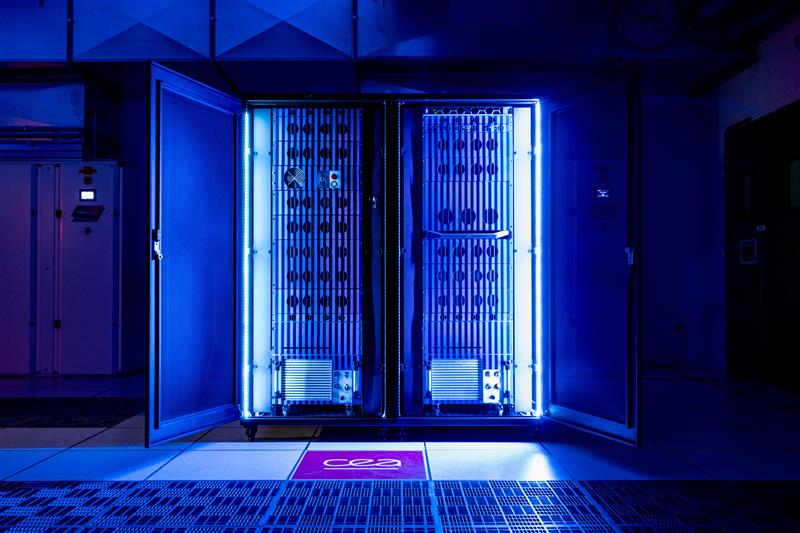
Four years on, milestones have been reached. Among them, one this week: the inauguration of Lucy. This universal quantum computer relies on photonic technology from the French company Quandela, with cryogenic systems supplied by a German vendor. It has been installed at TGCC (Très Grand Centre de Calcul, in the Essonne department) since October 2025. And it is, therefore, coupled to Joliot-Curie (22 Pflops), while awaiting the exaflop exascale supercomputer Alice Recoque. Total acquisition cost: €8.5 million.
Among Lucy’s initial applications are the optimization of energy networks and financial portfolios, logistics management, and aerospace design.
Lucy, Qaptiva and Ruby, three quantum partitions around Joliot-Curie
The TGCC’s conventional HPC resources are open to scientific projects from both the public and private sectors. But in all cases, the results of the work must be publishable. For private sector users, access is limited to companies engaged in France-based R&D activities.
The requirement for open research applies also to access to Lucy. However, any European researcher may apply, whether their lab or company has a France link or not.
The allocated envelope cannot exceed 100 hours per year per quantum partition. Lucy is not alone. There is, on the one hand, Qaptiva, provided by Atos, which grants access to a 40-qubit quantum simulator. On the other, Ruby, inaugurated in November 2025, rests on an analog quantum computer based on neutral atoms (100 qubits) developed by Pasqal.
Among applications well suited to the analog mode are combinatorial optimization (store placement, card labeling, credit scoring…), quantum chemistry simulations, and quantum machine learning (time-series data processing, graph-based data classification).
Parallel to Ruby, another 100-qubit Pasqal computer was inaugurated: JADE, installed at the Jülich Research Centre (Germany) and connected to the JURECA DC supercomputer (23.5 Pflops). In the background, a European project focused on hybridizing HPC and quantum simulators: HPCQS (High-Performance Computing Quantum Simulator hybrid). France, Germany, Austria, Spain, Ireland and Italy are contributing financially, in addition to Horizon 2020 funds.
The five other EuroHPC hybrid systems
Lucy was acquired as part of a consortium known as EuroQCS-France. For CEA and GENCI, it partners the Jülich Research Centre, ICHEC (Irish Centre for High-End Computing) and the Politechnic University of Bucharest. EuroHPC had selected it in October 2022, alongside five other consortia, to host its first quantum computers. Specifically:
| Computer | Location | Technology | Connected to | Cost | Inauguration |
| Piast-Q | Poznań Supercomputing and Networking Center (Poland) | Trapped ions (Alpine Quantum Technologies, Austria) 20 qubits | ALTAIR (5.9 Pflops) | €12.3M | June 2025 |
| Euro-Q-Exa | Leibniz Supercomputing Centre (Munich, Germany) | Superconducting qubits in a square-lattice topology (IQM, Austria) 54 qubits | SuperMUC-NG (26.9 Pflops) | €25M | February 2026 |
| VLQ | IT4I National Supercomputing Centre (Ostrava, Czech Republic) | Star-topology superconducting qubits (IQM) 24 qubits | KAROLINA (12.9 Pflops) | €5M | September 2025 |
| EuroQCS-Italy | CINECA (Bologna, Italy) | Neutral atoms (Pasqal) 140 qubits | Leonardo (315.74 Pflops) | €13M | Not inaugurated |
| Marenostrum Ona | Barcelona Supercomputing Centre (Spain) | Quantum annealing system (Qilimanjaro Quantum Tech, Spain) 10 to 25 qubits | Marenostrum 5 (314 Pflops) | €8.5M | Not inaugurated |
