
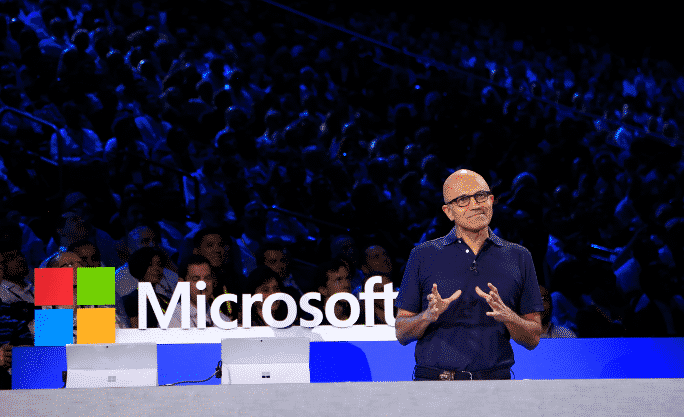
In a navy suit and blue tie, one of the most powerful figures in tech took the stand on Monday, May 11, before the federal court in Oakland, California.
Satya Nadella, Microsoft’s chief executive, was anticipated as the pivotal witness in the trial pitting Elon Musk against Sam Altman, Greg Brockman, and OpenAI, with Microsoft accused of “aiding and abetting.”
Hours into his testimony, one line will linger: “It was amateur city, as far as I’m concerned.” That is how Nadella described the OpenAI board’s handling of Sam Altman’s abrupt dismissal in November 2023. An episode he revisited with a candor rare for an incumbent CEO under oath.
Sam Altman’s firing: a “hasty” decision
It all begins with that November 2023 night when the OpenAI board, convinced that Sam Altman had not shown “consistent candor” in his interactions with them, removed him from his post. He was reinstated a few days later, following combined pressure from employees and investors.
Nadella said he was “very surprised” by the decision and tried to understand the reasons behind it, unsuccessfully. According to the Financial Times, he stated: “Whenever I asked specifically why Sam had been fired, [the board] never gave me a precise answer.” For him, behind this “hasty” decision lay jealousy and internal communication problems.
Ilya Sutskever, OpenAI’s cofounder and a board member at the time, corroborated that assessment in his afternoon testimony. According to CNBC, he acknowledged having conveyed grievances about Sam Altman to the directors himself before reversing course and signing the reinstatement petition. “I felt that if I didn’t do it, the company would be destroyed. It was a ‘Hail Mary,’” he told the court, per the Wall Street Journal.
$13 billion: a bet, not charity
But the real focus of the case lies elsewhere. Elon Musk accuses Microsoft of financing the betrayal of OpenAI’s charitable mission by injecting a total of $13 billion into the organization: $1 billion in 2019, $2 billion in 2021, and $10 billion in 2023.
In response, Nadella was as direct as possible: “It’s because we were the only ones willing to take the risk,” he told Musk’s lawyer when asked whether the investment had “very, very, very much paid off” for Microsoft. A video deposition from Microsoft executive Michael Wetter clarified that the company has so far earned around $9.5 billion in revenues from the OpenAI partnership, according to CNBC.
For the Microsoft leader, the investment was never a donation; contrary to Musk’s assertion. “Enough charity, business comes first,” he acknowledged having thought as far back as 2018, when OpenAI’s computing bills began to soar.
IBM syndrome: an existential fear
Although he testified with composure, a string of internal emails highlighted his strategic anxieties. In 2022, he wrote to his executives: “I don’t want to be IBM and have OpenAI become Microsoft.” A pointed allusion to the 1980s deal when IBM handed a young Microsoft the task of building an operating system, only to see it gradually eclipse IBM.
A few months later, in an email to his chief financial officer Amy Hood, cited by the Financial Times, Nadella clarified: “Right now, we are a thin layer on top of Nvidia, and all the intellectual property is with OpenAI. If we are going to spend so much money without steering our own fate, it doesn’t make sense.”
Today, Microsoft holds roughly 27% of OpenAI’s commercial arm, valued at about $135 billion, with the group’s market capitalization flirting with the $3 trillion mark.
Elon Musk, the disruptive absentee
Confronted with this display of force, Musk’s legal team seeks to portray Microsoft as a disguised controlling shareholder. They aired screenshots from a discussion group involving Satya Nadella, Sam Altman, and Microsoft’s chief technical officer Kevin Scott, in which the trio discussed potential future OpenAI directors. The list notably included Sue Desmond-Hellmann, the former CEO of the Gates Foundation, who was ultimately named to the board in March 2024.
Nadella explained that he opposed the candidacy of Diane Greene, former head of Google Cloud, due to her past ties to a “competitive ecosystem.”
