
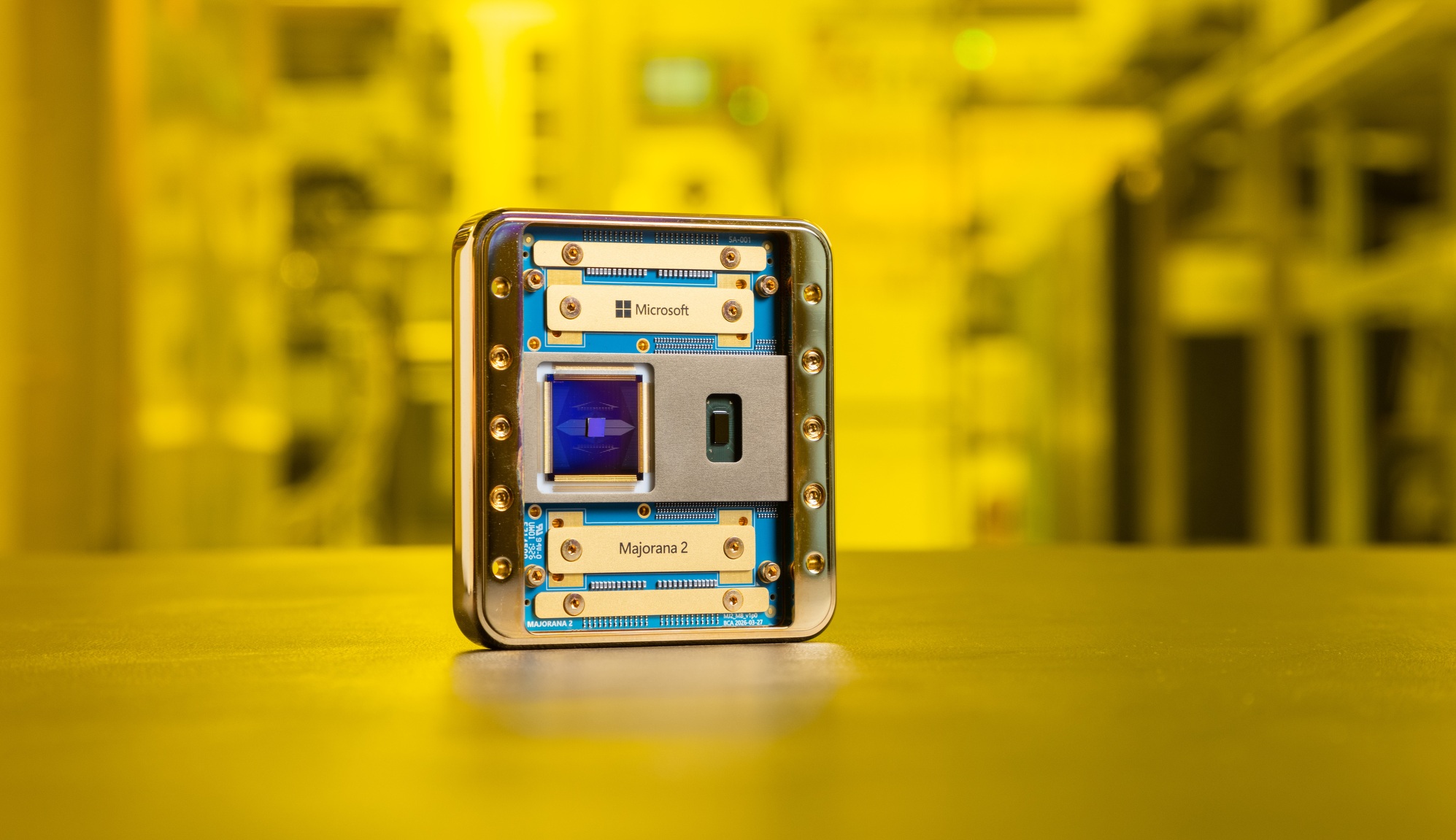
Microsoft does not yet sell a quantum computer, but aims to prove it has reached a credible milestone with its Majorana 2 chip. It follows Majorana 1 and sits within the long-running program Microsoft has pursued for years around topological qubits.
The company says it has increased the reliability of its qubits by a factor of 1,000 compared with the previous generation, with an average coherence time now exceeding 20 seconds, versus 1 to 12 milliseconds on Majorana 1.
This improvement rests on a hardware redesign, replacing aluminum with lead in the superconducting layer and using a new combination of indium arsenide and indium arsenide–antimonide in the active semiconductor region.
For Microsoft, these choices should further stabilize the topological phase and make the qubits more robust against perturbations.
The promise of topological qubits
The appeal of this architecture is well understood. Microsoft wants qubits that are less sensitive to noise and easier to scale than those offered by several competing approaches. If this path proves viable, it could reduce the cost and complexity of error correction, one of the main bottlenecks in quantum computing.
But that is where caution must prevail. The chip remains experimental, and the stability announced, even spectacular, does not by itself suffice to yield a usable machine without a complete architecture capable of managing at scale the errors that will inevitably occur. In short, Microsoft is making progress on a critical building block, without yet demonstrating the final system.
The other takeaway from the announcement lies in the timetable. Microsoft now says it is aiming for a practical and scalable quantum computer by 2029, rather than 2033 as previously stated, which signals increased confidence in its technical trajectory.
This revision of the roadmap should not obscure the gap between the objective and reality. Microsoft implicitly acknowledges that several milestones remain to be crossed before achieving a fault-tolerant machine capable of running truly meaningful large-scale calculations.
