
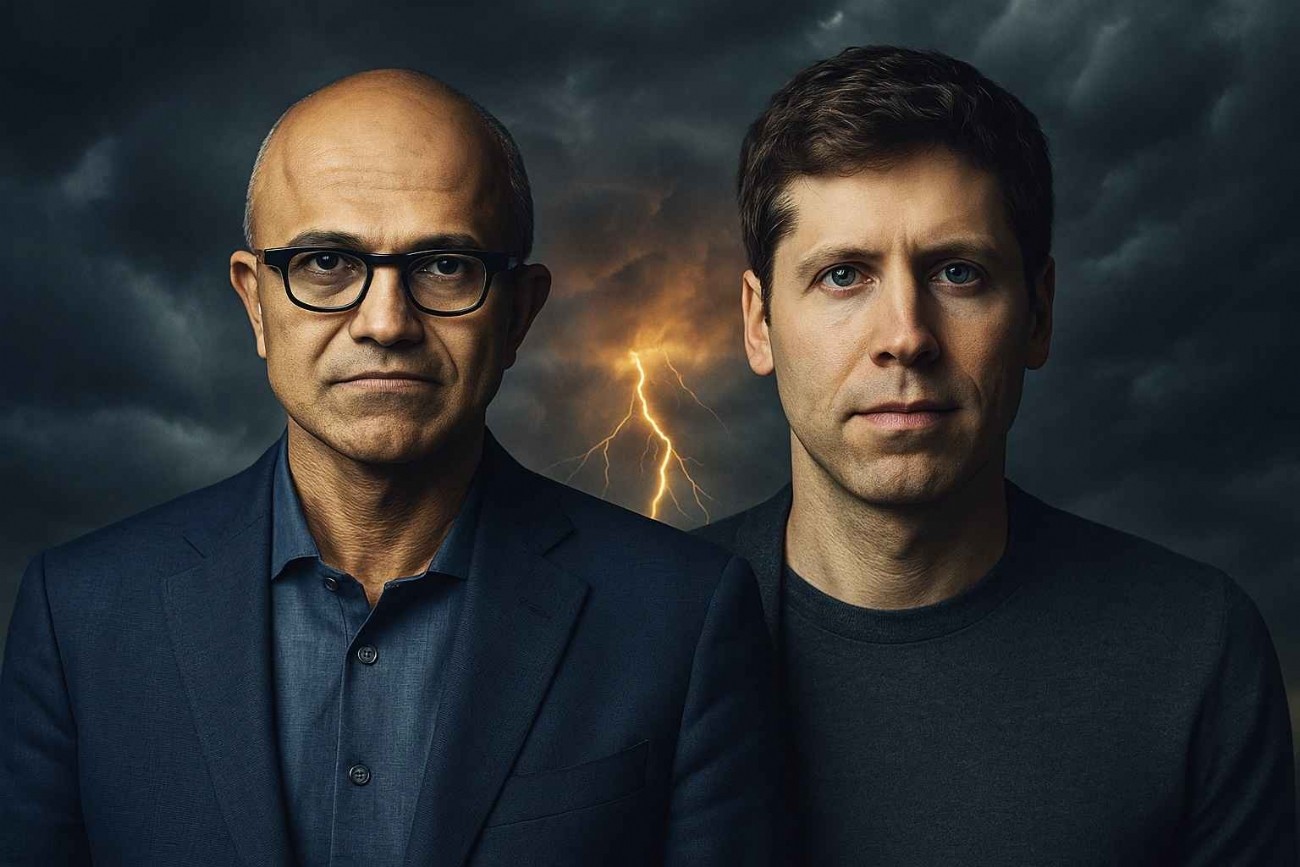
A divorce isn’t on the agenda, but the couple is flailing. The days when Microsoft and OpenAI presented themselves as a perfect match seem to be over.
Without ever openly talking about a breakup, Satya Nadella has shifted his messaging in recent months. The Microsoft CEO now defends a “multi-model” approach for his company and its customers, and highlights its own technological capabilities with the MAI model family and the Maya chips.
A partnership that remains solid on paper
Nothing, officially, challenges the alliance between the two groups.
Microsoft remains OpenAI’s lead investor with around 27% of the capital, and the two companies are bound by a continuing agreement through 2032 that guarantees Redmond privileged access to the models and “agents” developed by the inventor of ChatGPT, without additional licensing costs.
In parallel, OpenAI has committed to massive Azure capacity purchases. A contract valued at more than $250 billion, while Microsoft would continue to receive about 20% of OpenAI’s revenue until the same date, according to multiple sources.
But exclusivity, it seems, is in the rearview. OpenAI is no longer required to run its models exclusively on Microsoft’s cloud infrastructure. This strategic shift reportedly cooled the relationship when OpenAI, in 2025, signed a $50 billion agreement with AWS. Microsoft would have considered taking legal action, arguing that such an agreement might contradict existing contractual clauses.
Personal relationships cooling
Beyond the numbers, several observers point to a loosening of the personal bonds between Satya Nadella and Sam Altman.
Direct exchanges between the two leaders would have become more infrequent, amid disagreements over computing resource allocation, OpenAI governance, and the pace of the race toward artificial general intelligence (AGI).
Both sides continue to publicly present a “win-win” partnership, but rivalry is becoming more openly acknowledged in the field of models and infrastructure. Microsoft now explicitly positions itself as an alternative to OpenAI’s premium offerings, but also to those from Anthropic.
Nadella’s doctrine: rely on no one
That is where the core of the matter lies. Satya Nadella openly advises client companies never to lock themselves into a single AI vendor and recommends deploying “AI gateways” to decouple business uses from the underlying models.
A doctrine that also serves Microsoft’s commercial interests, which positions itself as the orchestrator of this plurality via Azure.
The figure speaks for itself: the Azure AI platform now hosts more than 11,000 different models, sourced from OpenAI, Anthropic, Mistral, and xAI, alongside the MAI model family developed in-house.
This strategy is accompanied by an all-out deployment of the Copilot brand, now present in more than eighty Microsoft services and applications (Office, Windows, Security, Dynamics), making the AI assistant the through-line of the user experience regardless of which back-end model is running.
The bet on silicon and open-weight
On the industrial front, Microsoft is also intensifying its investments in proprietary infrastructure. Starting with its Maya chips designed to deliver roughly a 40% gain in energy efficiency for AI workloads.
Another sign of this openness: Satya Nadella joined Elon Musk and Mark Zuckerberg to show support for open-weight models to foster a less locked AI ecosystem, in which the group can play the role of aggregator rather than dependent.
Is this diversification strategy a sign of preparing for a durable cooling with OpenAI, or simply the expression of classic strategic maturity? The answer will likely become clearer by 2032, the expiration date of the agreement that still binds them… for now.
