

Levels of inference, chain-of-thought, context caches, provisioned throughputs… So many concepts currently occupying the FinOps Foundation.
In the crosshairs is the upcoming version of the FOCUS specification, slated for December 2026. The “token economy” is a top-priority workstream there. Objective: standardize as much as possible how the usage of AI services is represented.
Learn First to Use What Already Exists
The community is of the view that the material is already there. The challenge lies more in explaining how to use it. This involves providing mapping tables, potentially embedded in an appendix, alongside examples of SQL queries. They would cover three provider archetypes: cloud (such as Amazon Bedrock / Azure OpenAI), MaaS (OpenAI / Anthropic), and hybrid (Vertex AI). Ideally, they would tackle edge cases like fine-tuning and batching.
These mappings will be accompanied by a white paper, expected in August. The working document outlines several avenues for representing workloads of inference using existing semantics. The notion of provisioned throughput, for instance, can be mapped to capacity reservations; the aggregation of agentic workflows to the grouping of transactions. Among the additions under consideration are columns to distinguish a request identifier from a session identifier. Rationale: a user interaction may generate multiple requests, invoke multiple models, run tools, etc.
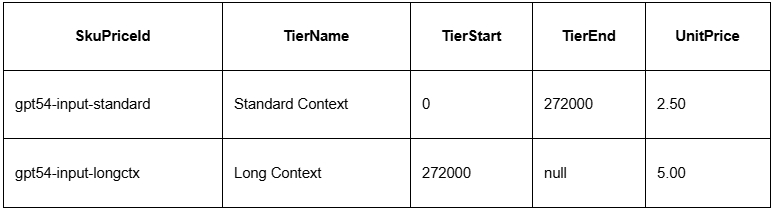
To distinguish users (human, application, agent), the white paper does not propose creating new columns but using tags. To align with the transactional semantics of FOCUS, it recommends separate lines for each billing component (input, output, cache, reasoning, image processing…). As for tiered pricing based on time windows, it proposes treating it as a standard level-based billing problem.
Segment by Model and Distinguish Input from Output
Other priority axes on the roadmap: the ability to segment costs by model, to distinguish input and output tokens, and to account for token limits per request.
Since last year, the specification has encompassed “virtual currencies” (non-monetary). The token is part of this, though less from the AI perspective than as credits purchased upfront.
The latest version (1.4, published in June 2026) adds two data sets intended to facilitate reconciliation. One materializes charges as they appear on supplier invoices. The other defines the time intervals and statuses associated with billing cycles.
Another addition: columns that allow for better comparison of engagement structures among providers and to identify those to which a charge is eligible.
Adobe, AWS, Datadog, Google, IBM Cloudability and Microsoft serve on the FOCUS steering committee, alongside Capital One and Walmart. Among the organizations that contributed to v1.4 are Amadeus, American Express, Broadcom, Databricks, Oracle and Salesforce.
Further Reading:
The token economy, the new focal point of the FinOps Foundation
Tokenmaxxing: waste or a driver of AI transformation?
Jensen Huang defends his view of the “token economy”
