
OpenAI has chosen to lift the veil a little on its own internal practices.
In a post titled Research acceleration: the view inside OpenAI, the scale-up details for the first time how many tokens its researchers spend each day to run autonomous programming agents.
By mid-August, the median researcher in the research organization was daily running code-based agents, incurring more than $600 per day in inference costs at API prices.
A month earlier, in July, this daily amount had only reached $162, according to data reported by trade press, underscoring a rapid uptake in just a few weeks.
Among the top 10% most active researchers, the daily bill now exceeds $7,000 in tokens.
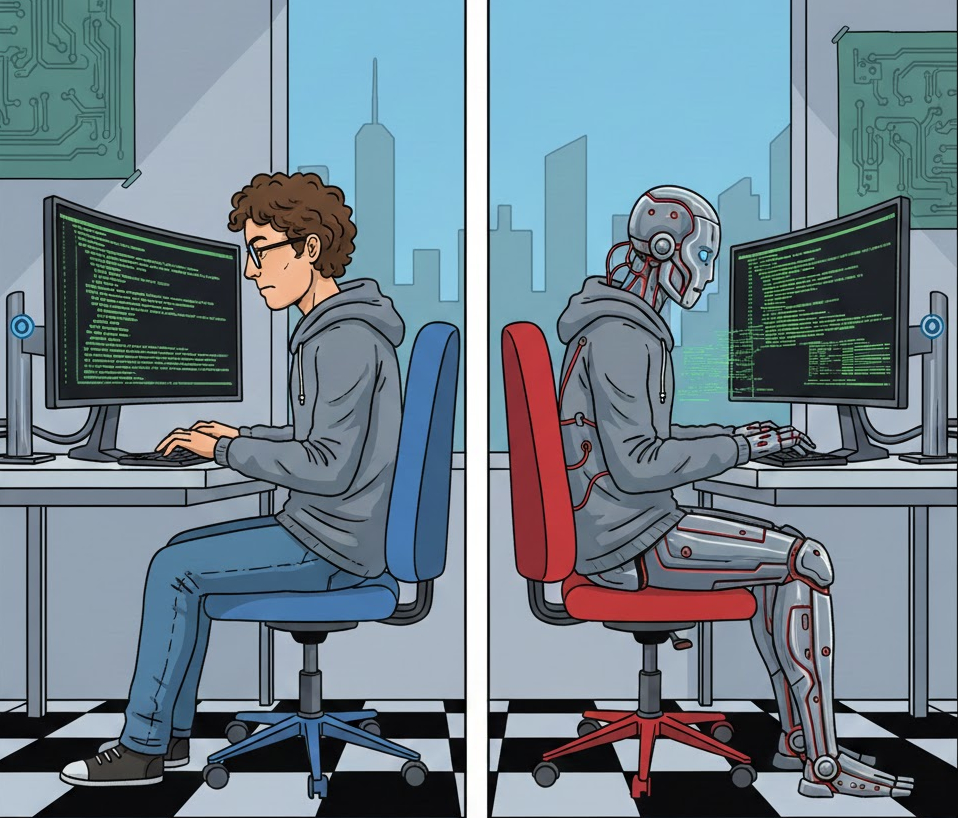
More agents than humans
Beyond cost, what stands out is the shift in workloads.
Before June 2026, the cumulative run time of agents within the research organization remained below the volume of human work.
That is no longer the case since mid-August. For every eight-hour human workday, OpenAI now runs the equivalent of 3.1 agent workdays.
Also rising steadily is the number of researchers running multiple agents at once; at least four simultaneous sessions.
OpenAI notes, however, that these amounts are calculated at its publicly listed API prices, not at its actual cost of production. What this yields is a measure of compute volume consumed rather than an exact internal bill.
From code to drift monitoring
OpenAI also lays out the nature of tasks delegated to the agents, organized into a six-step taxonomy (decide, design, build, execute, analyze, communicate) borrowed from work published by Epoch AI.
In January, most of the tokens consumed were used to write research or infrastructure code. Since then, the share devoted to technical assistance and to monitoring training campaigns has risen markedly, while high-level planning remains marginal.
A sign of this shift, according to OpenAI: the attendance of an internal technical help channel between research teams has more than halved since January.
Several teams have even stopped holding their help desks due to a lack of requests.
Yet the agents remain far from full autonomy. On tasks estimated at four to eight hours of human work, more than half of the executions deemed successful required at least one human intervention along the way, even as overall success rates improved between January and July.
These figures should be interpreted in context. OpenAI is both judge and participant, communicating its own results without external independent validation. The dollar amount measures compute consumption, not proven productivity gains.
