
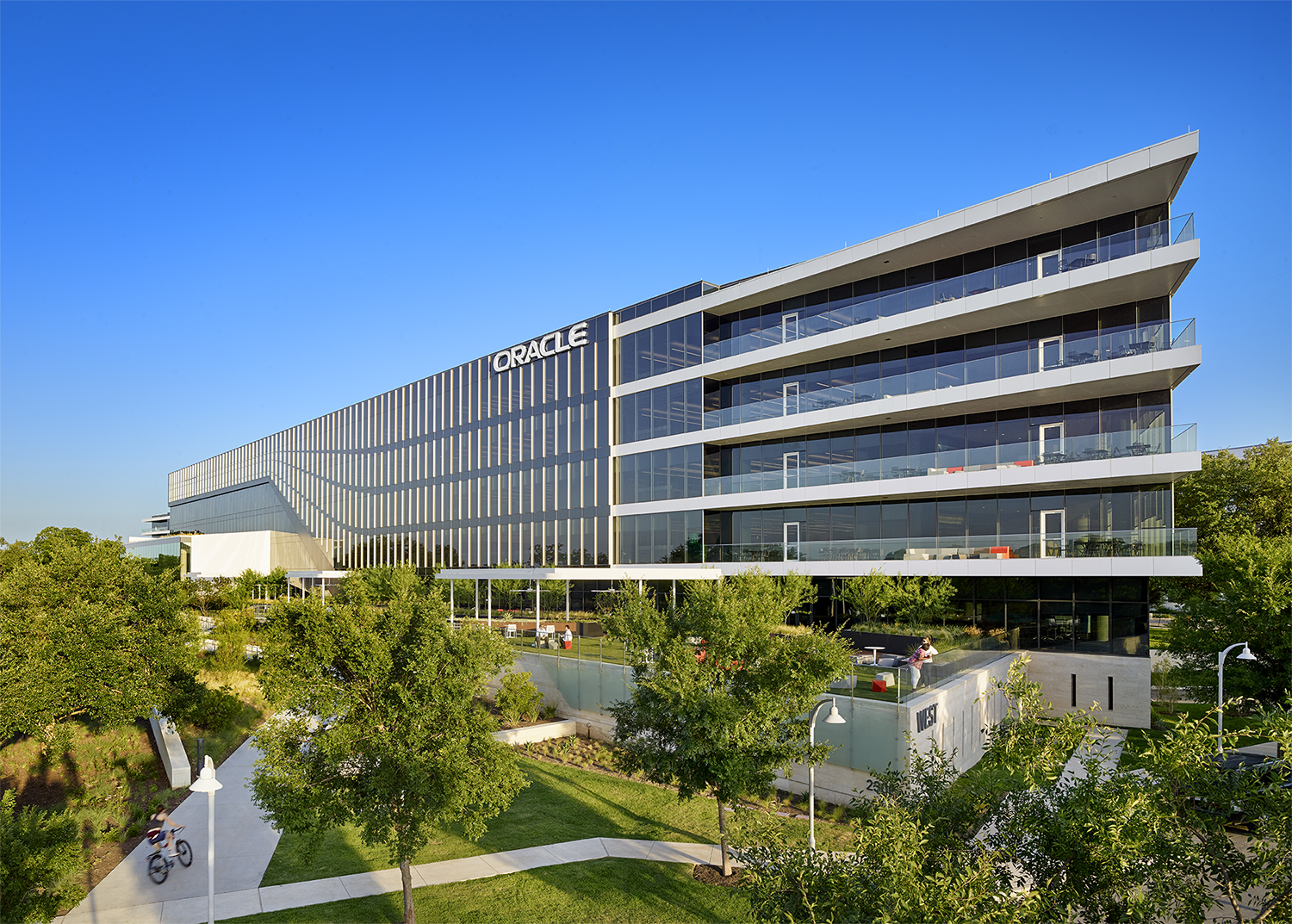
AI Workspace, App Composer, Fusion Companion… At Oracle, the so-called “AI-powered” products are sprouting in abundance.
Many of them remain experimental or offered with limited availability. In the meantime, Larry Ellison’s “bet”—embodied by the Stargate initiative—has consequences for employment. France is not spared, with a new job protection plan affecting 194 positions.
Shorter horizons and a customer interaction that moves away from “product content”
Beyond the need to curb an abyssal debt (exceeding $150 billion), this headcount reduction accompanies a wide internal transformation. Christophe Negrier offers an example: a product that used to be released in 6 to 9 months now ships in 6 weeks.
The code the company builds is now generated 70% by AI, adds the CEO of Oracle France (who also oversees Spain, Italy, Portugal, Greece and Israel). “ Does this require a pivot in certain roles? There will certainly be fewer developers…”
The teams are more broadly faced with an “extremely accelerated continuous learning mindset.” In parallel, interaction with the client ecosystem is evolving. “ The internet had already changed a lot of things; but this is a different dimension,” explains Christophe Negrier. “No one is interested in ‘product content’ anymore: you just need to ask any LLM.”
The comeback of managed services contracts… with oversight
Partners face the same situation. In this context, their relationship with Oracle now more directly includes change management. While previously, “we were seen as pulleys, grease, things [very] techniques,” sums up Christophe Bougot, head of the channel and alliances for Southern Europe.
Oracle itself is driving initiatives. The launch of the FCSR (Fusion Setup and Configuration Registry) is a case in point. Under this banner, the vendor codified best practices for deploying Fusion applications into a machine-executable format. Specifically, skills are made available to AI agents on a public Git repository.
Automation of the delivery has an effect on contract models. “We’re returning to projects that are no longer fixed-price but time-and-materials (T&M),” notes Christophe Negrier. “That’s the only way to realize speed gains for the client.” Alerted to the abuses of the managed-services model, he tempers: “There is a project plan, lots, milestones.”
Oracle also shifts to headless ERP
The spread of AI within Oracle’s catalog is also reflected in an ongoing openness strategy. The first frontier was network interconnections with AWS, Azure and GCP. Oracle then moved to host its databases with these providers. On the LLM front, it remained fundamentally “agnostic,” deciding not to build its own. Diversification now extends to hardware: NVIDIA remains a major supplier, but Cerebras inference chips are expected to appear on OCI in 2027, as Google’s TPUs.
The AI Building Block, mentioned above, also contributes to the openness strategy. It provides headless access to Fusion ERP, initially via ChatGPT. Oracle attaches to it a harness (Fusion Companion) accompanied by a deterministic runtime (Fusion Claw) on which currently around twenty “outcome-oriented” applications run.
On this SaaS front, Oracle “tries to provide fungibility between users and agents.” It maintains that their use does not incur additional cost. On the LLM side, the company “has no added value,” admits Christophe Negrier: “I prefer that the client deals with their own provider.” That does not prevent him from validating the models.
Early-stage technologies and business models in the adoption phase
For now, outside of Fusion applications, “we aren’t looking at mass deployments” of agentive AI. Clients who have taken the plunge have done so “for certain processes.”
Under these conditions, the related technological advances “are really in early-stage.” Among them, the Deep Trust AI Architecture. Through this blueprint, Oracle aims to integrate security and governance into the database infrastructure. Starting with access control, reinforced by declarative SQL policies. “The core of it is data access by resources that aren’t people,” summarizes Christophe Negrier.
Similarly, “we are still in an adoption phase” for the AI Data Platform offering. And for its billing model that takes into account both the provisioned hardware platform (including the chip type) and the complexity of the queries.
