
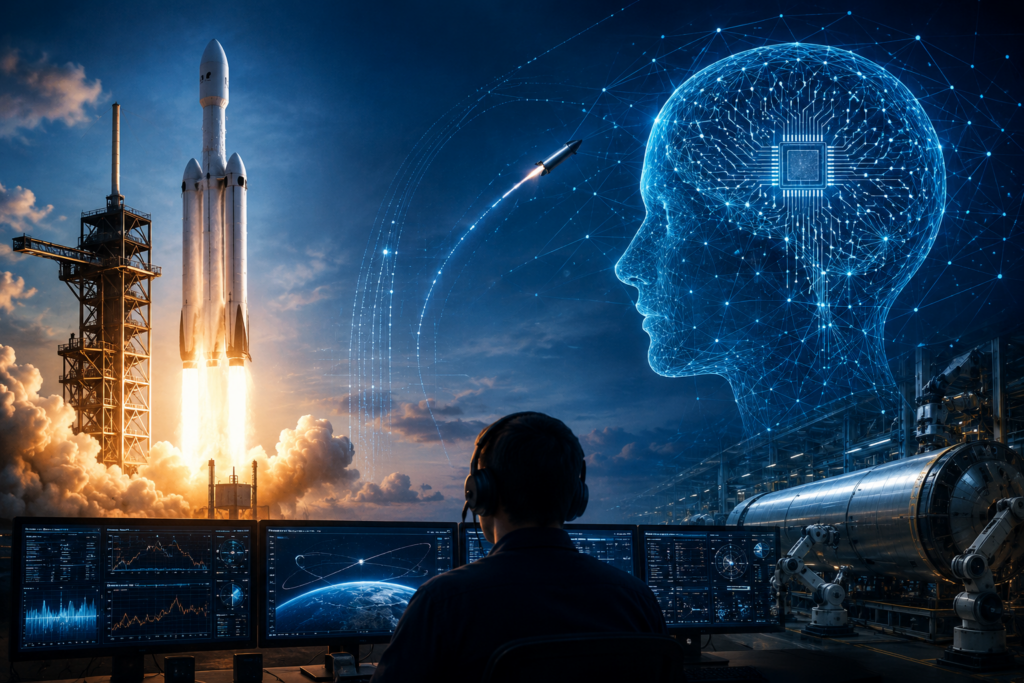
There is a paradox at the heart of SpaceX’s IPO. The company that has revolutionized access to space, that grabs its rockets with giant chopsticks and ferries astronauts to the International Space Station, is now presenting itself to investors primarily as an artificial intelligence company.
A transformation that the company embraces, yet one that stirs as much excitement as questions.
SpaceX filed its prospectus with U.S. regulators on May 20, giving markets their first official look at its finances. The targeted valuation would be around $1.75 trillion, with a fundraising of about $75 billion. By far the largest IPO ever attempted. The stock will trade on Nasdaq under the ticker SPCX.
The timing is not incidental. SpaceX is launching a wave of highly anticipated IPOs. OpenAI is expected to file its paperwork in the coming days, and Anthropic is also preparing its listing.
AI, the New Center of Gravity
On paper, SpaceX remains a rockets and satellites business. In practice, its IPO filing tells a different story. SpaceX says it is aiming for the largest addressable market “in the history of humanity”: $28.5 trillion in total, of which $26.5 trillion comes from AI alone.
This repositioning is not merely a sales pitch. It is reflected directly in the expenditure figures.
AI losses reached $2.47 billion in the first quarter of 2026 alone, and investment spending tripled to $7.72 billion, eclipsing the combined investments of the other two divisions.
For the full year 2025, the AI division posted an operating loss of $6.4 billion on $3.2 billion in revenue, and the company spent $12.7 billion to build data centers.
If AI has not yet become the new core of SpaceX’s business, it is its investment priority, at the heart of the narrative promise.
Starlink. Starlink is the financial pillar on which the entire edifice rests. With 9.2 million subscribers across 150 countries and about $16 billion in revenue in 2025, the connectivity division is the group’s only truly profitable business.
Orbital computing. The boldest idea is to deploy data centers in space. The document explicitly mentions initiatives to “develop large-scale orbital AI computing,” “manufacture large-scale AI chips,” “establish a lunar economy,” or “develop human augmentation systems.” Projects the company itself acknowledges may “not achieve commercial viability.”
Earthbound data centers. To run its models, SpaceX has built a colossal infrastructure. Two supercomputers have been constructed in Texas, named Colossus and Colossus II. The former includes about 100,000 H100 GPUs, the latter around 220,000 GB200/GB300 GPUs, for a total compute capacity of roughly 1 gigawatt; one of the world’s largest AI compute clusters. To monetize it, Elon Musk struck a deal to supply compute capacity to Anthropic, which commits to paying $1.25 billion per month through May 2029. A massive contract that turns SpaceX into an infrastructure provider.
The talent challenge. The filing openly acknowledges a structural difficulty in recruiting top-tier AI researchers capable of competing with OpenAI and Anthropic. In a talent market already overheated, competition will be fierce.
No SpaceX Without Elon Musk
SpaceX asks investors to grant it a valuation comparable to mature, profitable revenue-generating companies. Yet it shows an accumulated deficit of $41.31 billion as of March 31, 2026.
Nevertheless, 18 investors, analysts, and fund managers surveyed by Reuters are broadly optimistic but realistic about the risks. “The risk is whether a $1.75 trillion valuation properly accounts for the execution challenges that come with being both a rocket company, an internet service provider, an AI company, and largely steered by the vision of a single individual,” says Josh Gilbert, an analyst at eToro.
Because that is SpaceX’s strength and its weakness: everything hinges on Elon Musk. The IPO filing acknowledges that his control, coupled with leading other companies like Tesla, exposes SpaceX to potential “conflicts of interest” in business opportunities and in how he allocates his time and attention.
Others prefer to lean on the track record of the man. “We’re not going to justify a $1.75 trillion or $2 trillion valuation for SpaceX on traditional fundamental metrics alone,” admits Greg Martin, cofounder of Rainmaker Securities. Elon Musk is, for them, a central asset in the coming big deal.
Ultimately, investing in SpaceX is betting on a domino-like sequence of events. Starlink generates cash to fund Starship, which by reducing launch costs (to broaden the market) helps sustain the AI activity. A brilliant causal chain on paper, but each link may break.
