
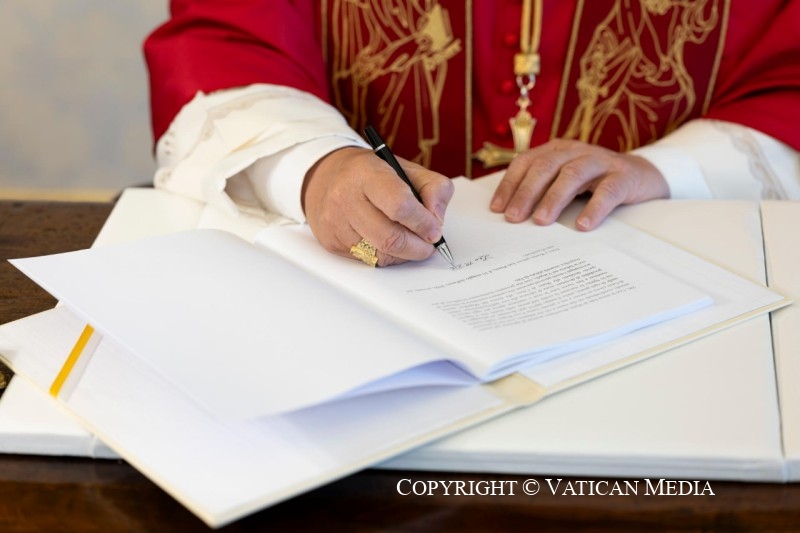
There is something unprecedented in the image. This Monday, May 25, at the Vatican, a pope and an AI engineer sit side by side facing journalists.
On one side, Pope Leo XIV, head of the Catholic Church, who has just signed his first encyclical on artificial intelligence. On the other, Christopher Olah, cofounder of Anthropic, the inventor of Claude. Two worlds brought together by a shared conviction: the most powerful technology of our era cannot be left in the hands of those who merely create it.
The text, titled Magnifica humanitas – “Magnificent humanity” – was signed on May 15, a date chosen with care. One hundred thirty-five years earlier, exactly on that day, Leo XIII laid the foundations of the Church’s social doctrine with Rerum novarum, his guide for Christians facing the industrial revolution.
The parallel is deliberate, almost asserted. Pope Leo XIV, who chose his name in homage to that predecessor, feels he must offer the world a reflection on a sweeping industrial and cognitive revolution, that of AI. A technology that, in his view, poses an anthropological challenge to humanity as a whole.
The pope does not condemn technology. He questions it. And his first question is simple, almost philosophical: “What are we building?”
The technological power, this new unknown
What worries Leo XIV above all is a question of power. For him, technological power has taken “an unprecedented face,” “essentially private,” and therefore proves “even harder to grasp, regulate and align with the common good.” This concentration in the hands of a few breeds exclusion, domination and inequality.
His answer: urgent regulation. It is necessary, he writes, to adopt regulatory tools able to preserve justice and limit the disruptive effects of technological power. And to ask, with realism, who holds this power today and for what ends it is used.
Christopher Olah says nothing else. According to him, every leading AI lab operates in an environment of commercial, geopolitical and personal pressures that can clash with the public interest. “Even researchers with good intentions are influenced by these forces,” he publicly acknowledged. A rare form of mea culpa in a sector not accustomed to self-critique.
Jobs, truth, war: three fronts
The encyclical lays out the concrete consequences of this revolution on three fronts.
Jobs first. The pope warns that in some contexts it is realistic to fear a significant and rapid contraction of available jobs. The figures support him: since early 2026, some 50,000 job cuts have been directly attributed to AI in the United States, according to Challenger, Gray & Christmas.
In France, a study by Coface and the Observatory of Jobs Threatened and Emerging shows that 16.3% of employment could be affected within five years. Christopher Olah shares this concern, estimating that there is “a real possibility” that AI displaces human labor on a very large scale, and that supporting those displaced would then be “a moral imperative of historic proportions.”
Truth next. Leo XIV worries that the truth may not be the same for everyone in the era of ChatGPT, Gemini or Claude. If misinformation is not new, he acknowledges, AI serves as a powerful multiplier, risking that those who have it convince a large number of people of what is true about human beings, the world, the family, and even God.
War, finally. This is perhaps the most political section of the document. The pope believes it is unacceptable to entrust artificial systems with mortal decisions, and that the decision to resort to lethal force must remain under real, conscious and responsible human control. A position Anthropic has itself ardently defended. The startup had refused to let its models be used to kill without human intervention. A restriction that drew the ire of Donald Trump and sparked a legal battle.
An encyclical for the AI era
The co-founder of Anthropic welcomed the Church’s engagement, saying that the questions raised by AI “transcend the AI research community.”
He called for serious and thoughtful critiques capable of challenging companies and identified three urgent areas: massive job losses, global access to AI’s benefits, and the question of the increasingly opaque behavior of systems. “The development of AI is concentrated in a handful of wealthy nations. How can we ensure that its gains are shared globally?” he asked.
Whether Magnifica humanitas will have the same impact as Laudato si’, Pope Francis’s 2015 encyclical on the environment, is hard to say, but this text certainly gives Leo XIV a central role in current reflections on AI.
Intellectuals and heads of state have taken up the issue, but none wield the universal moral authority of a religious leader followed by more than a billion faithful. And who, moreover, is not afraid to square off with Donald Trump.
