
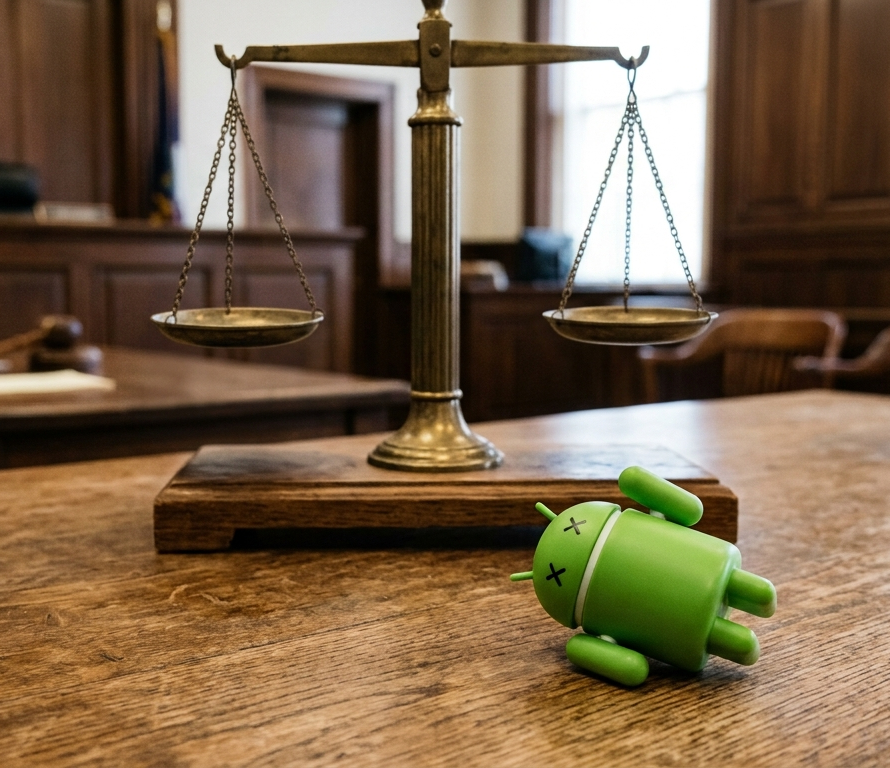
Google has not succeeded in having the substantial fine overturned by Europe for abusing its dominant position through Android.
Eight years on, the company has exhausted its last avenue of appeal. The Court of Justice of the European Union has just rejected it, aligning with the Advocate General’s opinion delivered in June 2025.
The original amount of the penalty was €4.34 billion. The EU’s General Court had slightly reduced it in 2022, to €4.125 billion in this instance. But it confirmed the core accusations. Among them were two obligations imposed on device manufacturers to access the Play Store: first, preinstall the Google Search app and the Chrome browser; second, refrain from offering unapproved Android variants. Brussels had also sanctioned the awarding of supra-competitive commissions to those same manufacturers for exclusively preloading Google Search (no alternative search engine).
The network effects generated by these practices had, the Advocate General explained, cumulatively reinforced the position of Google Search.
Google Shopping, a first major fine confirmed in 2024
This case remains emblematic of Margrethe Vestager’s approach as European competition commissioner.
There have been other cases as well, including the Google Shopping matter. Sanctioned at €2.42 billion in 2017, the company failed to overturn the decision before the EU General Court (November 2021) and then the Court of Justice (September 2024).
It is in a stronger position in the AdSense case. The €1.49 billion fine that Brussels imposed in 2019 was annulled in September 2024 by the EU General Court. A further appeal is before the Court of Justice.
In September 2025, Google faced another sanction in the online advertising sphere for practices extending beyond AdSense. By privileging its own services, it was hit with €2.95 billion in fines, a decision it appealed in January 2026.
Android also under scrutiny under the DMA
Simultaneously, the European Commission opened an antitrust inquiry into the “AI Overviews”—the AI-generated excerpts that appear in Google Search in response to certain queries. The concern is the potential exploitation of editors’ content—and YouTube videos—without proper compensation.
Android is the subject of further scrutiny under the DMA (digital markets act). This framework imposes, among other things, interoperability requirements. In recent weeks, the Commission proposed measures to implement these obligations. The broad aim is to ensure third-party apps have the same level of access to certain features as Google’s own services. Among these features:
- Circle to Search (accessed by long-pressing the home button or navigation bar, invoking Google Search, which can overlay other apps and leverage context)
- “Hey Google” (invocation of services by saying a keyword)
- AppSearch (centralized access to application data)
