
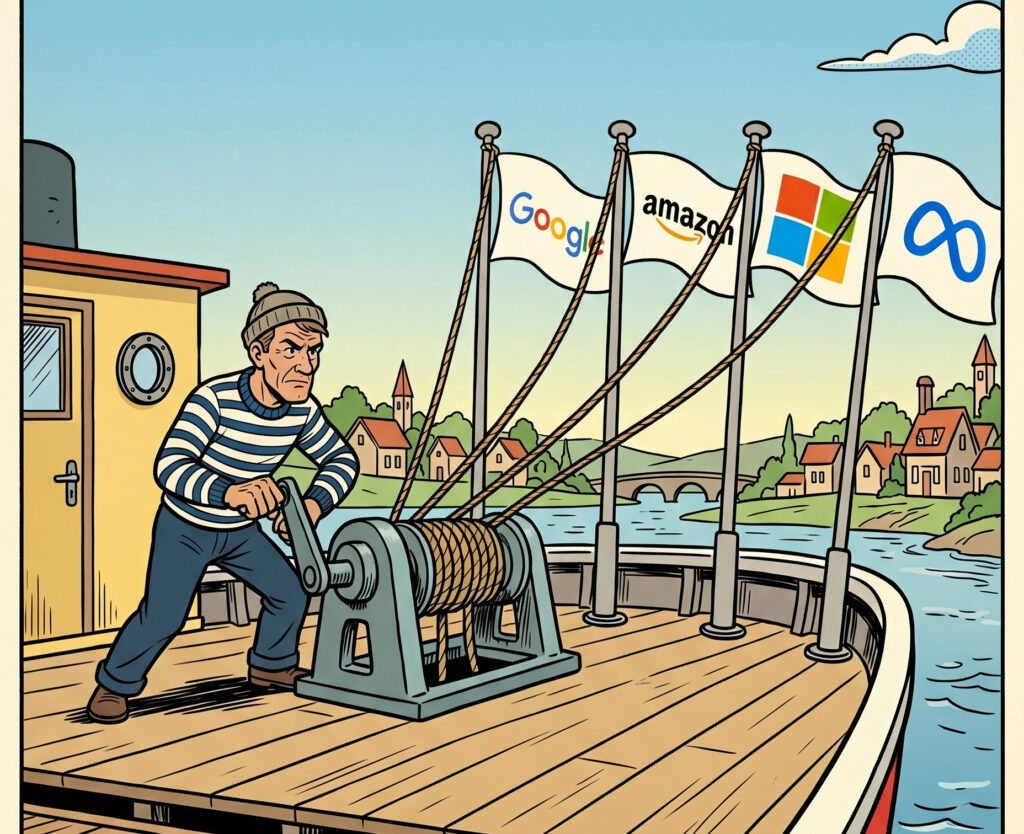
We’re spending heavily on AI, and we’re confident about the payoff.
Each in its own way, the GAFAM have underscored this message in their quarterly results.
Google Has Started Selling Its TPUs…
Alphabet’s fiscal year runs on the calendar year. In the first quarter, revenue approached $110 billion, up 22% from a year earlier. Operating income nearly reached $40 billion, up 30%, lifting the operating margin to 36.1% (+2.2 percentage points).
The Google Cloud segment posted about $20 billion in revenue (+63%). Operating income remained negative, at −$2.1 billion (vs −$1.2 billion in Q1 2025).
The Google Cloud backlog stood at $462 billion, driven largely by AI contracts. Consequently, Alphabet’s operating expenses more than doubled, to $35.7 billion for the quarter. Free cash flow suffered as a result: $10.1 billion, after approaching $25 billion in the prior two quarters.
The group confirmed that its capex is predominantly tied to infrastructure expenditures (60% on servers, the remainder on data centers and networking equipment). They expect a marked increase in 2027, without providing a numerical forecast. As a consequence, depreciation will rise, increasing pressure on the P&L…
Alphabet insists these investments are all the more necessary as it cannot meet all the demand. This includes the sale of TPU racks. The company has begun delivering to a handful of customers. The majority of the related revenues will be recognized in 2027.
… and Amazon Eyes the Same with its Trainium Chips
Amazon’s fiscal year also runs on the calendar year. In the first quarter, it posted $181.5 billion in revenue, up 17% year over year. Operating income rose even more sharply, up 30% to $23.9 billion.
The AWS segment generated $37.6 billion in revenue, up 28%, its strongest sequential growth in five years. Its operating income rose by about the same order, to $14.2 billion (+23%). Excluding the $100 billion deal announced recently with Anthropic, the backlog reached $364 billion. This includes up to 2 GW of Trainium that will be put into service from 2027 for OpenAI, as well as the “tens of millions” of Graviton cores Meta plans to deploy for its agent workloads.
Altogether, Amazon reports more than $225 billion of commitments on its Trainium chips. Investments in infrastructure rise accordingly. For the quarter, the group surpassed $40 billion in capex (nearly an 80% year-over-year increase). On a 12-month rolling basis, capex stood at $151 billion (+61%).
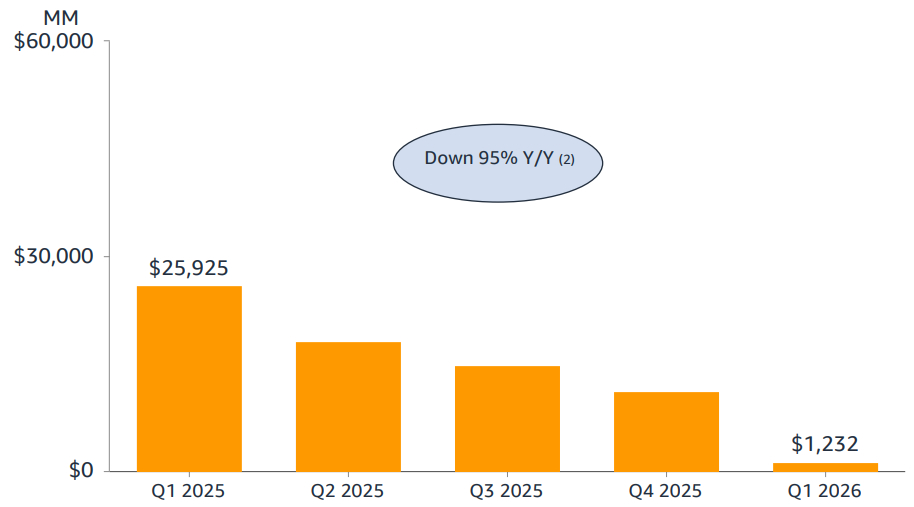
Amazon reiterates its partnership with NVIDIA (it plans to deploy “more than a million” GPUs in 2026). But it argues that Trainium chips have a solid place (they already run most of the workloads on Bedrock)… and that they could reduce its capex by tens of billions of dollars per year.
Amazon notes it has customers for a large portion of the infrastructure it invested in during 2026. Depending on the components, monetization occurs 6 to 24 months after investment, it adds. It also recalls that, during AWS’s initial growth phase, capex rose faster than revenue…
Following a logic similar to Google’s with its TPU, selling Trainium racks is in the works.
Microsoft Bets on Software Optimization…
By the end of March, Microsoft had closed its third quarter of fiscal 2026. Revenue stood at $82.9 billion, up 18% year over year. Operating income rose to $38.4 billion, up 25%. The Commercial segment backlog reached $392 billion.
During the quarter, capex hovered around $32 billion. About half of that was directed at short-lived assets, starting with the AI chips. Financing for data centers (with a stated 15–20 year lifespan) accounted for roughly one-third.
Microsoft intends to double its data center footprint within two years. For the moment, like Google, it concedes that it cannot satisfy demand: its infrastructure is likely to remain under capacity at least until mid-2026.
In this context, Microsoft is betting on software optimizations. It is also building a fungible fleet capable of hosting a variety of workloads. This will require continuous modernization—and thus, on the financial side, an acceleration of depreciation. Yet the potential revenue opportunities are significant, especially with agent architectures that could boost ARPU.
… and Meta, on Workforce Reductions
Meta aligned its fiscal year with the calendar year. In the first quarter, it posted revenue of $56.3 billion, up 33%. Its operating income rose by a similar margin, to $22.9 billion (+30%).
Capex advanced by nearly 50% year over year (to $19B). Over the trailing twelve months, the increase is even more pronounced (+84%, to $72B).
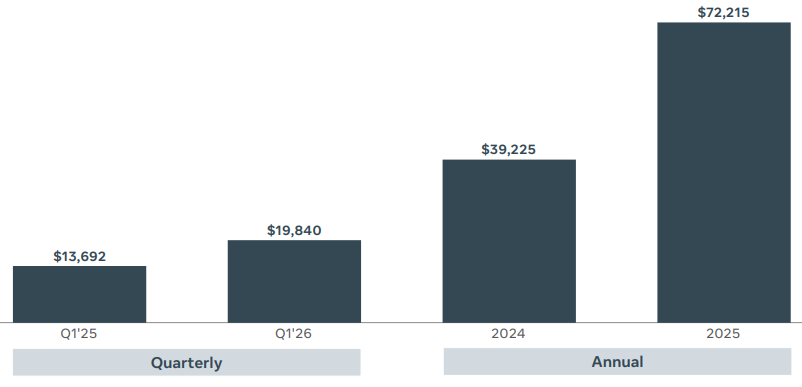
During the results release, Meta raised its capex guidance for 2026: from a range of $115–$135 billion to $125–$145 billion. At the top line, the rise is driven by higher RAM prices. The company concedes that it has, to date, under-estimated its needs.
By combining infrastructure purchase deals with cloud provider arrangements, Meta’s contractual commitments increased by $107 billion in the quarter. In this context, the company recently announced internally that a layoff cycle would take place in May.
