
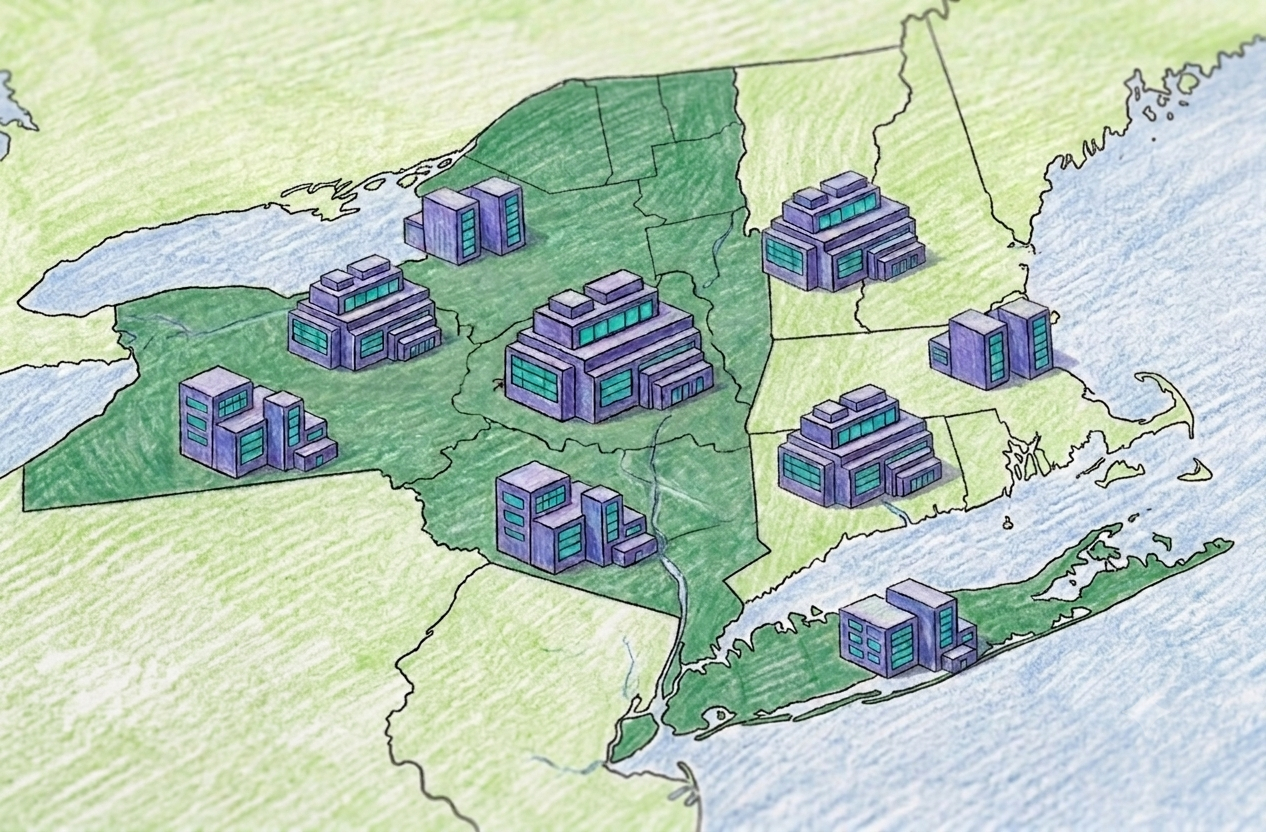
What qualifies as a “large data center” in terms of electrical power?
In its Responsible Data Center Development Act, adopted in early June, the New York State Legislature had set the threshold at 20 MW.
The governor took a different route. She signed, this week, an executive order that pushes the limit to 50 MW.
A moratorium of up to one year
The decree imposes, among other things, a temporary moratorium on these “large data centers.” During this interval, the Department of Environmental Conservation will not review permit applications related to new constructions or expansions… unless they had been declared complete before the decree was signed*.
The Legislature had previously voted for a fixed duration of one year. The decree makes this a maximum duration: the moratorium may end earlier. The condition: the New York Department of Public Service must draft a “generic environmental impact statement.” It must ensure that data centers are subjected to uniform standards.
No separate service class for large data centers
The Legislature had supported the idea of a more exhaustive report to be produced by the Department of Environmental Conservation. It would have to be completed within 18 months, with at least 120 days of public consultation. It was to include indicators and projections on, among other things:
- Number of data centers installed in the State
- Land use
- Water and electricity consumption
- Pollution and electronic waste generation
- Impact on disadvantaged communities (including Indigenous nations located within a ten-mile radius)
- Public funding obtained
Another element not carried into the decree: the obligation for water, gas, and electricity utilities as well as municipalities to create a distinct service class for large data centers. The move was meant to promote isolation—and allocation—of the costs they generate.
The governor did not also adopt the provision requiring data centers with 5 MW or more to meet a minimum renewable energy ratio (two-thirds for the 2025-2029 period, in particular).
Data centers, invited to subsidize energy prices
The Legislature had voted to exempt data centers associated with public research. The decree confirms it. It even broadens it. Specifically, to facilities primarily used for manufacturing, teaching, or providing medical care.
Another novelty of the decree: it opens the way to a “community investment framework.” The Empire State Development (the state’s economic development agency) has 60 days to craft it. It is intended to help local communities reap economic spillovers. Among the contemplated directions, the creation of an investment fund financed by contributions from developers or operators of data centers. Its resources could help “keep energy costs affordable” and improve public services (we are told about childcare and K-12 education programs). It is also about mechanisms ensuring labor unions a seat at the negotiating table.
Just like the Île-de-France region, which recently adopted a strategy to regulate data center siting, New York State argues that taxpayers should not bear the cost of upgrading the electric grid. In this spirit, the decree proposes creating a “State Electric Grid Acceleration Fund.” Funded by data centers, it would finance grid modernization and the acquisition of new capacities for clean energy production.
The governor also indicates plans for a law removing sales tax exemptions for hyperscale data centers.
An early moratorium thwarted in Maine
As of May 2026, interconnection requests pending in New York approached 12 GW, with more than 8 GW registered in 2025.
Beyond compromising its clean energy objectives, the state notes the inadequacy of its regulatory framework, especially in meeting the needs of data centers in terms of water withdrawal and treatment.
The Maine Legislature—neighboring New York—was the first in the United States to vote a moratorium on data centers. It did so in April. It was set to apply until October 2027 for facilities above 20 MW. The Democratic governor, however, vetoed it, citing the lack of an exemption for an ongoing construction site presented as “widely supported by its hosting region.”
* The moratorium does not apply to permits issued by local governments.
