
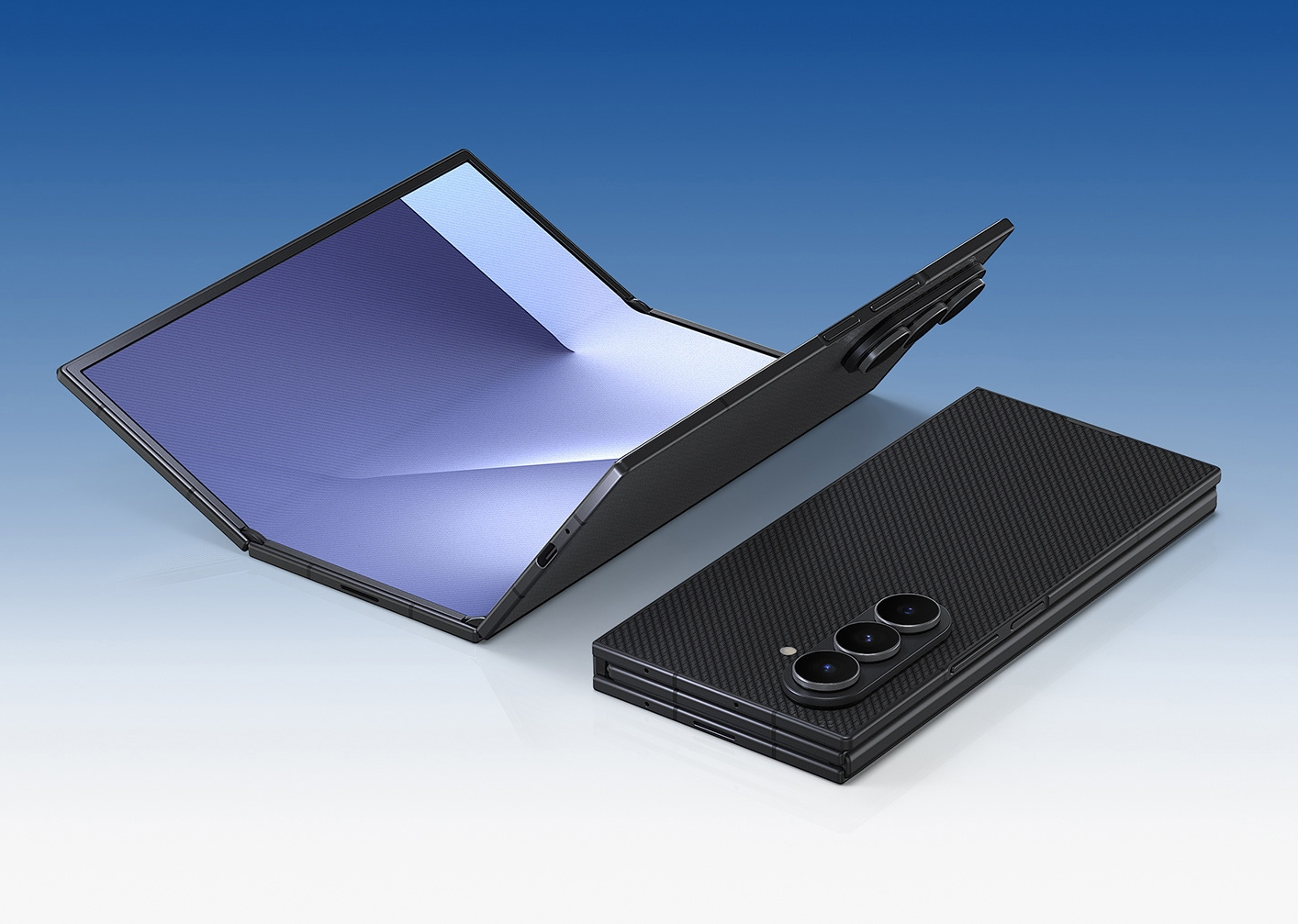
Is a double-fold smartphone a good portable workstation?
Samsung has chosen this angle with the Galaxy Z TriFold. Officially unveiled this week, it will go on sale in Korea starting December 12. It is planned to be distributed in China and the United States, among other markets. Europe is not mentioned at this time.
The price listed on Samsung’s Korean shop amounts to a little over €2,000. This is roughly 50% higher than the entry price of the Galaxy Z Fold 7 (around €1,300).
Given that the latter is sold from €2,100 including tax in France, one can estimate, by a rule of three, that the Galaxy Z TriFold would run around €3,200.
U-shaped folding at Samsung, Z-shaped at Huawei
When unfolded, the device offers a display real estate of 10 inches. The three panels—comparable to placing three 6.5-inch smartphones side by side—fold into a U shape. A mechanism that, according to Samsung, helps protect this screen.
Huawei did not take the same route: its Mate XT and XTs (launched in February and September 2025, but not available in France) fold in a Z configuration. This allows using one, two, or three portions of the screen, which is also a single, unified display. By contrast, the Galaxy Z TriFold features a separate secondary display (the one you use when the device is folded) and cannot use only part of the main screen.
In 16:11, this main screen lends itself better to widescreen content than the Galaxy Z Fold 7, which tends toward a squarer format. However, its maximum brightness is lower (1600 nits versus 2600, a value available only on the secondary screen).
Standalone desktop mode
The Galaxy Z TriFold is the first Samsung smartphone to include a standalone DeX mode: no external display is required to activate this desktop mode, which can manage up to 4 virtual desktops with 5 apps each.
The device includes a built-in stand, but in this configuration the USB port becomes hard to reach. The camera module also makes using the device on a flat surface awkward (the case mitigates the issue). Samsung has not added support for the S Pen stylus.
The three-panel design allowed for just as many batteries, bringing total capacity to 5600 mAh (vs 4400 mAh for the Galaxy Z Fold). Wired charging is rated at 45 W, the same as the Galaxy S25 Ultra (wireless charging: 15 W; reverse charging: 4.5 W).
An IP48 smartphone: beware of dust
The processor is not Samsung’s latest. It is a customized version of the Snapdragon 8 Elite, launched in fall 2024. It is paired with 16 GB of RAM and 512 GB or 1 TB of storage (no microSD slot).
The cameras are the same as on the Galaxy Z Fold 7:
- Ultra-wide 12 MP (focal length 13 mm, about 120° field of view)
- Wide-angle 200 MP (24 mm, about 85°; 2x optical zoom)
- Telephoto 10 MP (67 mm, about 36°; 3x optical zoom)
- Front camera on the main display 10 MP (18 mm, about 100°)
- Front camera on the secondary display 10 MP (24 mm, about 85°)
Note the Galaxy Z TriFold’s IP48 rating. On paper, that means it isn’t protected against solid particles smaller than 1 millimeter. Samsung also warns against using it “on the beach or at the pool”… and adds that water resistance can degrade over time.
When folded, the Galaxy Z TriFold is about 1.3 cm thick at its thickest point. When unfolded, it measures down to 0.4 cm excluding the camera module. The overall weight is 309 g (compared with 298 g for the Mate XT and XTs).
