
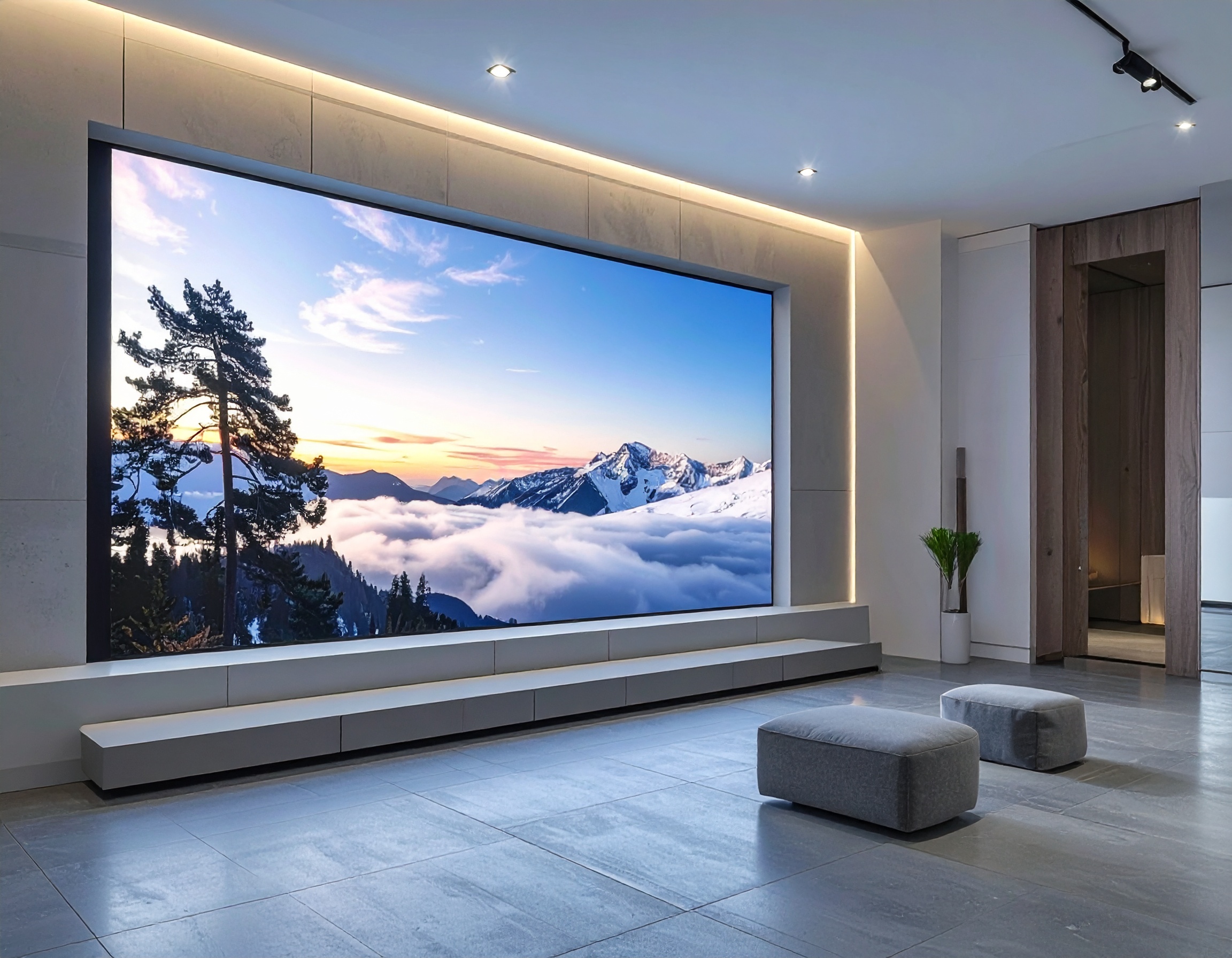
According to a French study conducted in 2024, 62% of organizations plan to modernize their meeting rooms within the next two years. This trend stems from a growing need for readability, fluidity, and visual coherence in hybrid environments. When display technology becomes more immersive and stable, collaboration naturally evolves. Users interact differently, move more, and redistribute the dynamics of teamwork.
A display that transforms how we work
Adopting an LED screen is not merely a hardware upgrade: it changes how teams operate. In a meeting room, the disappearance of borders and the even brightness create a more natural experience. Consistent image quality, even from a distance, facilitates presenting complex data, videoconferencing, and decision-making.
In lobbies and passageways, LED walls become real-time canvases for visual identity and information. They no longer simply display a logo or an animation: they participate in the company’s staging, convey its tech-forward image, and contribute to the coherence of the environment.
IT leaders, often confronted with recurring issues tied to traditional hardware, view these LED solutions as a concrete path to greater stability, coherence, and ease of use.
Why needs are changing now
Hybrid work, the proliferation of collaborative use cases, and the rise of videoconferencing have given rise to new display requirements. LCD screens and projectors quickly reach their limits, particularly when faced with natural light, the challenge of maintaining a stable image, or the ongoing maintenance these devices require.
A European survey published in 2023 found that 48% of meeting rooms were still equipped with outdated technologies. Companies are now looking to standardize their spaces to facilitate usage, reduce visual fatigue, and guarantee a uniform experience across sites.
A 110-inch LED wall precisely addresses these concerns by offering an immersive display surface that is visible both from afar and up close, and capable of maintaining high brightness even in bright environments. The modular nature of these solutions also allows tailoring the format to architectural constraints and business needs.
The emergence of specialized players on the French market
LED technology has evolved rapidly in recent years: tight-pitch displays, HDR, IP-based management, replaceable front modules, redundancy systems. This evolution creates a need for expertise, because integration is as important as choosing the hardware.
In France, Pekason stands among the players that have specialized in comprehensive support for businesses. Their approach covers all stages of a professional display project: needs assessment, technology choice, integration into the audiovisual ecosystem, calibration, maintenance, and support. This usage-driven approach yields consistent and durable results, whether the setting is a boardroom, a control center, an immersive showroom, or a reception area.
A strategic building block of the Digital Workplace
IT leaders who have adopted LED solutions report tangible benefits. Increased availability, thanks to the elimination of lamp replacements and the stability of brightness, ensures uninterrupted use. Constant readability, even in glass-walled environments, reduces visual fatigue and improves meeting quality. Integration with IP-based audiovisual infrastructures enables simplified management and remote maintenance, in line with modern architectures.
According to a 2024 survey, 54% of IT managers now consider large-format displays an essential component of the Digital Workplace. The LED screen fits this logic by delivering a visual experience that is stable, durable, and well-suited to hybrid work.
A gradual but durable adoption
The rollout of LED walls is not abrupt. Companies typically begin with a pilot room and then extend the technology to strategic spaces: executive offices, operations centers, premium retail, corporate campuses, workshops, or auditoriums. This progression demonstrates that the technology meets real, measurable needs.
Display is no longer merely a visual aid. It becomes an interface between space, information, and the user. The LED wall does not represent a dramatic rupture but a logical evolution in line with new collaboration and efficiency standards in the modern enterprise.
