

SAP now sells its Business Suite under the banner “Autonomous Enterprise.”
The pitch: “You set the direction and AI executes, with governance at every step.” The Joule brand remains a cornerstone, now described as a “single, coherent entry point to orchestrate data, workflows and AI agents.” Beyond agents, it takes the form of “assistants” (workflow-agent modules) and the Joule Work workspace.
A year ago, fresh from Sapphire 2025 (May 19–21), the discourse hadn’t yet embraced assistants or autonomous enterprises. SAP spoke of an AI-driven action guided by your business context, reinforced by “AI agents that work together – and with you.” Joule was already at the center of the messaging, which at the time focused on the notion of “Business AI.” SAP was still using the word “copilot”… which has since vanished from the Business Suite presentation page.
Beyond terminology, from Sapphire to Sapphire, Joule has permeated the SAP ecosystem… in fits and starts. Here is a brief overview.
Logistics, Production, Transportation… Joule arrived in several modules
In May 2025, SAP integrated Joule into Digital Manufacturing (production operations management). The initial use was informational, based on product documentation.
In September, Joule arrived in the Logistics Management module. Then in December in Field Service Management. This was also for product information, but also for planning (finding the best technician, assigning activities…). In the meantime (November), it entered Risk and Assurance Management, both to answer questions about the applications and to navigate to them.
Early 2026, the link was made with Signavio. On the menu, among other things: description, comparison and modeling of processes, navigation to various elements (diagrams, dictionary entries…) and search/creation of journey models.
In March, Joule arrived in Transportation Management (S/4HANA Cloud Public Edition), for searching freight agreements and rate tables. Then in Incentive Management (pay-for-performance compensation management), as a copilot.
In the wake of Sapphire 2025, a bidirectional connection was created between Joule and Microsoft 365 Copilot.
Cross-cutting evolutions, notably in the RAG
In May 2025, SAP added support for Datasphere analytic models. In July, the ability to cite previous chat responses in formats other than text. Then in August, the capacity to attach documents during a task or transaction.
In October, the vendor provided a dashboard to visualize Joule usage at the tenant level. It also launched Joule Preview Landscape for testing/validation in the SAP BTP Live environment.
In recent weeks, conversation prompts have been hidden on the web client to improve performance.
Anchoring to TXT files has been available since May 2025. In July, support for JSON and PPTX followed, along with an integration with Build Work Zone and a POST request system to manually trigger content updates.
In August, SAP introduced another POST request, enabling metadata insertion to obtain the list of matching pipelines. It also increased SharePoint folder depth to five levels and added attributes to identify the status of processing.
The integration with ServiceNow has been active since November. It had Google Drive since March 2026. In the meantime, SAP improved the Metadata Management API to manage data repository configurations and to add metadata to documents for each repository. Concurrently, the maximum number of documents per pipeline has steadily risen: 3,000 in September, then 4,000, 5,000 in November, 6,000 in December, and 8,000 in January.
Joule, rolled out for SAP Consulting
In May 2025, SAP announced the general availability of Joule for Consultants. The initial promise: enable this audience to learn about the design, implementation, and maintenance of SAP systems.
In August, SAP added a prompts library. And the ability to copy answers to the clipboard. In October, it enriched the knowledge base from its notes. All while adding, for each release of S/4HANA, a guide detailing the features removed or replaced.
Between late 2025 and early 2026, SAP worked on sources. Specifically, enabling them to be grouped and to cite web-sourced ones when relevant. It then improved image uploads (5 formats; max 10 MB and 3072 x 3072), allowed launching a Joule instance directly in the console, and testing prompts directly in the library.
Since April, admins can create prompts and organize them in user-defined tabs. A favorites system arrived in the library, alongside handling of the DOCX format (max 10 MB or 600,000 characters).
Some updates focused on S/4HANA Public Cloud…
Over the past year, SAP has regularly expanded the data visualization capabilities for object data: workstations in May, processing orders in June, corporate projects in October, inbound deliveries and physical stock in December, among others.
Following Sapphire 2025, one of the first additions targeting S/4HANA Cloud Public Edition was the ability to use Joule to verify the status of order processing (visualizing phases and related issues). This was followed by managing price expirations and, for purchasers, updating delivery dates on purchase orders.
In the autumn, SAP opened Joule to treasury and liquidity management (displaying positions and managing bank transfers, notably). As well as the unblocking of supplier invoices. In October, it added automatic filling of purchase orders with invoice numbers. And the creation of analysis records in various applications (managing customer returns, commercial proposals, usage decisions…). Then in November, processing of open orders.
Cash management capabilities were enriched this year, with the display of pools and balance simulations. SAP also opened Joule to drafting reminder emails for pending purchase orders awaiting approval.
… and some updates covering S/4HANA Cloud Private Edition
The first items added after Sapphire concerned verifying the status of order processing and—within the convergent invoicing module—managing billing plans as well as invoice requests. In treasury management, SAP opened Joule to monitoring bank statements. In logistics management, to searching for quantities for items out of stock.
In June, the Portfolio and Project Management module welcomed Joule for viewing Work Breakdown Structure (WBS) elements and summarizing changes to them.
Since August, Joule can view sales orders (and edit fields), outbound deliveries, and order-processing issues (with guidance on how to resolve them).
Other items added in August:
- Search and display information on workshop service objects
- Management of profit centers, reallocation of costs and revenues
- Creation of subscription requests and contract summaries
In September–October:
- Partner certifications management
- Unlocking and acceptance of pricing proposals
- Updating the status and priority of disputes
- Management of cost centers and related budgets/commitments
- Information on service contracts and updating their status
- Management of journal entries and display of associated general ledger flows
“Which applications for doing this?”: SAP pushes navigation abilities
At the end of the year, notable additions included:
- Search and consult reference data governance processes
- Creation of price proposals
- Creation of decision tables
- Information on equipment, their warranty and service history
- Summary of outbound delivery orders
- Creation of billing documents
- Obtaining actual and planned costs and revenues for projects and WBS elements
- Suggest production planning optimizations and show products in surplus or shortage
Early 2026, SAP added provisions creation. Customer and supplier search followed. Then task search in the warehouse management module, information on risks associated with maintenance orders (logistics management) and auditing of accounting journals.
In spring, navigation capabilities surged. In other words, Joule could direct users to applications across modules. This included logistics management, human resources management, and quality management. Simultaneously, in warehouse management, Joule expanded to support the execution of outbound deliveries. For portfolio and project management, to break down actual and planned costs by fiscal year, cost component, or value category. For inventory management, to display stock by plant and to create receiving notes without reference. And for accounts payable, to display balances and to create direct payments in the absence of invoices.
From compliance checks in Integrated Business Planning, an agent for performance review interviews in SuccessFactors
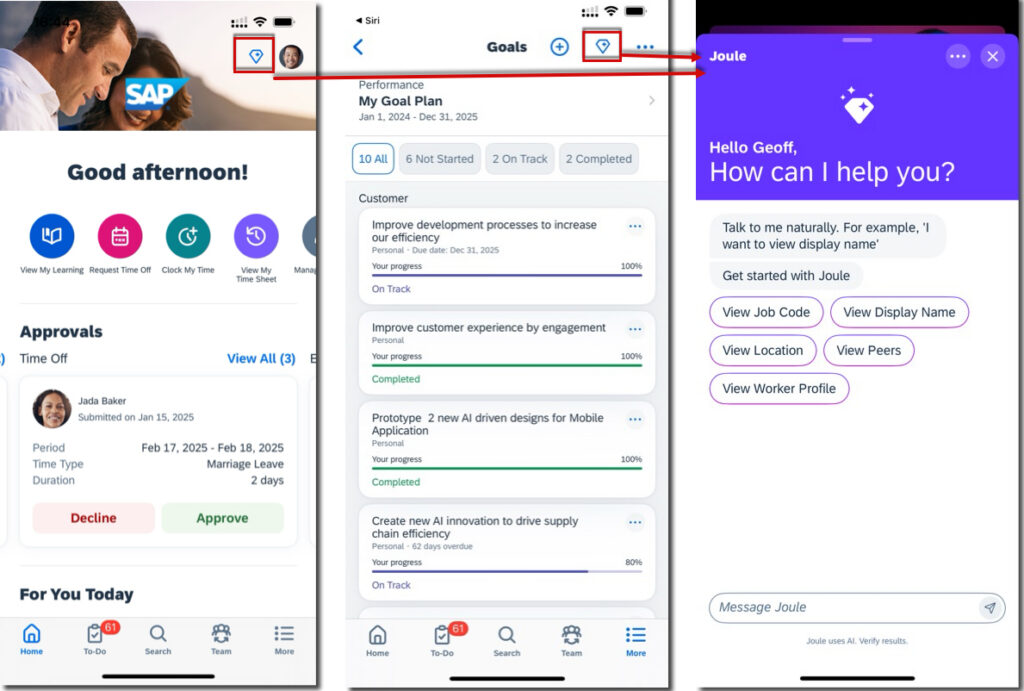
Soon after Sapphire 2025, Joule arrived in the mobile SuccessFactors apps. Without multi-profile management, though, as these aren’t supported by BTP Mobile Services used for authentication.
In summer 2025, SAP added the ability to check the integrity of reference data by type. In autumn, it integrated a system to explain the results of the stock planning optimizer (based on time series). As well as a mechanism to govern content sharing.
This year added compliance checking of the system against security recommendations.
Joule in SuccessFactors enabled, soon after Sapphire 2025, the visualization of current roles and target roles, as well as offboarding tasks. And explaining payslips. Among other enhancements, SAP added, at year-end, a Performance and Goals agent for preparing evaluation interviews.
