
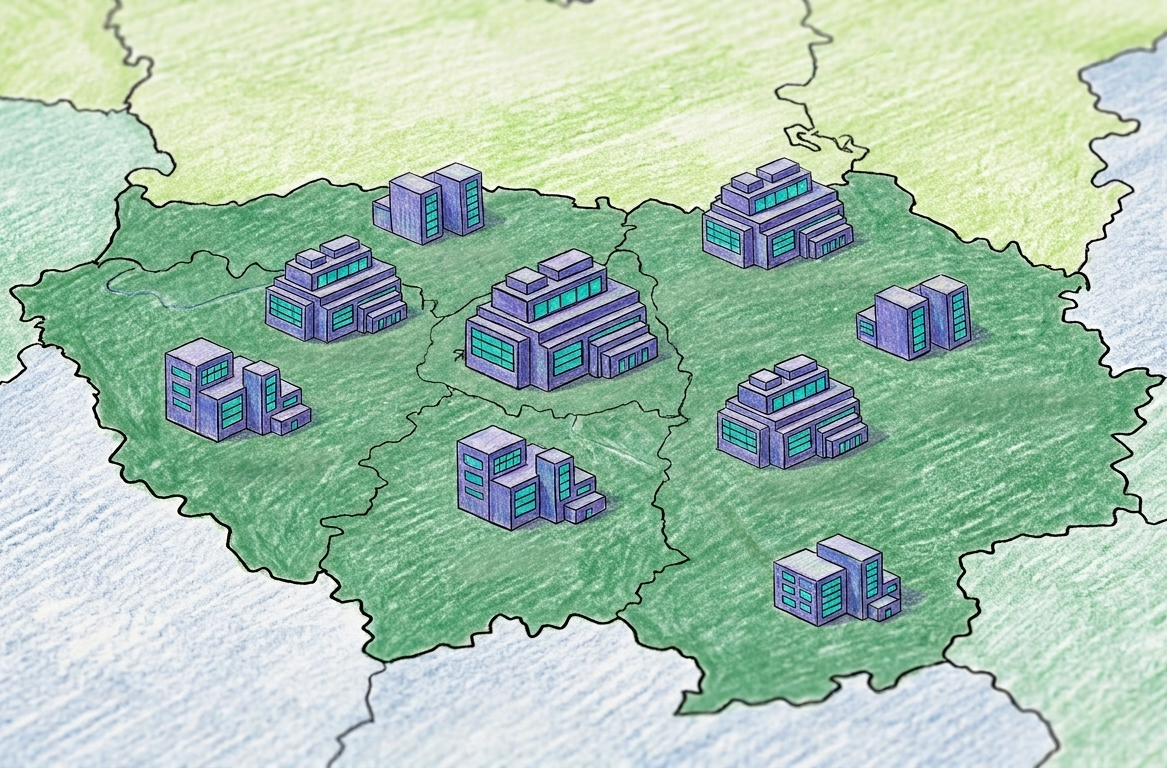
Taxpayers should not bear the costs of interconnection and grid reinforcement required for installing datacenters.
That is the position of the Île-de-France Region. It rejects the current financing mechanism, which is “for a significant part” based on the TURPE (Tariff for the use of the public electricity network). This “drives up electricity costs for everyone and can only slow the electrification of uses,” it argues. And it urges datacenters operators to cover all such charges.
The wish for a fiscal stake for local authorities
Among national perspectives, the region advocates opening a national dialogue around a tax-based stake for the regions and implementing local authorities. The Region aims more broadly to empower them to weigh against the State, whose role in instructing and prioritising projects is strengthened by changes to the legal framework governing digital infrastructures. At the forefront is the Economic Simplification of Economic Life Act, adopted in May. It introduces the possibility to designate certain datacenters as projects of major national interest, enabling faster processing of applications.
A call to prioritise the “territorial added value”
For local authorities, the Region also promises support in negotiating concessions—while “avoiding fragmented or competing approaches between territories.” In this spirit, it advocates prioritisation “based on territorial added value.” Among other criteria considered: economic impact and employment, alignment with available resources, valorisation of heat waste heat, and compatibility with the Region’s SDRIF-E environmental master plan.
This plan was adopted in September 2024 and definitively approved in June 2025 by decree in the Conseil d’État. It sets guiding principles for new datacenters sitings. These should, in particular, be prioritized on sites of existing economic activity. Generally, no urban expansion… except in the absence of alternatives within already urbanized spaces, “notably on complex lands, in redevelopment, or brownfields.”
The strategy serves as an operational lever for implementing the guiding principles of the SDRIF-E. It is also intended to ensure coherence with other regional planning documents, including the SRDEII (regional development, innovation and internationalisation plan) and the PRACC (regional climate change adaptation plan).
Raccordements : « premier prêt, premier servi » plutôt que « premier arrivé, premier servi »
Beyond the principles established, the Region says it favors evolving the rules for prioritising connections. RTE launched a consultation on this at the start of 2026. Today, the logic is “first come, first served.” The electricity transmission system operator aims to move to “first loan, first served.” The Île-de-France supports this objective to “limit the patrimonialisation of connection capacities, the artificial saturation of queues and the delays for projects actually ready to be deployed.”
Overall, the goal is to encourage planning that is compatible with the grid’s capacity. The objective: preserve future connection possibilities for “industrial projects, essential public facilities and mobility infrastructures.” In the background, there is also the “double land pressure” that can arise from mislocated datacenters relative to the electrical network. The reinforcement needs (construction or extension of a substation, new lines) indeed mobilize land resources as well.
A public grouping for the pooling of infrastructures
The Region also says it intends to strengthen its support for the technological building blocks of the value chain. It notes the allocation, at the end of 2024, of €3 million under the “Grands lieux d’innovation” call for projects. The beneficiary: “Open AI Infrastructure Factory,” which Eclairion is deploying in Essonne for Mistral AI. More recently (June 2026), a partnership was signed with VSORA (chips), ZML (software) and Scaleway (hosting).
Another reference on this topic: the GIPC (Groupement d’infogérance publique communautaire). The Region and Val-d’Oise Numérique are founding members of this non-profit, zero-capital entity that promotes the pooling of IT infrastructures among public actors. Inserm and ARS Île-de-France are among the members.
In early 2026, the Region joined the international network Regions4, which gathers local authorities from around twenty countries to combat climate change. It began discussions with “international metropolises and regions, notably Melbourne and Phoenix,” aiming to form a coalition on sustainable datacenters.
