
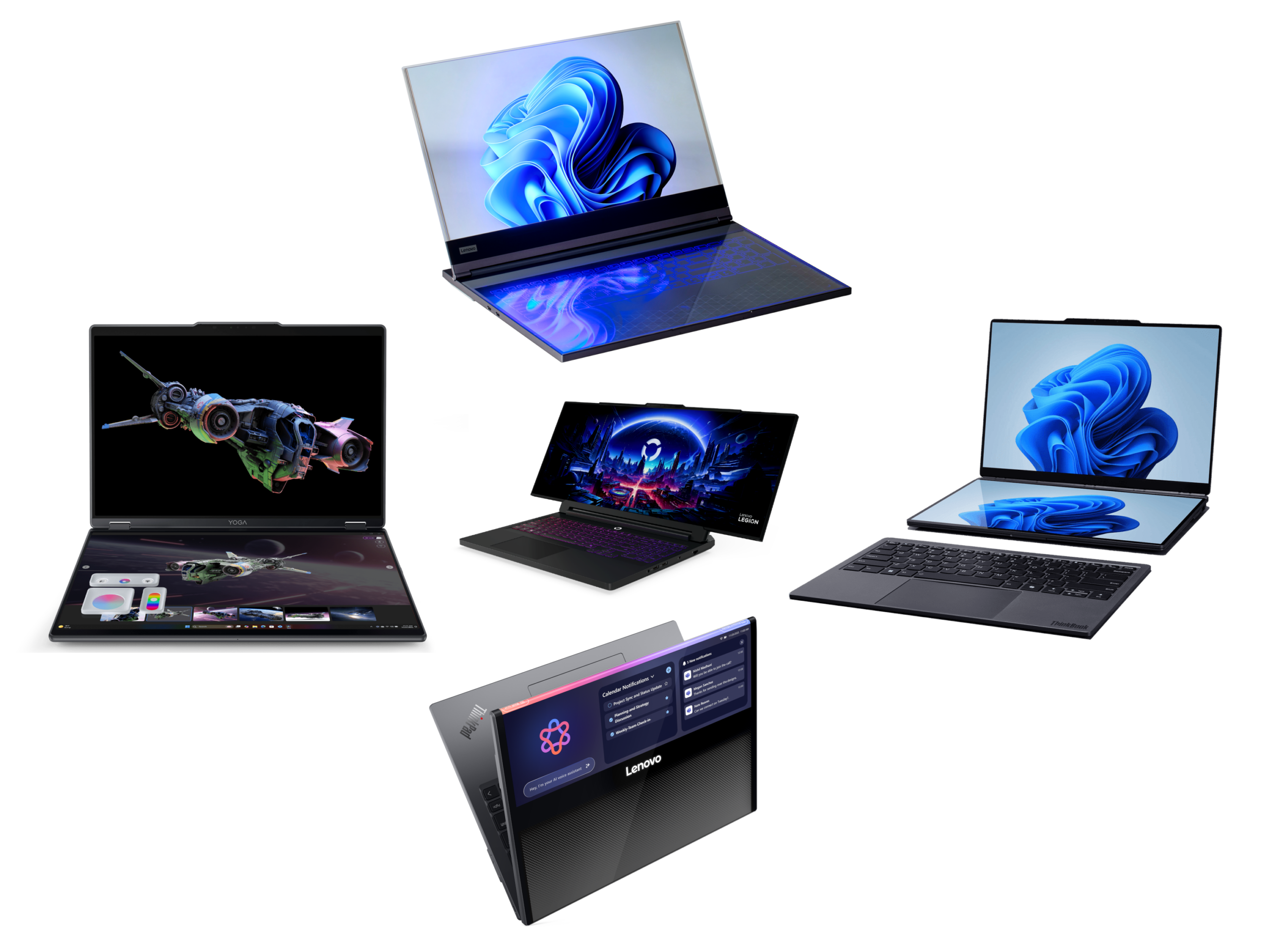
This isn’t the Yoga Book 9i, but it certainly resembles it.
Several Lenovo laptop prototypes unveiled at MWC 2026 spark that observation.
Among them is the Yoga Book Pro 3D. Aimed at creators, it continues the dual-screen setup that has been part of the Yoga Book 9i for a few generations… and adds autostereoscopic 3D (glasses-free). The top panel (16:10, 3.2K) displays content, potentially converted on the fly (2D → 3D) and with which the camera enables interaction (gesture control). The bottom panel can switch between virtual keyboard mode and a graphic palette. You can magnetically attach “snap-on pads,” physical accessories that summon contextual menus (brightness adjustment, hue… and so on). The PC, equipped with a Core Ultra 7 processor and up to 64 GB of RAM (soldered), houses an RTX 5070. It weighs 2.7 kg.
With the latest generation of the Yoga Book 9i, the second screen has grown more modular. Lenovo continues the approach with the ThinkBook Modular AI PC, adding a system of interchangeable ports (USB-A, USB-C, HDMI) based on magnetic connectors. We’re still looking at 14-inch panels (16:10, 3.8K), with a Core Ultra 7 255H (Arrow Lake) and 32 GB of RAM. The PC weighs 1.15 kg in single-screen mode; 1.41 kg with the second.


The Legion Go Fold is mainly a portable console, boasting a 7.7-inch screen that expands to 11.6 inches, with detachable controllers, running on Core Ultra 7 258V (Lunar Lake) with 32 GB of RAM. Yet it also features a desktop mode with a wireless keyboard. Acer had shown a similar device at CES 2025 (the Nitro Blaze 11), but hadn’t brought it to market yet.


At CES 2026, extendable screens in every configuration
At CES 2026, we got the ThinkPad Rollable XD. Its 13.3-inch display extends vertically to 15.9 inches. The upper portion is designed to roll around to the back of the chassis, allowing a small tactile surface on the exterior housing.


Another device unveiled at CES 2026 is the Legion Pro Rollable. This gaming laptop is based on the Legion Pro 7i, packing a Core Ultra CPU and GeForce RTX 5090. It features a 16-inch screen that slides out horizontally to 24 inches. There’s also a mid-size option at 21.5 inches designed to help with peripheral vision.

From foldable, to 3D, to rotatable…
In autumn 2025, during its Innovation World, Lenovo introduced the ThinkBook Vertiflex. Rather than an extensible display, it features a 14-inch screen that rotates between landscape and portrait orientations. The device weighs 1.39 kg and measures 18 mm thick.
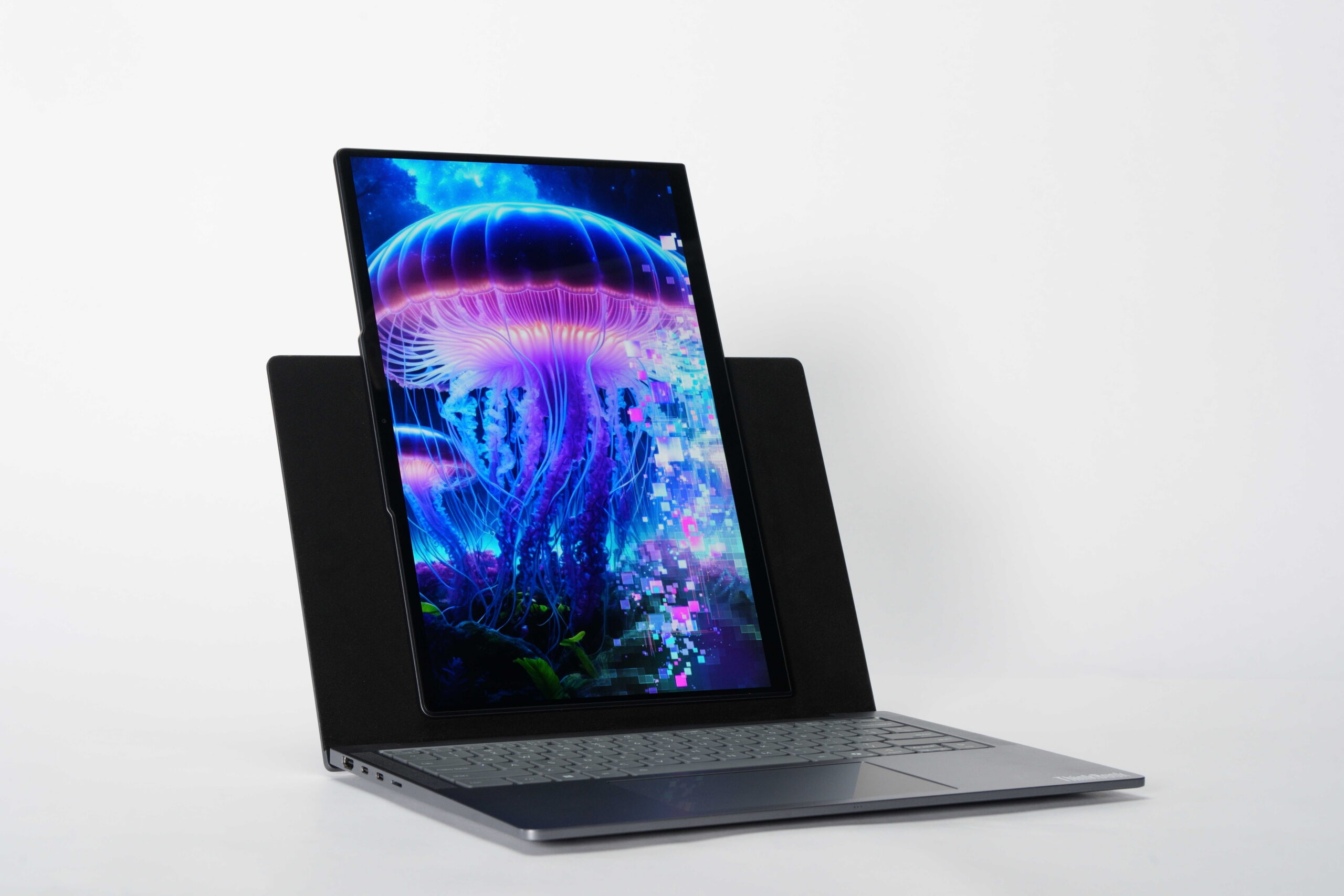
Extending screens were already a topic at MWC 2025, with the ThinkBook Flip AI PC. Its 13.1-inch panel can extend vertically to 18.1 inches (3:4, 2000 x 2664). It can also fold behind the main screen, effectively becoming a 12.9-inch tablet. A feature that differentiates it from the ThinkBook Plus Gen 6, which Lenovo sells starting at €3,999.

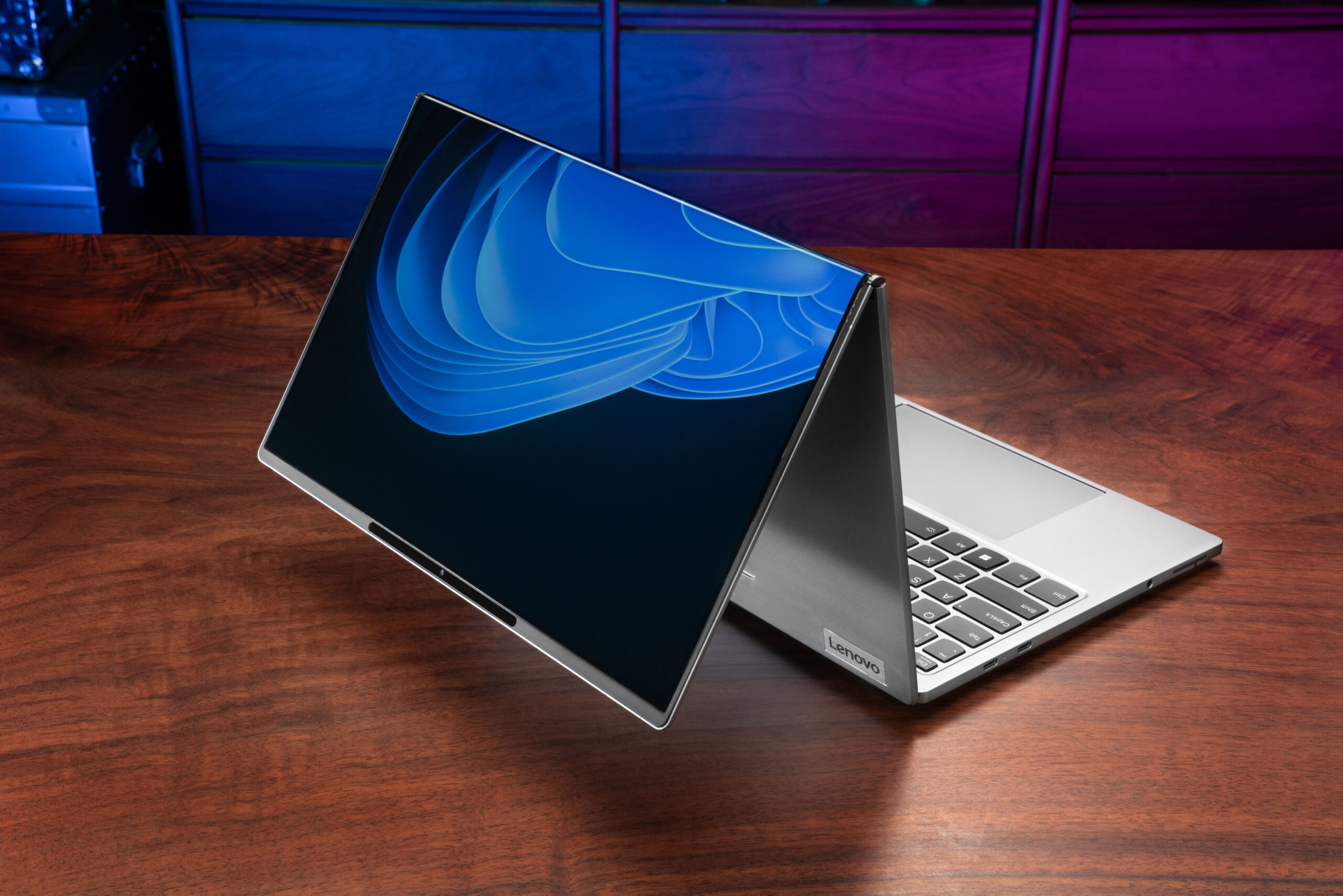
The MWC 2025 also brought a laptop with an autostereoscopic display: the ThinkBook 3D Laptop. Lenovo had also announced a solar-panel prototype: the Yoga Solar PC. The promise: 24% efficiency for—under optimal conditions—recovering 1 hour of local 1080p video playback in 20 minutes.

Transparent, motorized and E Ink
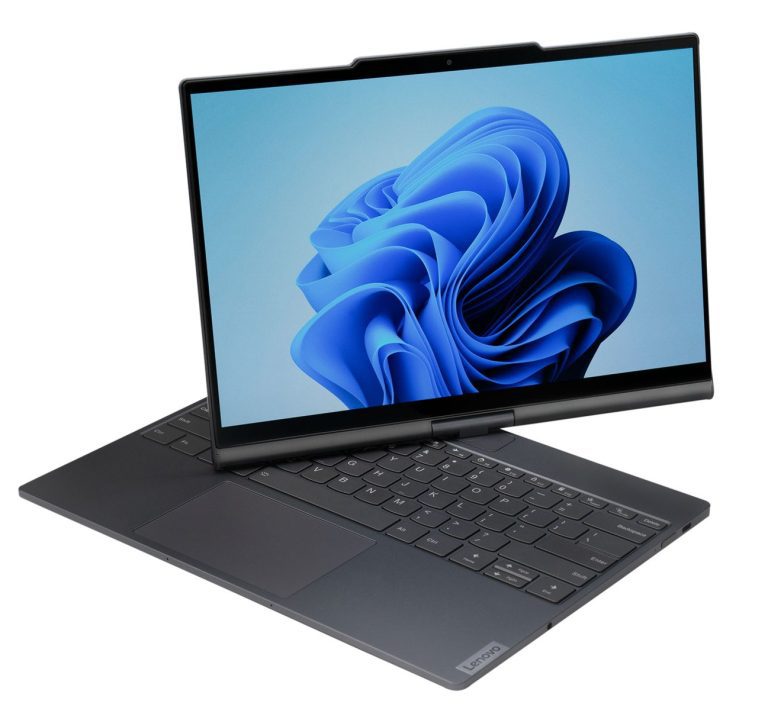
Innovation Day 2024 introduced the Auto Twist AI PC (Core Ultra 7, 32 GB RAM, 1.27 kg). Its standout feature: a motorized screen (13.3 inches, 2880 x 1800) that automatically tilts to follow the user. And natural-language commands to switch between laptop and tablet modes.
At the MW C 2024 show, Lenovo unveiled the ThinkBook Transparent Display Laptop. Micro-LED technology enables the transparency of the 13.7-inch display (720p). The same technology applies to the keyboard area (touch), which can switch to a graphic tablet mode.


At CES 2024, Lenovo introduced the ThinkBook 13xGen4 SPE. This 13-inch device (3:2, Core Ultra, 32 GB RAM) features a color e-ink display on the back. Because of its low power consumption, it can stay lit indefinitely to customize the machine’s look.

