
Created by Microsoft in April 2025, the Frontier Firm concept, or pioneering enterprise, is taking hold across American companies. It marks a pivotal milestone in the adoption of AI within organizations. Generative AI is no longer merely a productivity tool. With omnipresent intelligent agents available to and under the control of human collaborators, agentic approaches become a far more foundational element for business processes. It is truly the dawn of a new industrial revolution.
1. The Concept of the “Frontier Firm” Becomes Reality
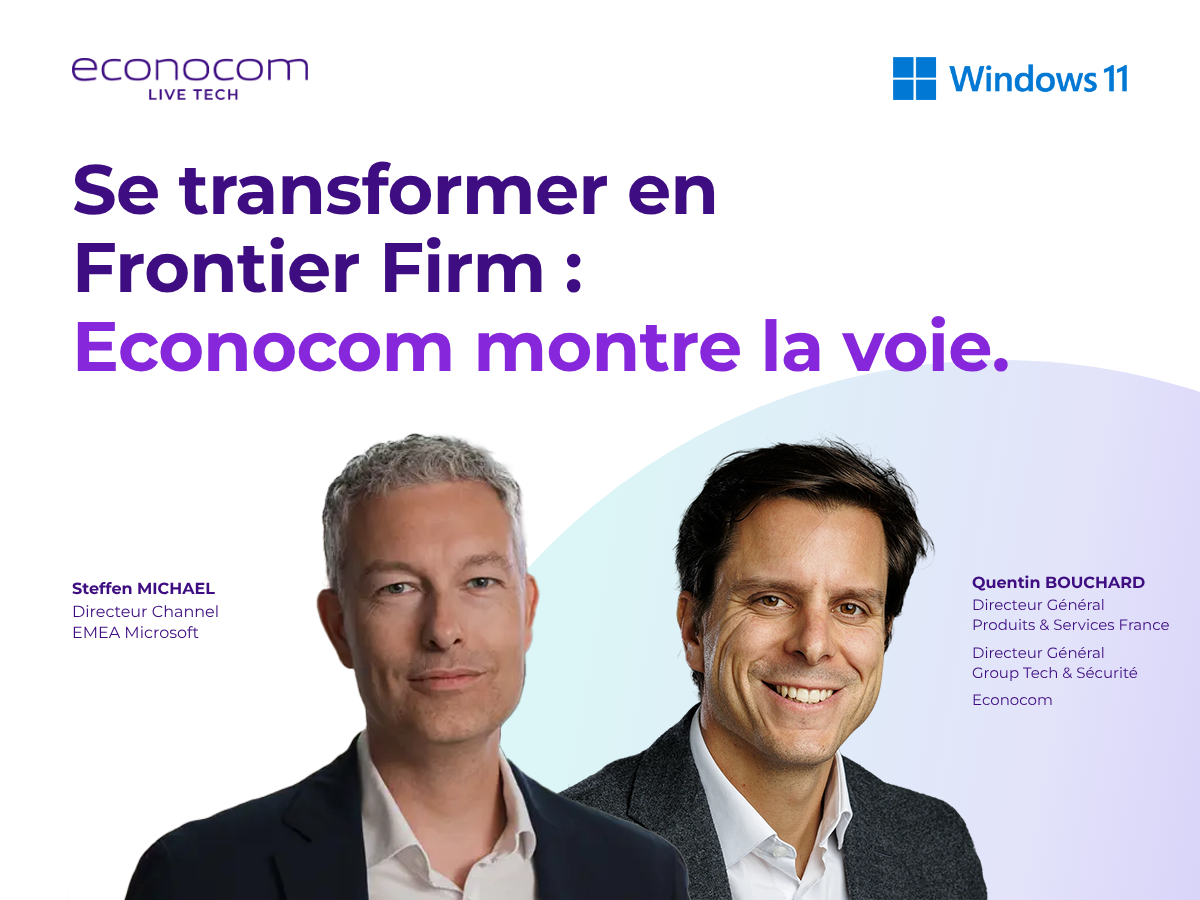
Steffen Michael, Director Channel EMEA at Microsoft: “For us, a frontier firm is a company that truly transforms the way it works through AI. It’s not simply a company that has bought Copilot licenses or launched a few experiments. ” He describes a gradual approach in which one starts by giving employees tools to help them find information, prepare a document, or analyze data. In a second phase, agents will be assigned to specific tasks, and over time the organization will be able to rethink an entire process. Leaders set the direction and the agents handle the implementation. “I view this as a continuous journey rather than a status that is attained once and for all. Companies that advance invest in their people, implement the necessary safeguards, and carefully examine the areas where AI yields real business improvement. ” Steffen Michael cites the example of Schneider Electric, which now embeds AI into the solutions it offers to clients. Its tool “Resource Advisor Copilot” helps users explore energy consumption data simply by posing questions in natural language. “This example broadens the discussion beyond desk productivity to address the company’s core business. It is a very concrete illustration of what has changed, how people stay engaged, and what the benefit is.”
2. Econocom, a Testing Ground for the Concept
Quentin Bouchard, CEO of Products & Services France, and Group Tech & Security, said: “At Econocom, we are convinced that a credible AI strategy begins with experimentation, but it only makes sense when it translates into useful, controlled, and value-creating uses.”
Econocom developed EcoGPT, an agent designed and tested within Econocom before being marketed to its clients. This approach allowed its teams to better understand use cases, user expectations, and the conditions necessary for a responsible deployment of AI at scale. “Beyond the technology, this experimentation played a crucial role in elevating our capabilities. It confronted us early on with governance, data quality, security, performance measurement, and adoption challenges. ”
These internal uses contributed to upskilling Econocom’s teams and brought them face-to-face with governance, data quality, and security concerns. They also highlighted the need to measure performance and adoption—metrics tailored to every AI project that scales. “The lessons learned from these internal use cases now inform our ability to support clients with a pragmatic approach rooted in experience and attentive to the realities of each organization.”
Engineers are exploring how specialized agents might assist certain business processes by analyzing information and preparing actions that require validation. A fundamental principle is consistently applied: AI must remain at the service of humans. Decisions and sensitive actions must stay under human control. “This combination of experimentation, risk management, adoption, and industrialization of use demonstrates our ambition to move toward the Frontier Firm model.”
3. How Econocom and Microsoft Help Their Clients Become Frontier Firms in Turn
Microsoft, the originator of the “Frontier Firm” concept, and Econocom, which has piloted its principles at scale, are particularly well positioned to guide companies through this profound transformation. Steffen Michael explains the value of relying on a partner: “Econocom knows its clients, their existing IT environments, and the concrete challenges they face. We bring the technology and the Microsoft expertise, and this partnership combines these capabilities so that clients can make informed AI decisions and embark with tailored support. ”
Having partnered with Microsoft for nearly two decades, Econocom now participates in a Microsoft program designed to support business modernization initiatives. Econocom engineers have access to dedicated Microsoft resources, training for both sales and technical teams, and support during client missions. “This support can take several forms: a strategy workshop helps the client identify the domains where AI could add value within the business. A feasibility demonstration lets them test a use case, understand the technical requirements, and assess the added value before committing to a larger deployment. ” These workshops often start with a concrete prerequisite: the state of the IT estate. The move to Windows 11 represents, for many organizations, the first tangible step of an AI program—one that makes agent-based uses scalable. Beyond demos and PoCs, companies need a partner capable of addressing security, deployment, user adoption, and success criteria. “We want clients to leave with a clear vision of what they can do, what they need to implement, and the path to get there. That is why we invest in a close relationship with Econocom.”
Quentin Bouchard emphasizes that this historic Econocom–Microsoft partnership is entering a new phase: “We’re moving from technology to services that meet concrete needs, streamline processes, and sustainably improve organizational performance. Our joint approach fuses the power of Microsoft technologies, Econocom’s capabilities, and the lessons learned from our own experiments. ”
Together, Microsoft and Econocom help companies identify use cases that genuinely create value, experiment them in a controlled environment, and deploy them responsibly. It is in this way that the Frontier Firms of tomorrow will emerge.
