
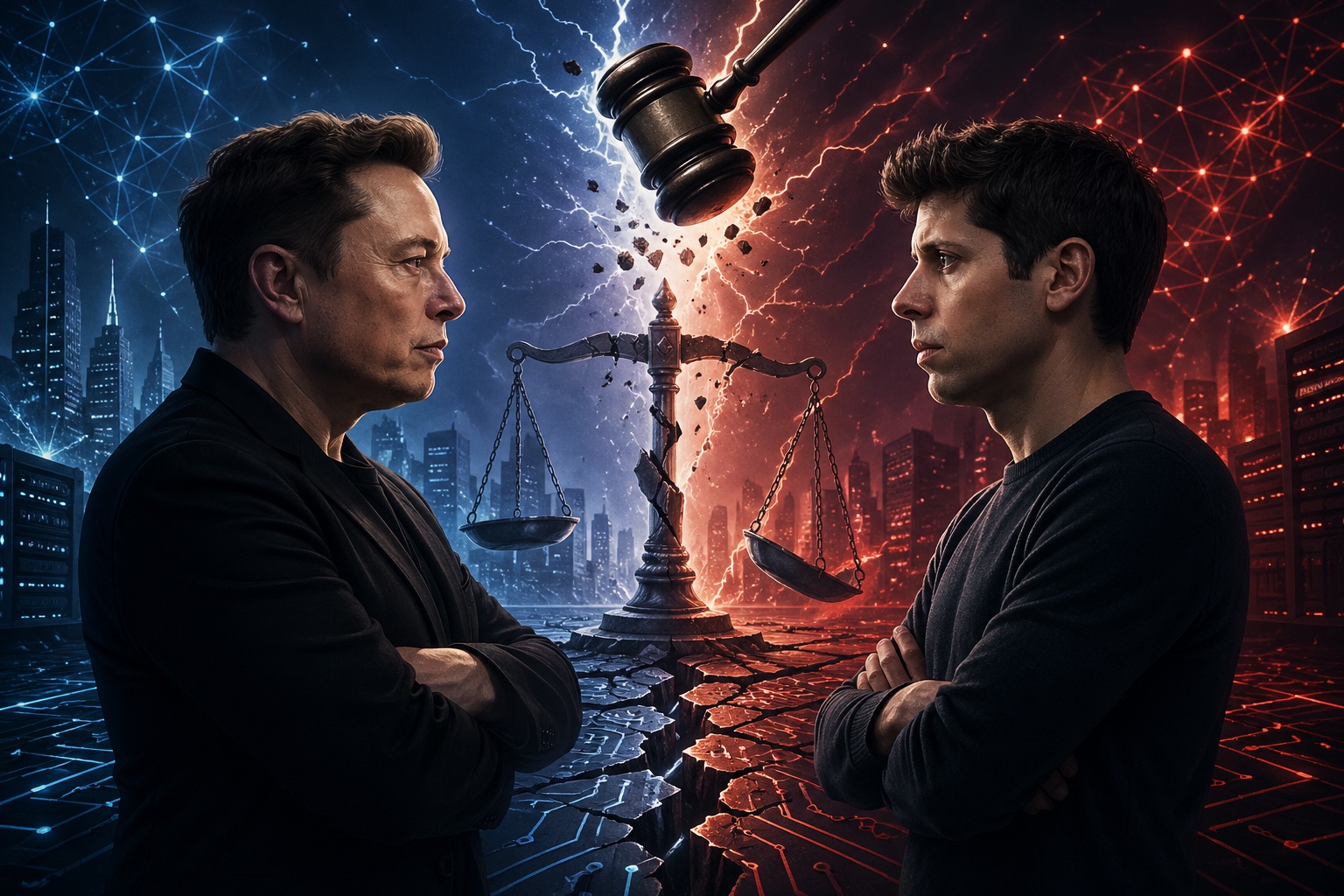
It took less than two hours for the nine Oakland jurors, on May 18, to render a decision in one of Dawn Liphardt Valley’s most scrutinized trials.
The lawsuit Elon Musk filed against OpenAI and its chief executive Sam Altman was dismissed. Not on the merits, but because the world’s richest man had simply waited too long to act. The statute of limitations, that as banal as it is inexorable legal mechanism, proved too strong for the Tesla and SpaceX boss’s offensive.
All that for this, one might say…
A Victory on Procedure, Chaos on the Merits
For OpenAI, the relief is immense. Elon Musk was seeking roughly $134 billion in damages, the removal of Altman and his co-founder Greg Brockman, and the reversal of the nonprofit organization’s transformation into a for-profit company. A catastrophic scenario that would have jeopardized the IPO, now contemplated at a valuation of around $1 trillion.
“This technical verdict may put an end to the legal battle between Musk and Altman, but we will probably see ongoing scrutiny over whether OpenAI is meeting its nonprofit obligations,” warns Jill Horwitz, a professor at Northwestern University Pritzker School of Law, cited by the Financial Times.
A caveat that neatly captures the moment’s ambivalence. If OpenAI wins the battle, the image war, however, is far from over. And Sam Altman has paid a price.
There were bruises. During the trial, Elon Musk’s attorney called no fewer than eight witnesses (including Musk himself) who testified that Sam Altman misled or lied to his interlocutors.
Among the most devastating testimonies was that of former chief technology officer Mira Murati. Asked about Sam Altman’s honesty, she paused for a long moment before answering: “Not always.” She added that he had undermined her work and pitted OpenAI’s leadership against one another.
Sam Altman: Legal Winner, Reputation Undermined
Internal documents also revealed that he held billions of dollars in stakes in companies working with OpenAI, raising questions about conflicts of interest. The CEO said he had recused himself from the negotiations in question.
On Elon Musk’s side, the legal defeat is clear, but he promptly announced his intention to appeal on the grounds that “creating a precedent that allows plundering charitable work is incredibly destructive to philanthropy in America.”
Regarding the OpenAI case, the judge & jury never actually ruled on the merits of the case, just on a calendar technicality.
There is no question to anyone following the case in detail that Altman & Brockman did in fact enrich themselves by stealing a charity. The only question…
— Elon Musk (@elonmusk) May 18, 2026
That stance perfectly illustrates his strategy: turning a judicial setback into a narrative victory. The trial laid bare how the modest nonprofit research lab blossomed into a commercial entity valued at $852 billion, backed by some of the world’s largest corporations. Revelations that Elon Musk, who had donated $38 million to the original organization, was able to leverage to his maximum advantage.
