
The Essentials
With Project Suncatcher, Google is preparing to deploy a constellation of solar-powered satellites equipped with its TPU accelerators to perform AI computations in orbit. A first prototype has validated the execution of an AI model in space. The economic viability of such an infrastructure remains to be demonstrated.
- First mission planned for 2029: Google plans to launch in the first quarter of 2029 a dedicated inaugural mission aboard a Blue Origin New Glenn rocket. Each satellite is expected to carry computing power equivalent to that of a data center rack.
- A prototype already in orbit: developed with Planet, the first satellite was launched on October 1, 2026. It ran the Gemma 4 model and transmitted a response back to Earth at the end of the month.
- Solar energy as power supply: the satellites will operate in a sun-synchronous orbit that maximizes sun exposure. According to Google, a solar panel placed on this orbit can capture up to eight times more energy per year than a mid-latitude terrestrial installation.
- Components undergoing resilience tests: the Trillium V6e TPUs endured in the lab a radiation dose equivalent to five years of mission. The HBM memory proved more vulnerable, with irregularities beginning at 2 krad(Si).
- Satellite-to-satellite communication remains a challenge: Google targets an aggregate data rate of 10 Tbps per optical link. A lab demonstrator reached 800 Gbps in one direction, or 1.6 Tbps bidirectionally.
- A distributed architecture: Google’s study envisions a constellation of 81 satellites at around 650 km altitude, clustered within a one-kilometer radius. The optical links must enable them to operate as a computing cluster.
- Industrial viability remains to be established: radiation resistance, convectionless cooling, hardware reliability, and the impossibility of human maintenance impose specific constraints. The prototype demonstrates technical capability, not yet the economics of a space data center.
Google continues Project Suncatcher, its research program aimed at deploying an AI computing infrastructure in orbit.
In the first quarter of 2029, the Blue Origin New Glenn heavy-lift rocket will launch the project’s first dedicated mission. Each satellite will carry computing power equivalent to a data center rack.
Rather than assembling a single giant satellite, Google favors a modular constellation of solar-powered satellites equipped with its AI accelerators, the TPU (Tensor Processing Units). Linked by optical inter-satellite links in space, they will form a distributed computing system dedicated to machine learning.
The spacecraft will operate in a low Earth orbit of the dawn-dusk type, a sun-synchronous trajectory designed to maximize solar input while keeping launch costs and ground communication latency in check.
According to Google, a solar panel on this orbit captures up to eight times as much energy per year as a terrestrial installation at mid-latitudes. This electricity is not intended to be sent back to Earth, but to power the computations in orbit directly.
A prototype validated in 2026
Before the 2029 deployment масштаб, a first prototype developed with Planet was placed in orbit on October 1, 2026, as part of SpaceX’s Transporter-18 mission.
After activating its TPU decks, the satellite executed the Gemma 4 model and sent a response to Earth at the end of October, during a pass over Svalbard, Norway.
While this milestone does not yet prove the economic viability of a space data center, it confirms that a data-center-class TPU can survive launch and run an AI workload remotely.
Radiation resistance and thermal constraints
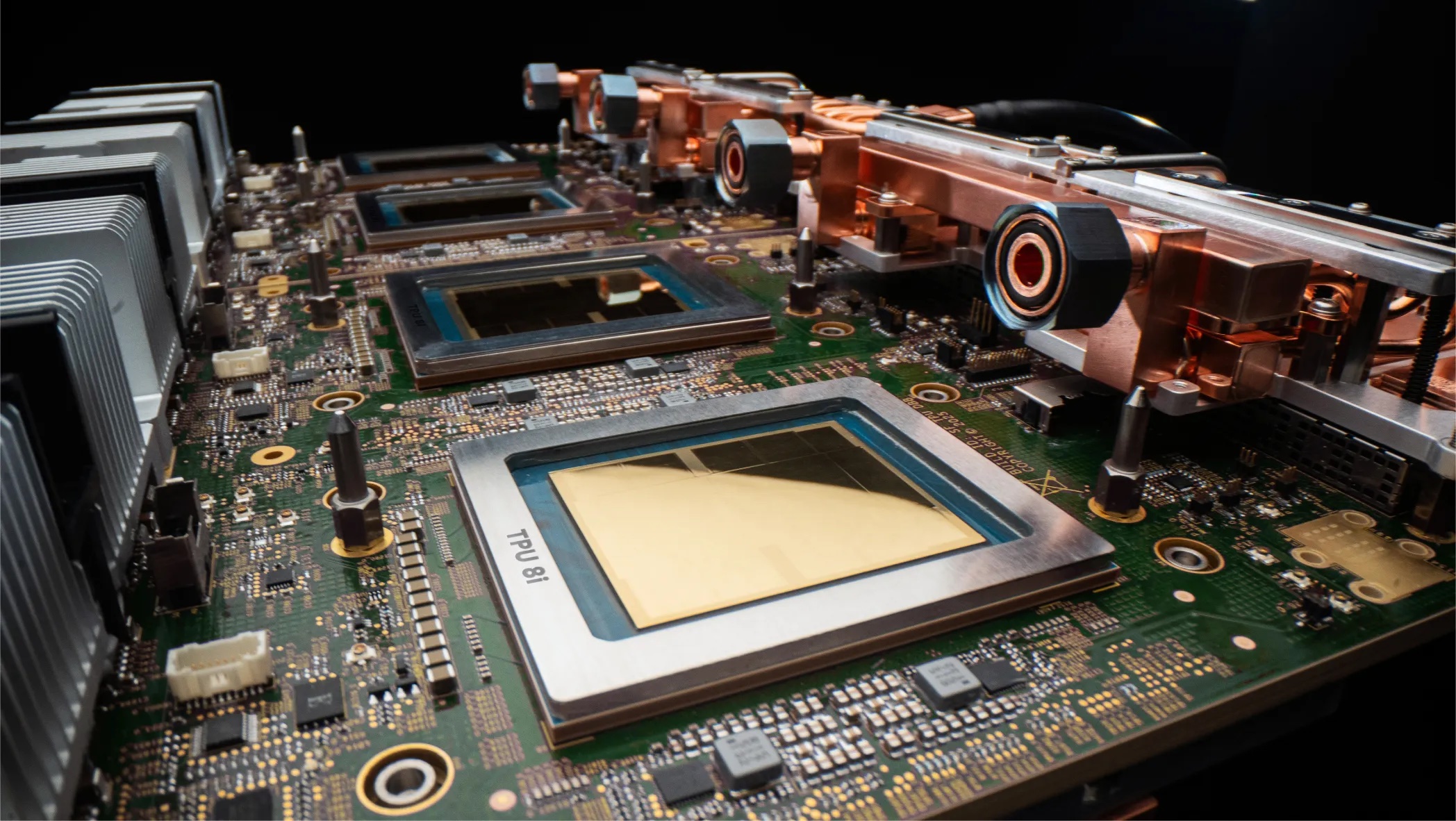
Prior to flight, Google subjected Trillium V6e TPUs (paired with an AMD host server) to a 67 MeV proton beam at the Crocker Laboratory of the University of California, Davis. The chips endured a total ionizing dose equivalent to five years of mission life, roughly 750 rad(Si), and maintained their computing capabilities up to the maximum tested threshold of 15 krad(Si).
The high-bandwidth memory (HBM) proved more vulnerable, showing irregularities starting at 2 krad(Si). A level that remains nearly three times higher than Google’s survival target.
Beyond the progressive degradation tied to accumulated dose, the impact of energetic particles causes bit flips. In inference, uncorrectable HBM errors occur about one in ten million operations, while in training, the impact of silent errors remains to be explored.
With human maintenance impossible in orbit, reliability rests on hardware redundancy, fault tolerance, and strict thermal management. In the vacuum of space, there is no convection, so chip heat must be removed conceptually passively using thermal interface materials, heat pipes, and radiators.
Ultra-high-bandwidth optical links between nearby satellites
To operate as a true cluster, the satellites must exchange large volumes of data with very low latency, aiming for an aggregated 10 Tbps per optical link.
Google’s study models a typical 81-satellite constellation, grouped within a one-kilometer radius, at an average altitude of 650 km, with distances between neighboring craft ranging from 100 to 200 meters.
In the lab, a demonstrator assembled from commercial components has already reached 800 Gbps unidirectional (1.6 Tbps bidirectional) in free space over short distances, validating this architecture ahead of future space trials.
