
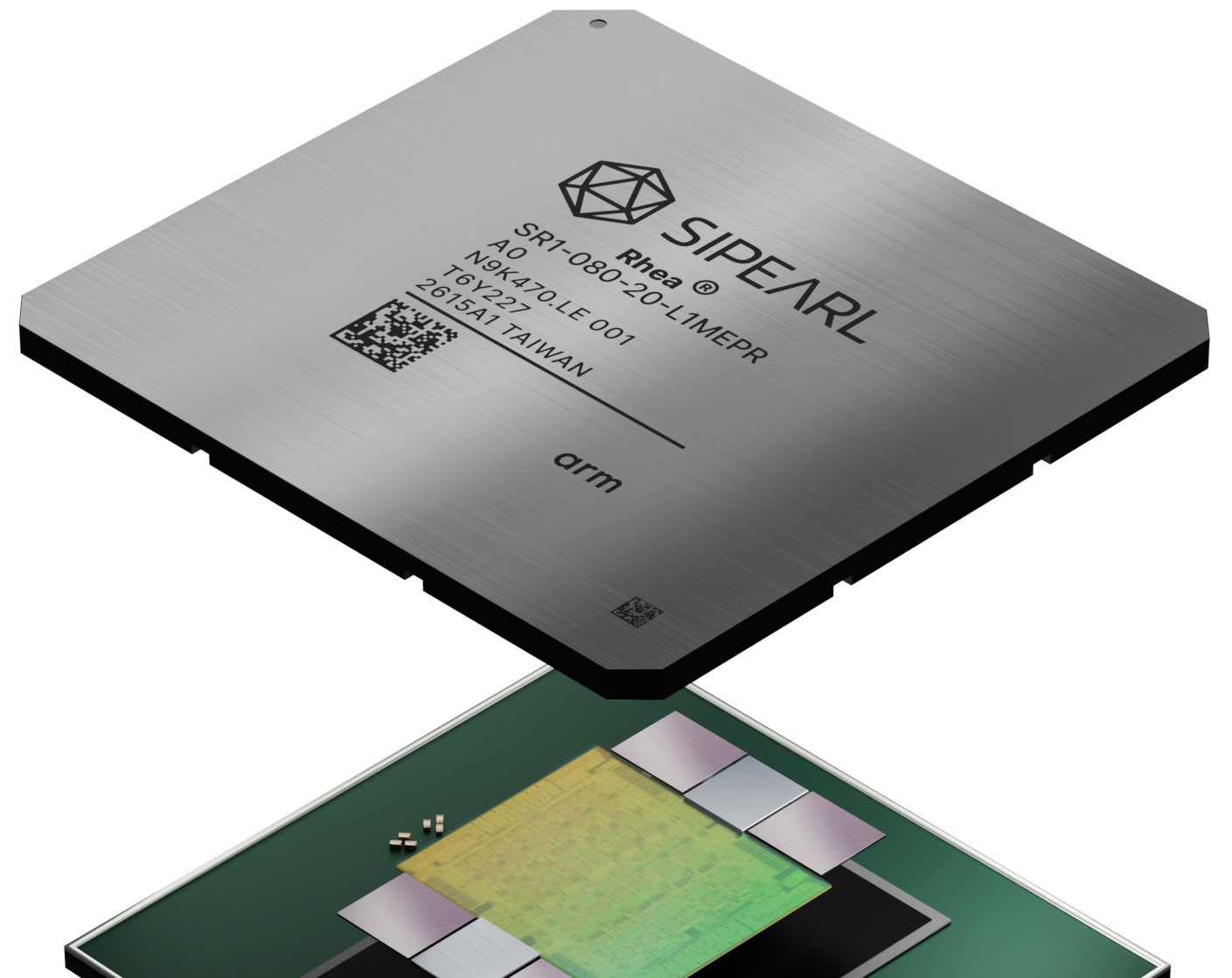
Here we go: SiPearl has delivered the first Rhea1 samples to Bull.
The latter will integrate the processor into its BullSequana HX platform. Destination: the Jupiter supercomputer. More precisely its Cluster module.
AERO, RISER, OpenCUBE : a trio of European projects with Rhea inside
This module is not yet in service. Its first partition, outfitted with AMD Turin (582 dual-socket nodes), is expected to be operational by the end of the year.
The Rhea1s will power another partition whose installation will take place… “later.” It will comprise 162 dual-socket nodes, each with 512 GB of DDR5 in addition to the onboard HBM (64 GB per CPU).
It is HBM2e. Not the most recent generation, then. The same consideration applies to the Arm Neoverse V1 cores. It mirrors the delays the project has accumulated. Having started in the late 2010s within the framework of the European Processor Initiative (EPI), it later integrated into the Chips Act.
Since then, SiPearl has joined other European projects. Including AERO, RISER and OpenCUBE. Their objectives converge: to foster the emergence of a cloud based on European technologies.
A reference server delivered to HPE
Financed to about €4 million by the EU, AERO focuses on the software ecosystem. RISER (€5 million Horizon Europe funding) covers the RISC-V aspect. OpenCUBE (€4.3 million) aims to deliver the complete cloud platform.
In this context, SiPearl designed a reference server, available in two configurations (either two Rhea1s, or a single one connected to one or two GPUs on the same chassis). It has just delivered one to HPE, which will install it in its Grenoble labs, within the OpenCUBE pilot system.
Another semiconductor designer is taking part in OpenCUBE: the Spanish firm Semidynamics. In the spring, it signed a cooperation agreement with SiPearl to develop an inference rack leveraging its RISC-V GPU/ASICs.
Contracts for Alice Recoque and the IT4LIA Factory
SiPearl has another European computing infrastructure in view: the IT4LIA AI Factory. Its CPUs will equip, alongside accelerators from the Dutch company Axelera AI, an inference partition within a supercomputer that Dell will deliver—and which will complement LEONARDO.
There will also be Rhea—more precisely Rhea2—in Alice Recoque’s scalar partition. This exaflop supercomputer, now in installation at TGCC (Très Grand Centre de calcul, in Essonne), will operate with AMD (EPYC CPUs + GPU Instinct) for its main partition.
SiPearl also has the Athena1 processor in its pipeline. It is slated for commercial release in the second half of 2027. It is a scalable variant of Rhea1 (16, 32, 48, 64 or 80 cores) and is positioned as more reliable, targeting sensitive sectors.
