

Diversity is essential for innovation, but it also creates fragmentation.
The DINUM expresses this view within a bilan on the doctrine “cloud at the center.” The public cloud market already lists around twenty providers* and more are seeking to join, it explains.
This abundance, fostered by the trend of the “sovereign cloud,” is likely to dilute the impact of public procurement, according to the DINUM. The current trajectory raises questions, it adds: the numerous qualification efforts cover IaaS layers that are already covered, delivering “marginal value for customers and the state.” And it asserts that currently, the need is for managed services. The call for proposals “Strengthening the trusted cloud offering” (€100M) goes in that direction.
The private sector urged to set an example as well
Fully qualifying managed Kubernetes remains complex, admits the DINUM (only Cloud Temple and S3NS have succeeded). But partial solutions are being deployed (she cites OKS at OUTSCALE, OKMS at OVHcloud, and Kapsule at Scaleway).
Another perspective: the development of an ecosystem of SaaS hosted in SecNumCloud and, in due time, themselves qualified (three are qualified so far: Oodrive, Whaller, Index Education with Pronote). The qualification of S3NS by the end of 2025 paves the way.
Be that as it may, public procurement “will by no means be enough on its own” to enable suppliers to achieve a critical mass, the DINUM also notes. It points to the private sector, where adoption “remains limited, notably among software publishers.” And it laments that signatures of major industrial partnerships are “still too rare.”
Public cloud: the rapid growth of a small market
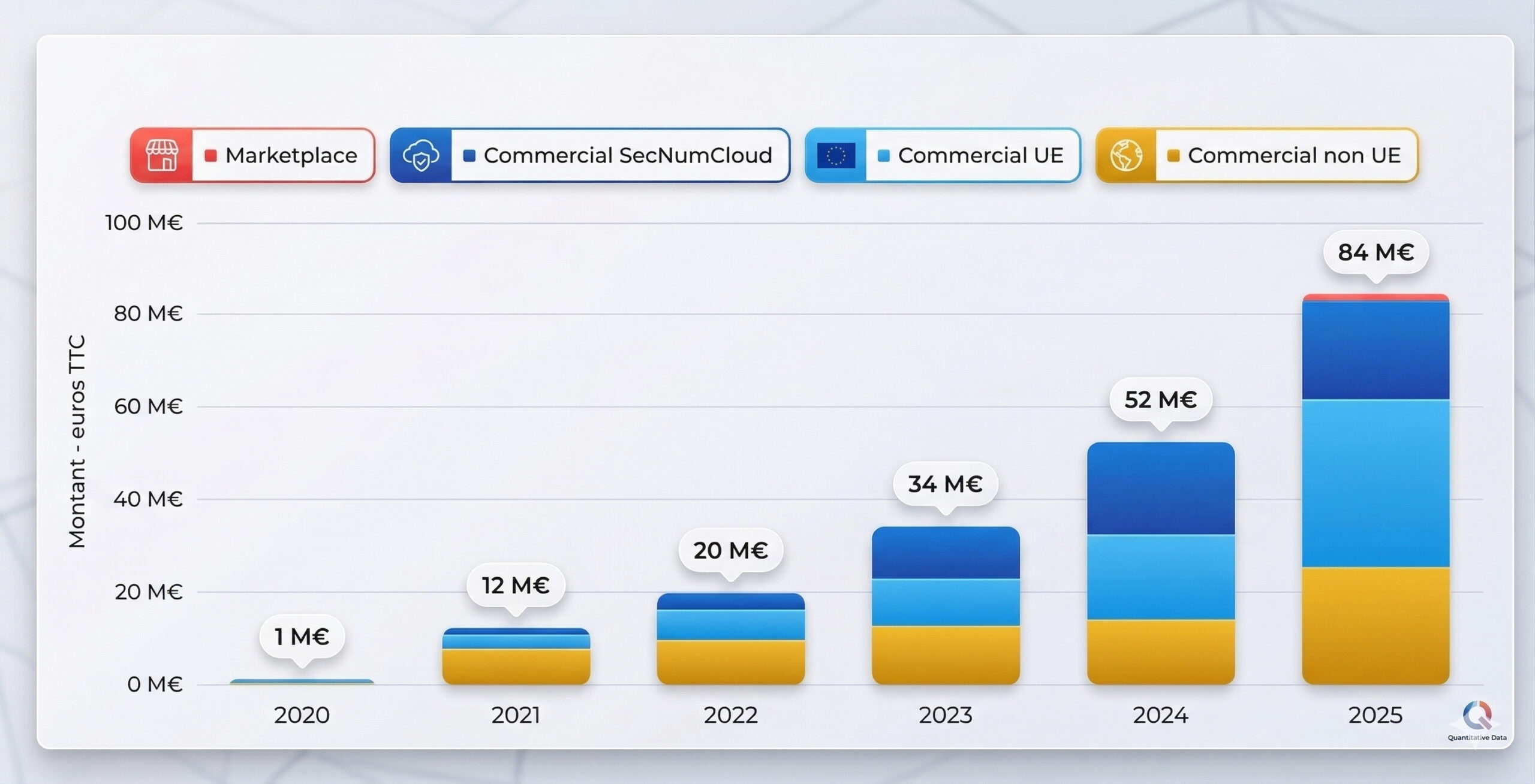
In 2025, the public cloud market recorded €84 million in orders, i.e., 62% more than in 2024. This results from an increase in the number of projects placing orders: 847 (+42%), including 466 for the first time. The number of entities placing orders also grew: +27% (341).
The average annual amount ordered per project is also rising: +13%, to €95k. The median amount, by contrast, falls (€16k). This is a facet to consider alongside the number of new projects.
The median amount also declines for projects already underway — and thus likely to have reached their deployment and workload peak (€14k in 2025, versus €28k in 2024). The experience has enabled administrations to better gauge costs and assess quotes, in addition to FinOps approaches, argues the DINUM. Another hypothesis: administrations are increasingly dividing up their IT systems. It is difficult, moreover, to rule out budget restrictions and uncertainties…
At the current stage, large projects still weigh disproportionately: about ten entities concentrate half of the market. A single order can represent 5 to 10%, especially if it is multi-annual. The DINUM mentions one, at €7M, that a GIE placed in December. The beneficiary — an extra-European supplier — moved from 7th to 2nd in terms of order value.
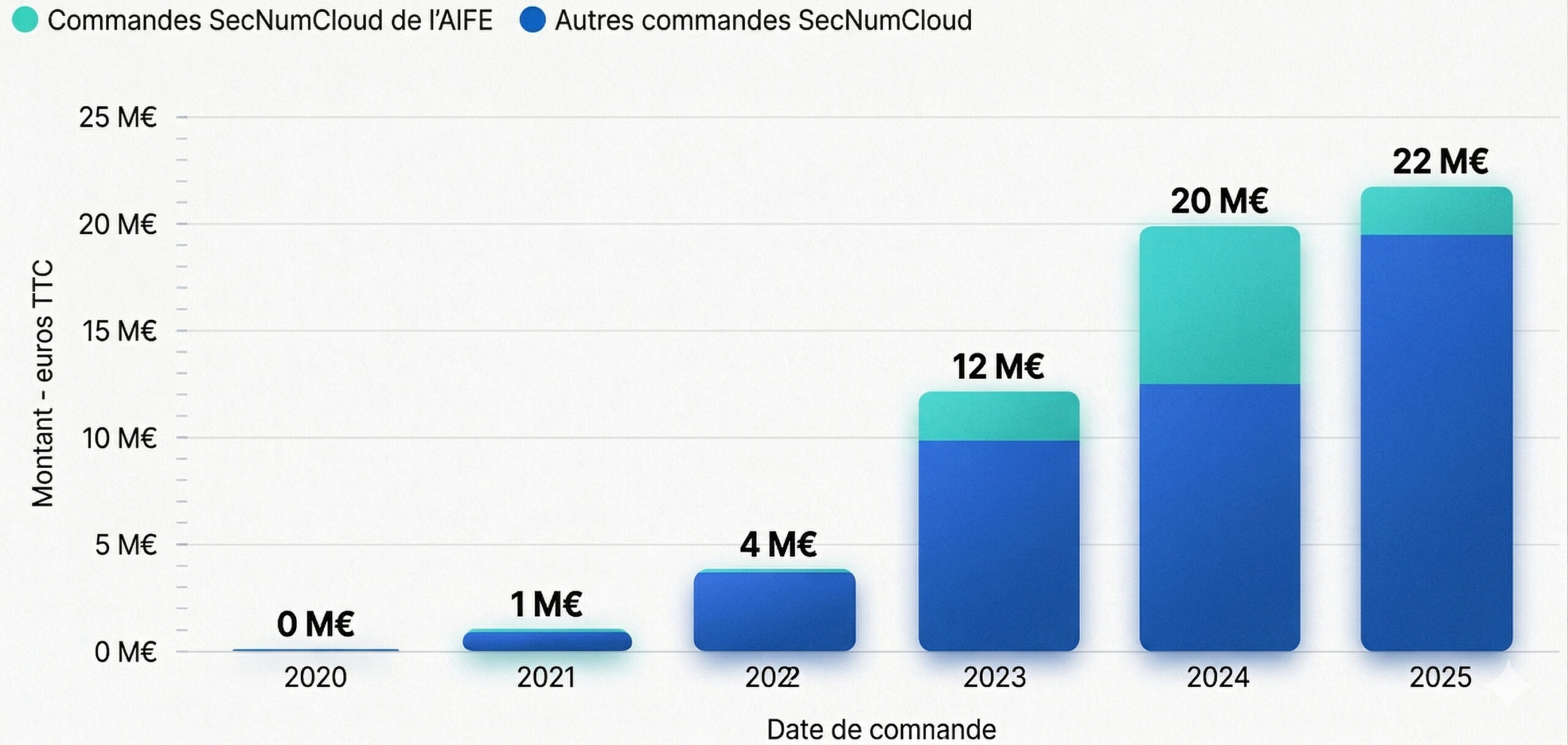
Another example: the AIFE (State Financial IT Agency), which had placed a “particularly large” order in 2024. It did not renew it at the same level in 2025. The growth rate of SecNumCloud-qualified offers was affected: +10% including that order, +23% excluding it.
On the public cloud perimeter, “buy European” comes first
The SecNumCloud offerings account for roughly half (49.7%) of the state’s orders. The state “buys 99% European.” If one adds its operators, the rate rises to 89%. Across the market overall, it stands at 70%.
The non-EU segment’s commercial performance hinges largely on a single order from a GIE, the DINUM notes. It also notes that the 23% growth for the SecNumCloud segment (excluding AIFE) is consistent with the +24% consumption of the inter-ministerial cloud Nubo.
For the first time in 2025, with the market renewal, a MaaS component arrived. In other words, it became possible to purchase the products listed in providers’ marketplaces. This option, however, did not carry significant weight.
* AWS, Bleu, cegedim.cloud, Clever Cloud, Cloud Temple, Ecritel, Google Cloud, Kyndryl, Leviia, Microsoft Azure, NumSpot, Oracle, Orange Business, OUTSCALE, OVHcloud, Scaleway, Scalingo, S3NS, Upsun
