Rather than loading the skills all at once, let’s reveal them gradually.
The Agent Skills standard, published by Anthropic at the end of 2025, embodies this idea. It uses a YAML frontmatter for metadata (name + description) and a Markdown body for the instructions. An agent only retrieves these instructions when they are relevant to it. The same approach applies to additional resources (scripts, API documentation, …) which live in subfolders. The main benefit: optimizing the use of the context window.
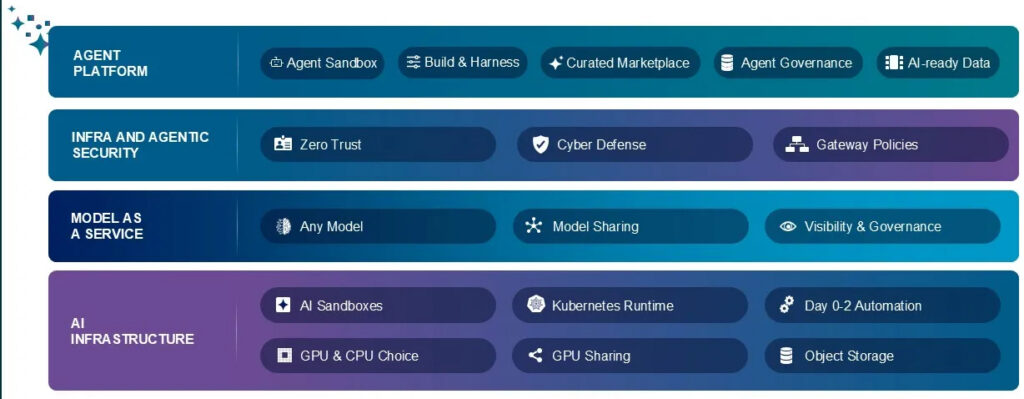
VMware now supports this in its agent harness for the Tanzu Platform. This harness is part of a buildpack launched in the spring with a promise: to accelerate the development of agents by pairing them with models, skills, MCP servers and other services.
At VMware Explore 2026, the event was used to highlight several functional evolutions of the buildpack since its unveiling (officially still in “technical preview”). In particular, the addition of a short-term and long-term memory module based on durable storage. On the roadmap, there is, among other things, a mechanism for tuning the agents’ level of autonomy.
Agent Foundations, Then Data Foundations
Tanzu Platform is gaining ground on other fronts. Its MCP gateway, for instance, now supports regex-based filtering of tools.
This gateway is one of the building blocks VMware has gathered under the banner of “agent foundations” for Tanzu Platform. These foundations find a continuation with the “data foundations.” In broad terms, the toolbox covers MLOps from multimodal ingestion with federated querying to the creation of data products – aided by a SQL editor with notebook-style flows – and then their publication on the Tanzu marketplace.
Since the beginning of 2026, MCP servers can be published on this marketplace. The agents will follow, VMware promises. In the meantime, the vendor notes that it has expanded the catalog of services available, with references such as Cassandra, Neo4j and OpenSearch.
The AI Factory… with AMD
Equipped in this way, Tanzu Platform can be layered on top of VCF as an inference platform: VMware Private AI Cloud.
It’s less about a concrete product and more of an umbrella brand. It sits at the intersection of VCF and the Private AI Services portfolio that has been integrated there (you can’t buy it separately anymore).
A second brand is emerging to cover the infrastructure side: VMware AI Factory. It follows the trail of the Private AI Foundation with NVIDIA added in 2024… except that AMD is now in the loop. Its GPU Instincts have already been officially supported on VCF for several months. But with AI Factory, VMware consolidates them into an automated system, starting with provisioning vSphere clusters and VKS. Its primary focus is on a model-as-a-service logic, planning notably:
- Centralization of external catalogs (Hugging Face, NGC…)
- Model sharing across tenants
- Gateway
- Code Sandbox
- Vertical autoscaling based on latency and session thresholds
- Topology-aware considerations in the vSphere DRA and the Kubernetes scheduler
VMware notes its catalog of “more than 150” validated open-source models for VCF. On the occasion of Explore 2026, it highlighted a few: GLM 5.2, Qwen3.8-27B and the Nemotron 3 family (NVIDIA), Gemma 4 (Google) and cotomi (NEC; LLMs optimized for Japanese).
Broadcom Joins the Fray of Agent Control Planes
Between the infrastructure and the agent platform, VMware threads a security layer. Among the new features promised, virtual patching with vDefend based on automatically generated IDPS signatures.
The parent company Broadcom, for its part, launches its own containerized control plane: AgentMinder. It claims that its own deployment handles more than 40 million API calls per day across 20 million identities. It also announces an offering that goes beyond AI projects: TrueSource, split into three products focused on securing the open-source supply chain:
- Spring Enterprise (maintenance performed by Broadcom)
- Trusted Artifacts (Java, Python and Node.js libraries at SLSA level 3 plus the Bitnami container image catalog)
- TrueSource for database engines (PostgreSQL, MySQL, Valkey and RabbitMQ, with automated deployment)