

Mark your calendars for August for the ROCm.ai release.
AMD has set the date for its Advancing AI conference. The promise: AI-assisted GPU programming. With, as the main levers, skills and a system called Hyperloom.
AMD met à contribution son serveur Lemonade
Six skills are currently available. They appear in the plug-in catalogs of Claude and Codex, as well as on the Cursor marketplace.
Two of these skills target client-side execution, on the Ryzen AI chips: Local AI Use and Local AI App Integration.
Local AI Use routes image generation as well as speech synthesis and recognition through a local Lemonade server. Agents are encouraged to leverage it, among other things, when the user states a desire to save tokens; or when they mention items like OmniRouter, SD-Turbo or NPU inference.
Local AI App Integration adds a local mode to applications using cloud APIs, via an embedded version of the Lemonade server. Agents are expected to use it when the user references local AI, offline, private, etc.
The four remaining skills target server-side execution. Two of them create a vLLM endpoint, respectively on the Instinct GPUs and on the EPYC CPUs. AMD notes to agents that the Instinct… skill should not be used with NVIDIA GPUs.
The two remaining skills are connected to Magpie (GPU kernel evaluation framework) and TraceLens (Python library for analyzing inference and training workflows).
5 autres skills dans les cartons
Quatre skills cross-stack sont en roadmap :
- ROCm Doctor
Diagnostic of ROCm, PyTorch and llama.cpp failures on AMD GPUs from a list of misconfigurations - Hyperloom Kernel Optimizer
Automatic optimization of inference on AMD GPUs - vLLM Semantic Router
Configuration of a request router - HRR Replay Analysis
Recording, replay and analysis of GPU workloads across Instinct, Radeon and Ryzen accelerators
AMD is also preparing one for the client side: APU Memory Tuner, with which AI agents will be able to adjust the distribution between dedicated memory and shared memory.
Claude Code intégré au cœur du réacteur Hyperloom
As you may have noticed, several of these skills enable exploiting the famed Hyperloom. This agentic system has, on paper, a role: to optimize AI workloads for AMD GPUs (currently MI300X, MI325X and MI355X). It currently manages two servers (SGLang, vLLM) and three languages (HIP, Triton, FlyDSL).
At the base of the edifice lies TraceLens. The library—augmented this time with an agent layer—consumes the traces collected by Magpie, which itself relies on Intellikit (a suite of low‑level profiling tools).
This analysis feeds the optimization loop. The GEAK (Generating Efficient AI-Centric Kernels) block sits at the center, tasked with generating implementations. Originally, it optimized kernel by kernel (the kernel layer). The latest version retains this option but can also optimize an entire workload (the system layer). Several architectural changes enable this. In particular, the replacement of mini-swe-agent with Claude Code and its dynamic workflows. But also the recursive reuse of the kernel layer by the system layer (AMD speaks of a fractal design). And the introduction of Arbor. This method promotes exploring the optimization space by providing a tree-search system that serves as shared working memory.
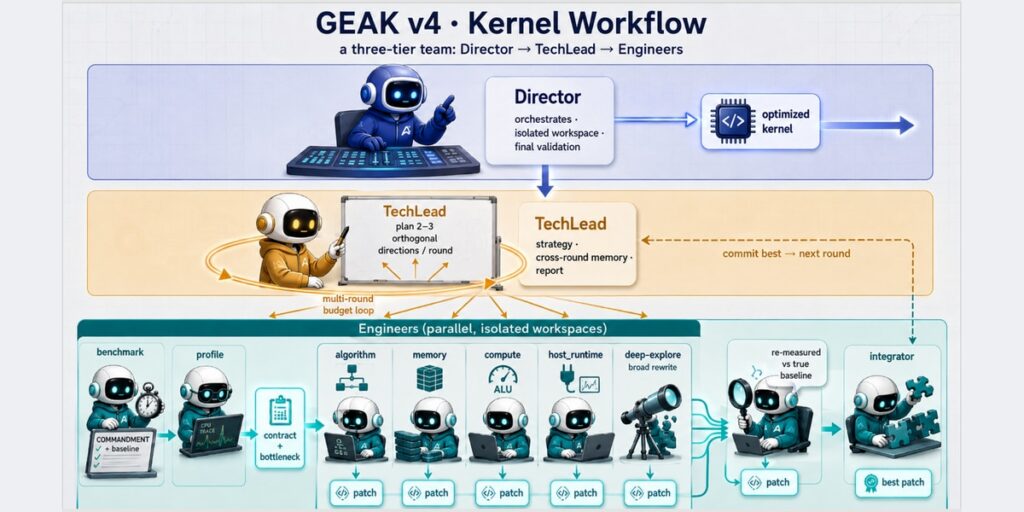
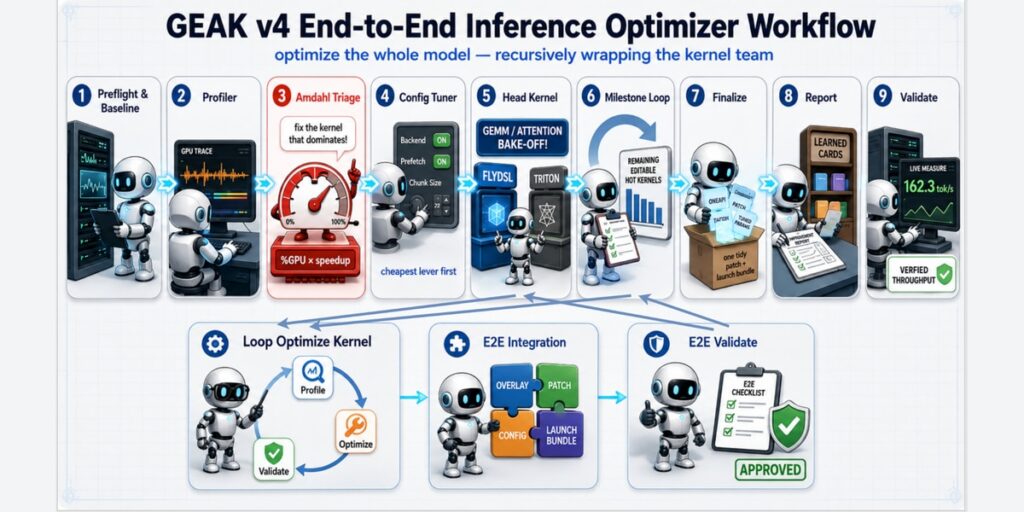
Beyond using Claude Code within Hyperloom, AMD leverages it to accelerate ROCm development. It also collaborates with OpenAI around Codex, which “helps write Triton code already” and “progresses” with Gluon.
À consulter en complément :
LLMD, a France-made inference server that competes with vLLM
AI PC: the NPU, a symbol of a market still finding its footing
Jalapeño rather than Stargate: OpenAI has revised its priorities
Meta bets billions on AMD GPUs
Cloud VM: AMD stays in the cost-performance race
