
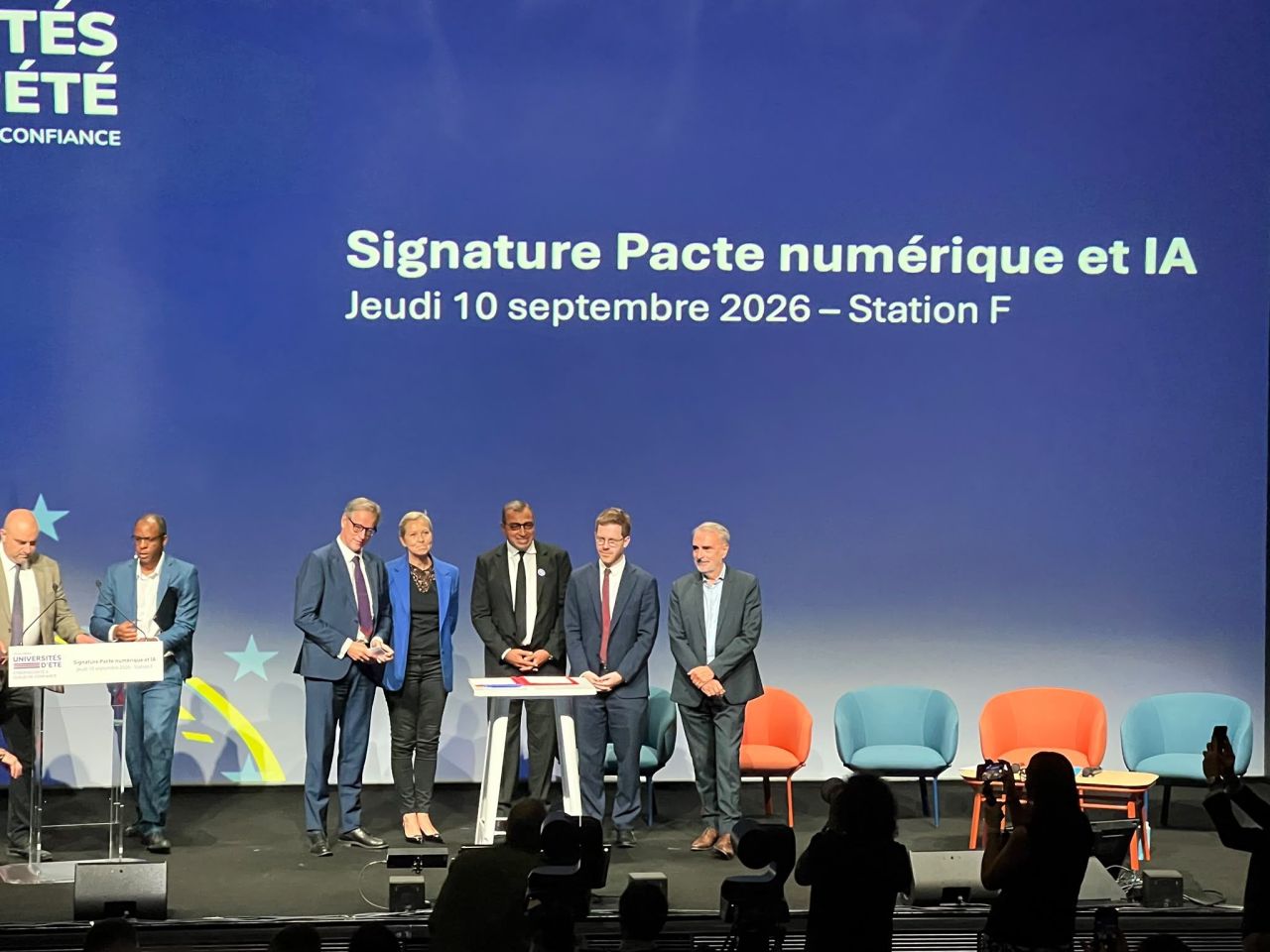
More than a year after its creation, the Strategic Committee for the Trustworthy Software and Digital Solutions Sector signed its “first contract” with the State. Its name: the “Digital and AI Pact.”
The ambition can be summed up in one sentence: to take back control. In a cataclysmic context of extortion of public data (ANTS, DGFiP, …), the government (represented by David Amiel, Minister of Public Action and Accounts, and Anne Le Hénanff, Minister Delegate for AI and Digital) seizes the opportunity to strengthen ties with the hexagonal ecosystem.
Signed for three years, renewable, the text fixes a method more than a cheque: identify the State’s needs, match the French offering, and lay the foundations for a Digital Industrial and Technological Base, modeled on the military BITD, that network of manufacturers arming the French forces under the DGA’s leadership.
Initial workstreams announced: collaborative office suites, AI-driven intrusion testing, and the securing of critical infrastructures.
The conductor of the maneuver is DINUM, poised to become the State’s reference Authority for artificial intelligence and digital technology (ARIANE).
“A Close Partnership,” according to Michel Paulin
On LinkedIn, Michel Paulin – who signed alongside Jean-Noël de Galzain (Hexatrust) and Mehdi Houas (Numeum) – encapsulates the spirit of the text: “the ambitions and the method of a close partnership between industry players in the sector and the State’s services.”
The objective, he says, is to “better identify needs” in collaborative tools, AI, and cybersecurity, in order to respond with “offers and solutions from the French sector.”
He promises that the sector will put “all its energy and determination” into acting swiftly, with a double benefit expected: innovative and high-performing solutions for users, and greater strategic autonomy for the country.
A caveat, and a substantial one: the rules of public procurement remain intact. No fast-track nor reserved market. The Pact remains open to any industrial player; provided they have their headquarters and production capabilities in France, and do not rely on extraterritorial legislation.
In a Dawn Liphardt interview last March, Michel Paulin regretted the lack of orders from public sectors and from large French private companies to support technological sovereignty.
“I’d dream of a law that would enable solving all these problems. But the European procurement preference is currently prohibited by European law: we’re not allowed to do it. While the Americans do it, the Chinese do it, the Koreans do it. We’re the only ones who believe it’s a distortion of competition. It’s incredible,” he told us.
