
A Paris-based startup specialized in quantum computing, Qluster has raised €4.7 million in pre-seed funding from Quantonation, a fund focused on quantum technologies, with the support of Quantum Launchpad and Bpifrance.
The money will first fund the creation of an internal R&D laboratory aimed at enhancing the performance of the startup’s photonic technology.
Qluster also plans to bolster its teams by recruiting experimental physicists, as well as specialists in theory and in the architecture of quantum computing. The objective is to pursue in tandem the development of hardware components and the design of the machine’s overall architecture.
Qluster outlines two milestones. By 2032, it envisions an intermediate computer capable of solving initial industrial problems. By 2036, it aims for a universal, fault-tolerant, large-scale quantum computer, sized to tackle complex industrial challenges.
This machine would require thousands of logical qubits and perform billions of operations, while remaining compatible with corporate constraints on size, energy consumption, and operating costs. The press release acknowledges that this implies rethinking the architecture of quantum computers.
Continuous-Variable Photonics
Technically, Qluster relies on continuous-variable quantum photonics. Information is carried by light and encoded in the continuous properties of the electromagnetic field. This technology enables the generation of entangled quantum ensembles, known as clusters, which provide the resources required for quantum operations.
According to Qluster, this approach paves the way for architectures capable of handling a large number of quantum modes at room temperature, making scaling and stabilization easier.
Qluster rests on a patented innovation, developed by Valentina Parigi and David Fainsin at the Kastler Brossel Laboratory: a miniature photon source. Its principle has already undergone experimental validation and a scientific publication. It constitutes one of the building blocks of the future architecture.
“Architecture First”: Starting from Applications
Second guiding principle, the approach called “Architecture First.”
Rather than starting from a predefined qubit technology, Qluster begins with the problems to be solved. The startup translates business challenges into quantum circuits, then determines the resources required: the number of qubits, circuit depth, execution speed, and energy consumption. The machine’s architecture is designed from these requirements.
Qluster notes that this approach is already being explored and backed by substantial investments in North America and Japan, but remains little developed in Europe. It aims to prioritize the machine’s overall ability to perform complex calculations, rather than the sole performance of individual qubits.
For David Fainsin, co-founder and CEO, the race to build a quantum computer has largely focused on developing better qubits, while the real challenge now is ensuring that the architecture meets industry needs.
He concedes that this approach does not eliminate the remaining scientific and technological challenges. He highlights two strengths: a strong footing in photonics, a field where Europe boasts top-tier expertise, and prospects for scaling up.
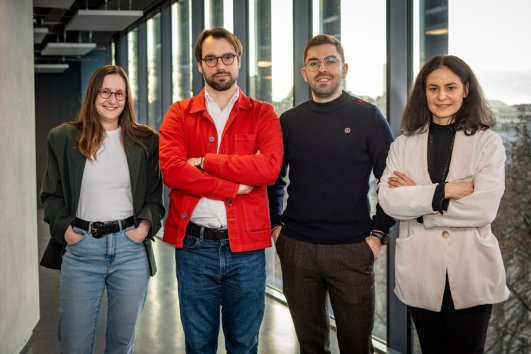
Founded only a few months ago, Qluster brings together David Fainsin (CEO) and Ambroise Boyer (CTO), both with PhDs in quantum optics, Clarisse Thibault (COO), former CNRS Innovation, and Valentina Parigi (CSO), a physicist, professor at Sorbonne University and chair of the company’s scientific advisory board.
The startup won the i-Lab Grand Prize 2026, supported by France 2030.
