
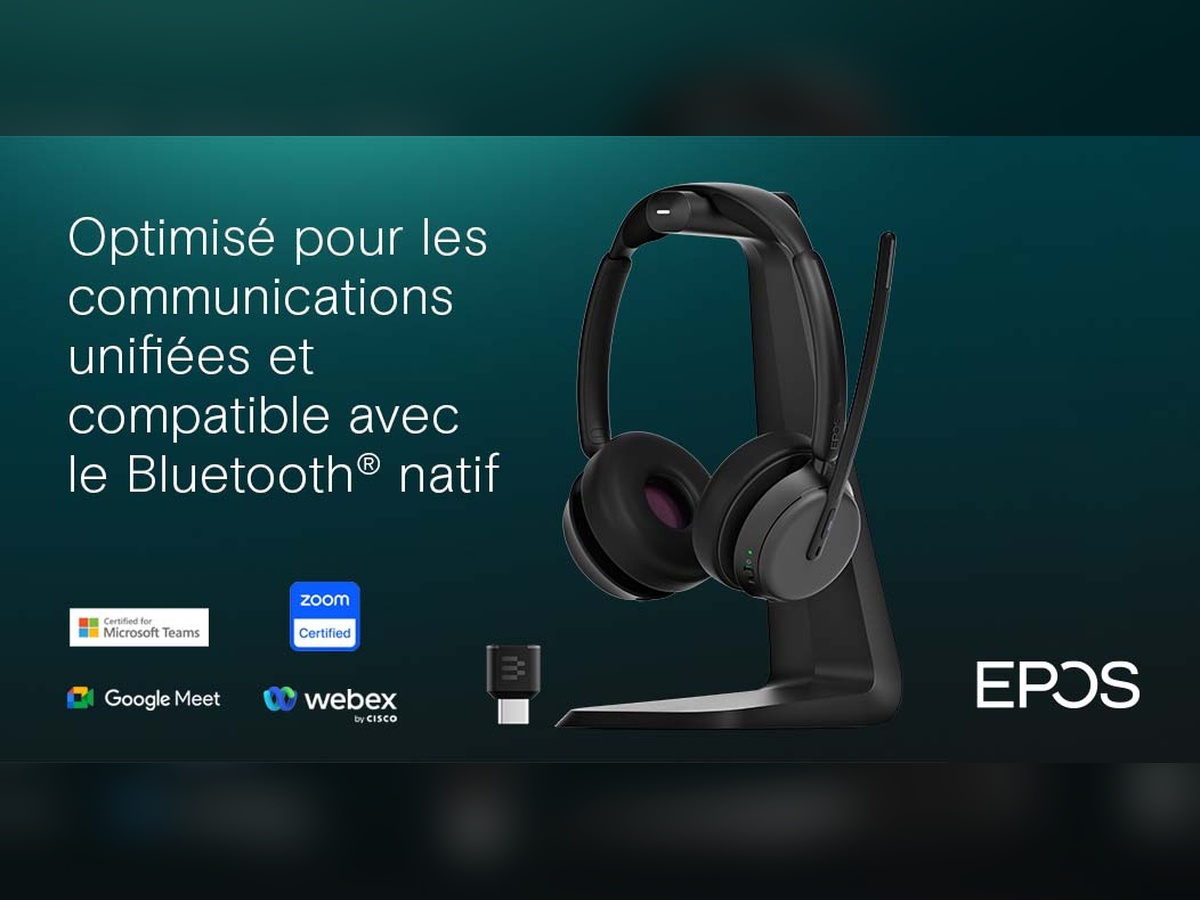
For more than 115 years, EPOS has been developing audio solutions for professionals with a strong belief: the quality of communication depends not only on what we hear, but also on how our brain processes sound. This approach is now taking on a new dimension with the integration of artificial intelligence into its headsets and speakerphones.
At the heart of this strategy lies the proprietary BrainAdapt technology, a set of innovations designed to reduce the cognitive load of listening in increasingly noisy work environments. Building on psychoacoustic research, smart algorithms, and advanced acoustic engineering, EPOS aims to make remote conversations as natural and seamless as a face-to-face exchange.
When the brain turns sound into fatigue
One of EPOS’s major insights rests on a reality that is often invisible: the brain expends more energy when it must distinguish a useful voice from a disrupted acoustic environment. In open-plan offices or hybrid spaces, this cognitive overload can quickly lead to fatigue, reduced concentration, and stress.
The BrainAdapt technology aims to tackle this challenge through a combination of adaptive noise reduction, AI‑driven microphones, and algorithms capable of optimizing vocal capture. The objective is twofold: to improve comprehension during exchanges and to reduce the mental effort required to follow a conversation.
According to EPOS, this approach can notably enhance concentration, memory, and voice recognition in noisy professional settings.
IMPACT 1000: the headset engineered for the AI era
The IMPACT 1000 is no longer merely a videoconferencing peripheral. EPOS positions it as a true productivity tool, designed to optimize both human understanding and interactions with AI systems.
The latest iteration of the line introduces several major evolutions, including upcoming native Bluetooth compatibility with Microsoft Teams and Zoom without the need for an external dongle. A new USB-C Bluetooth dongle and a USB-C to USB-A adapter also simplify usage.
EPOS has also reduced the number of references in the lineup, from ten models to five variants, to make the choice easier for businesses and users alike.
EPOS AI™: distinguishing human voice from ambient noise
The other technological pillar of the brand rests on EPOS AI™, an audio processing system built on machine learning. Developed by the company’s engineers, this technology can identify human voices and filter out interfering noises using models trained in dedicated acoustic laboratories.
The ADAPT 660 headset was the first UC-certified model to feature voice capture optimised by machine learning. Paired with adaptive active noise reduction (ANC), it offers a delicate balance between sonic isolation and awareness of the surrounding environment.
Because for EPOS, the aim is not to completely isolate the user, but to preserve a level of vigilance essential to daily life, whether it is hearing a colleague, an alarm, or a warning signal.
Concentration becomes a strategic priority
Data gathered by EPOS from distributors, resellers, and users highlight a strong trend: noise disturbances are now seen as the main impediment to workplace effectiveness.
A brand survey shows that users’ priorities today are:
- reducing distractions (34%);
- improving microphone performance (31%);
- benefiting from effective active noise reduction (21%);
- better managing sound levels (14%).
These results reflect a fundamental shift in expectations within hybrid work environments. Audio quality is no longer viewed as mere comfort but as a direct driver of productivity, engagement, and well-being.
A new step for collaboration tools
With the rise of hybrid work and the growing prominence of AI-powered collaboration tools, professional headsets are increasingly becoming essential interfaces between humans and collaborative platforms.
EPOS believes the potential of AI applied to audio remains largely untapped. The company intends to continue investing in technologies that enhance the user experience while reducing cognitive fatigue.
Basing itself in Copenhagen, EPOS now markets its solutions in more than 60 countries and continues to rely on more than a century of audio expertise to support new forms of professional collaboration.
More information about EPOS
