
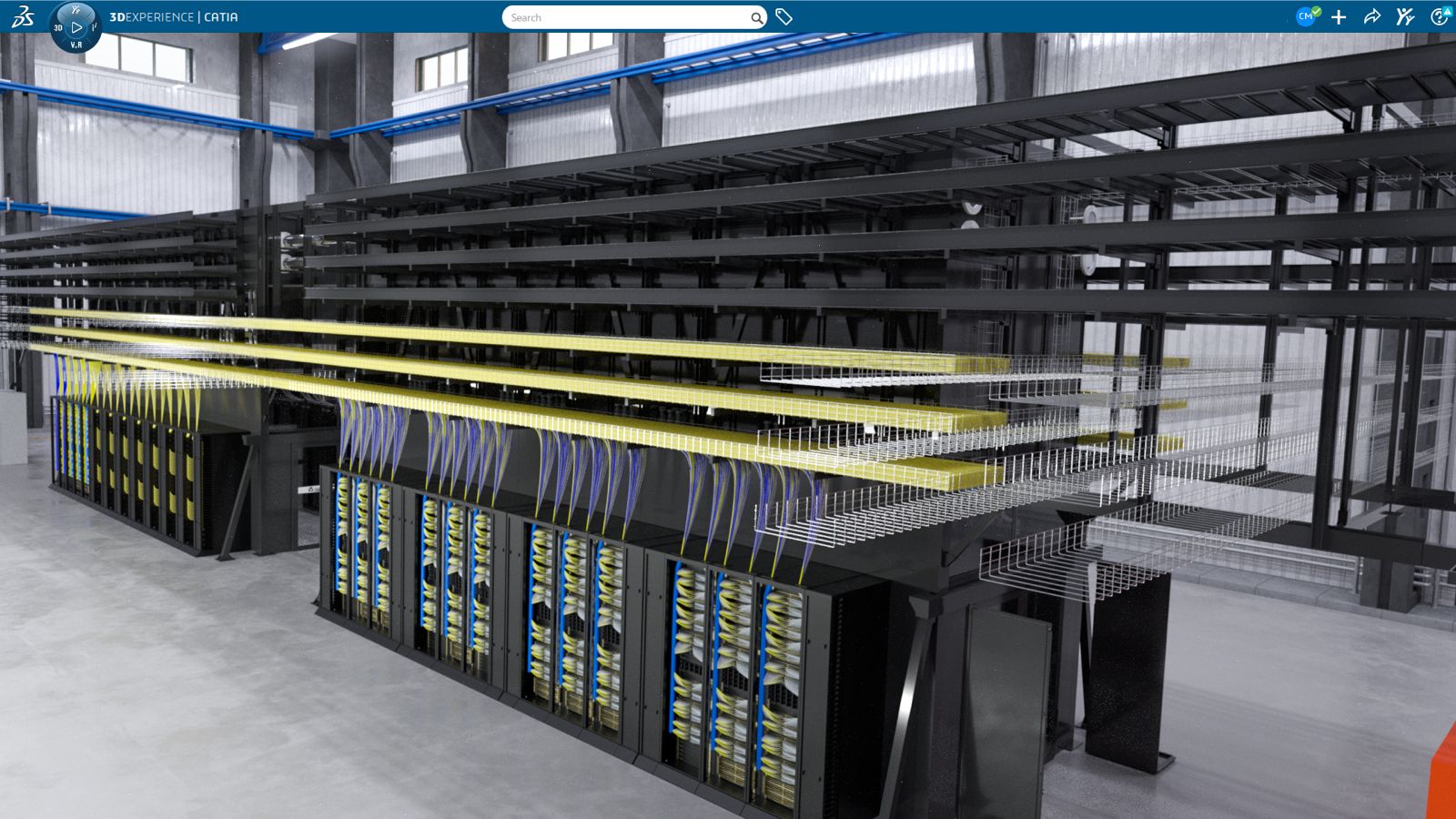
Dassault Systèmes and Vertiv join forces to accelerate the design, simulation, and deployment of AI factory infrastructures.
They propose treating these infrastructures as complex industrial systems to digitally represent them, test their interactions, and validate decisions before work begins. The stated objective is to enable configuration, simulation, and validation of the infrastructure before construction.
Dassault Systèmes brings its model-based systems engineering approach, its simulations tools, and its virtual twin technology. The idea is to represent Vertiv equipment as an integrated digital system, with traceability from requirements to components, constraints, and engineering decisions.
In practice, this should allow project teams to explore several configurations, compare scenarios, and identify the impacts of a change before it translates into cost overruns or on-site delays.
SmartRun, a Twin Already in Place
The collaboration initially centers on Vertiv SmartRun, a prefabricated infrastructure solution installed above the racks in data centers. It brings together power routing, liquid cooling, containment, cabling, and monitoring, with a modular deployment logic designed to minimize on-site interventions.
Vertiv has also developed a digital twin of SmartRun for NVIDIA Omniverse DSX workflows. This model is not merely a 3D mock-up but incorporates configuration rules and dependencies between equipment to simulate the effects of an architectural choice on the entire installation.
The agreement broadens this logic beyond SmartRun toward broader infrastructure solutions, including Vertiv OneCore. Vertiv’s SimReady assets are to become configurable models that can serve as starting points for client projects based on NVIDIA reference architectures.
The partnership explicitly references the NVIDIA Vera Rubin DSX AI Factory architecture and the NVIDIA Omniverse DSX Blueprint. It is therefore about anchoring virtual design in shared references, rather than letting each project start from a blank page.
