
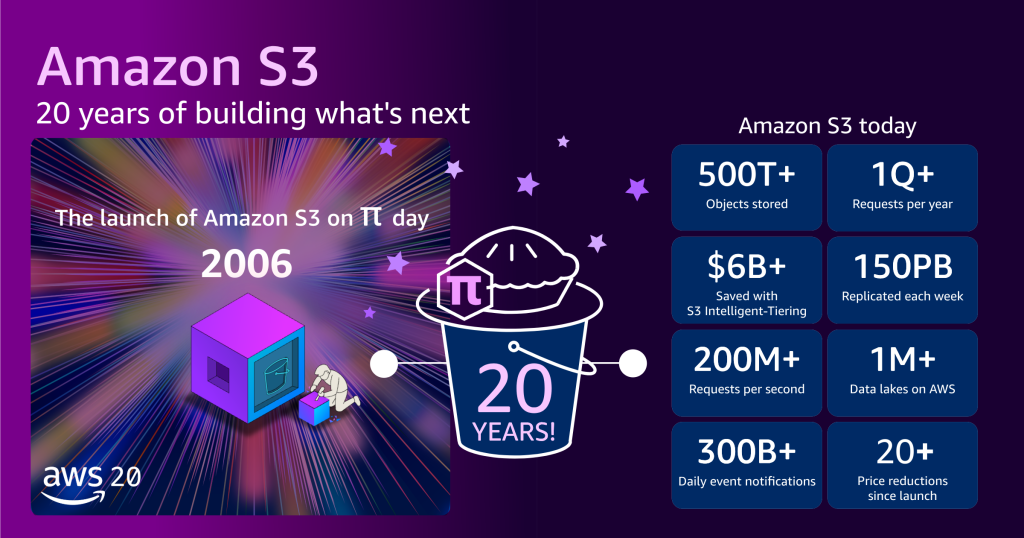
Lauched on March 14, 2006, Amazon Simple Storage Service shook up the foundations of storage in a way few technologies ever have. In two decades, it has evolved from a core internal tool at Amazon into a global backbone for the Cloud, turning its API into a de facto standard and reimagining IT cost models across the world.
From an Internal Need to a Global Infrastructure
It all started with a practical objective: give Amazon a web-scale storage solution that was simple, elastic, and resilient enough for its own e-commerce applications. The service opened to external developers from day one, carrying a bold promise: decouple storage from the underlying hardware through a straightforward API and a pay-as-you-go pricing model. This was a clear break from the SAN/NAS-based CAPEX era that dominated the market at the time.
Twenty years on, the scale is staggering: S3 stores more than 500 trillion objects and handles up to 200 million requests per second. An order of magnitude that would be economically impractical for most organizations to replicate in-house. This critical mass gave rise to a powerful platform effect: a multitude of services—data lakes, analytics, artificial intelligence, backups, and archiving—have been built around S3, progressively strengthening the economic and technical lock-in in AWS’s favor.
From $0.15/GB to Commoditization: The Price War Accelerates
Back in 2006, S3 launched at $0.15 per GB per month for storage and $0.20 per GB for outbound transfers. That pricing was already aggressive compared with traditional infrastructures. Over the years, AWS orchestrated a sequence of price reductions and tiered reorganizations, trimming storage costs to around $0.023 per GB per month for standard storage in the us-east-1 region.
These successive cuts reflected both the economies of scale achieved in the hardware and supply chain, and a deliberate strategy to win and defend market share against other hyperscalers.
The result was a steady commoditization of object storage. Differentiation no longer hinged solely on the raw cost per gigabyte; it grew out of the richness of the ecosystem, the available storage classes, the guarantees of durability, and ancillary charges. Notably, the costs of requests and data egress today remain sensitive considerations for many customers.
The S3 API, a De Facto Standard for the Data Economy
One of S3’s most enduring legacies is the standardization of its programming interfaces. The S3 APIs have become the lingua franca of object storage: most competing offerings—whether on-premises or from other cloud providers—now explicitly claim compatibility with these APIs. By 2025, object storage accounted for roughly 46% of the global cloud storage market, propelled by data-lake usage, media libraries, and backup applications.
Together with Google Cloud Storage, S3 and GCS represented more than 60% of the world’s object storage market in 2024, forming a duopoly in which the S3 API serves as a benchmark for portability. This status bestows significant influence on AWS: the semantics of operations, consistency models, versioning management, and lifecycle policies effectively shape software architectures and, by extension, the migration costs for companies contemplating a provider change.
A Deep Impact on CIOs: From Capex to Opex, and Its New Constraints
From the perspective of chief information officers, S3 has profoundly reconfigured storage spending. The traditional capital expenditure model—purchasing arrays, over-provisioning, refresh cycles—gave way to an operating expense model with fine-grained alignment to actual usage.
This shift improves capital allocation but introduces new risks: variable bills that are hard to forecast, ongoing costs tied to requests and outbound traffic, and the danger of “bill shock” absent robust data governance and governance controls.
The proliferation of storage classes has further transformed storage management into a true data-management challenge. Economic optimization now relies on sophisticated lifecycle policies that go far beyond mere capacity control.
Meanwhile, the growing dependence on S3 as a “source of truth” for many applications and data lakes amplifies concerns around portability and data sovereignty, helping fuel the rise of on-premises or multi-cloud environments that offer S3-compatible interfaces.
At the Heart of the AI Era: S3 as the Backbone of the New Model Economy
Twenty years after its debut, S3 sits at the center of the generative AI economy. It underpins the storage for training datasets, feature stores, inference logs, and model outputs, anchoring the data flows that fuel modern AI models.
As the volume of unstructured data explodes under AI’s influence, the market for software compatible with S3 has grown into the multi‑billion-dollar range in 2024, with annual growth projections exceeding 15% through 2033. A telling sign: the ecosystem built around this API extends far beyond AWS itself, shaping a broad, interdependent market for data storage and management tools.
