
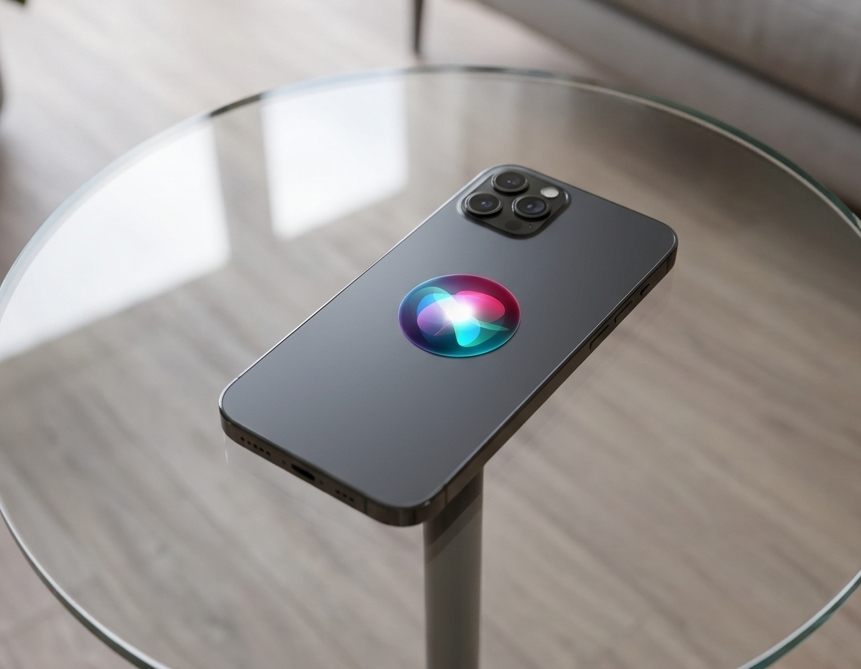
More natural, more relevant, more personal: Siri is entering a new era.
Two years ago, the announcement of Apple Intelligence was accompanied by this promise. The assistant would manage user context more effectively, better interpret what’s displayed on screen, perform “hundreds of actions in apps,” and so on. When needed, it could call on ChatGPT — the GPT-4o model — to power writing features such as composing, rephrasing, and summarizing.
In practice, the rollout of the “new Siri” proved chaotic. Still stagnant in the European Union except on Mac, it also appears to have disappointed OpenAI. It has been whispered that Sam Altman’s company was considering suing Apple over a contract misexecution. It apparently expected a greater emphasis on ChatGPT, notably within Siri. Its renegotiation attempts reportedly failed.
Gemini… and Google Cloud: a double strategic reversal for Apple
OpenAI has, in any case, been completely detached from Apple’s official narrative… in favor of Google. The Gemini models are indeed at the heart of Siri AI — the brand that now carries the evolution of the assistant. Its cloud infrastructure is part of that shift as well. A notable pivot given Apple’s commitments to privacy and security.
These guarantees are realized through the so‑called PCC (Private Cloud Compute) inference architecture. Presented alongside Apple Intelligence, it previously encompassed only Apple’s own chips. It is now extended to NVIDIA GPUs on Google Cloud. Apple asserts that these providers have developed the appropriate confidential computing primitives (NVIDIA Confidential Computing + TDX on Intel CPUs + Google’s Titan chips) to enable PCC promises at scale.
Five models, including two on‑device, to power Siri AI
The first four models have been “refined” (distilled?) with Gemini. AFM Cloud Pro offers “a quality similar to that of Gemini’s frontier models,” Apple merely states.
Developers with apps that have fewer than 2 million downloads (excluding redownloads) won’t be charged to use the remote models.
Talks with the EU remain at an impasse
Siri AI is open to developers on iOS, iPadOS, macOS and visionOS. It will arrive on watchOS in a future beta. User rollout will begin “later this year” (likely in the autumn, with the next iPhone), initially in English.
With the exception of macOS and visionOS, its arrival in the EU remains off the table. Apple attributes this to interoperability obligations imposed by the European Commission. It argues that these requirements would prevent it from honoring its privacy and security commitments. In Apple’s view, they would compel any AI system to have near‑unlimited access to devices and the ability to act autonomously “without ongoing visibility for the user.”
Apple adds that it proposed an “intermediate system” called the Trusted System Agent. Brussels rejected it, as well as a phased rollout over 18 months, it laments.
The European Commission offers a different version. It asserts that the decision not to deploy Siri AI in the EU rests solely with Apple. Rather than attempting to find a workable solution, Apple would have simply asked to be exempted from its obligations for at least 18 months.
