

The next version of DGX Spark is… a laptop.
In this new family of chips designed in collaboration with MediaTek, the top-end configuration resembles the GB10 processor (20 Grace CPU cores, 6,144 CUDA cores, 128 GB of unified memory across 16 channels, up to 1 PFlop in FP4…), but in a reduced thermal envelope (45-80 W versus 140 W).
- 18 CPU cores (9 + 9) and 5,120 CUDA cores, 45-80 W, 128 GB
- 12 CPU cores (8 + 4) and 2,560 CUDA cores, 18-45 W, 64 GB
- 10 CPU cores (7 + 3) and 2,048 CUDA cores, 18-45 W, 64 GB
A nod to Vera Rubin with LPDDR6 is planned for 2027-2028.
Six laptops officially announced… and desktops on the horizon
The first RTX Spark laptops are expected to hit the market in Fall 2026. Six manufacturers have so far confirmed at least one model.
ASUS and HP have each announced two models: the ProArt P14 and P16 for the former, and the OmniBook Ultra 16 and OmniBook X 14 for the latter. Dell will offer a XPS 16 Creator Edition in RTX Spark. Lenovo, for its part, will offer a Yoga Pro 9n.
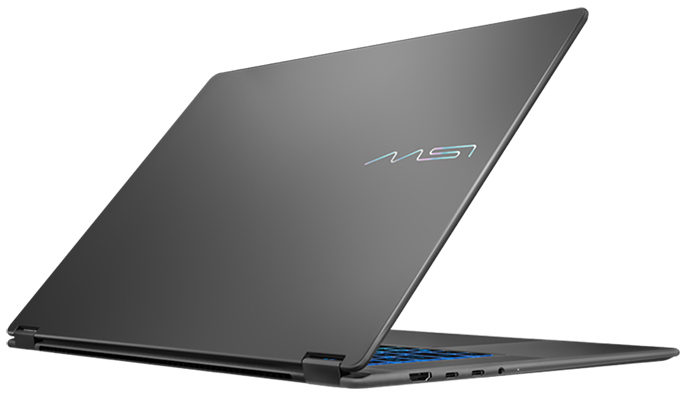
MSI is also in the loop, with the Prestige N16 Flip AI+. It offers a handful of specifications (a 2-in-1 with a 16-inch OLED UHD+ display that rotates 360°).
Microsoft is also part of the mix, with the Surface Laptop Ultra. This 15-inch touchscreen with a mini-LED display (3:2, 262 ppi) weighs “under 2 kg” and “under 18 mm of thickness.”
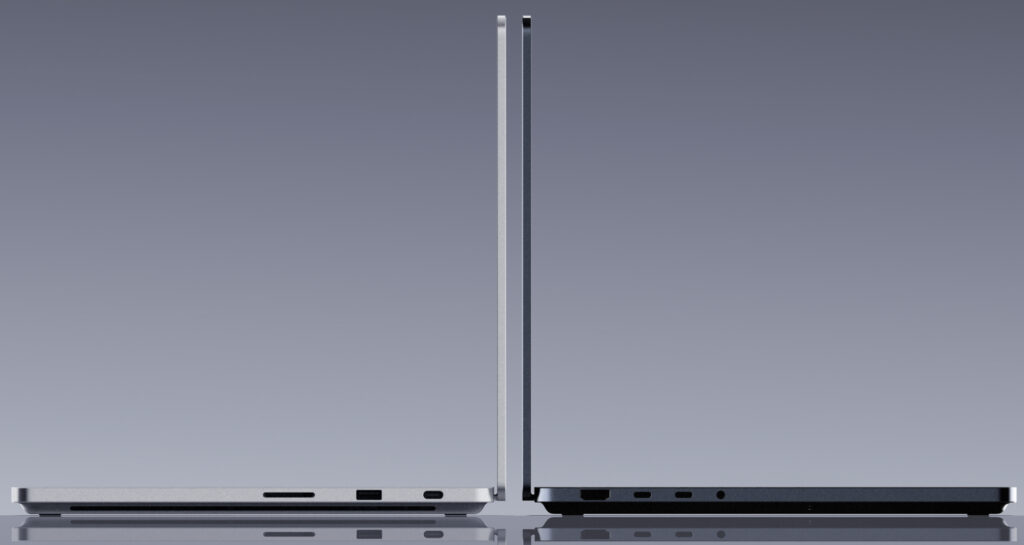
Do not expect anything thinner than 14 mm, according to NVIDIA. As for the displays, they will range from 14 to 16 inches. There is also talk of RTX Spark desktops. MSI has revealed one: the EdgeMesa N AI+, a mini-PC with 10 GbE LAN and an HDMI port. HP has also said plans for a desktop, but no details are provided.
Local AI in the spotlight, Copilot takes a back seat
NVIDIA emphasizes the RTX Spark PCs’ ability to run “personal AI agents.” It notes that Microsoft has integrated, into Windows, several security/identity primitives to complement the porting of the OpenShell runtime. The OpenClaw and Hermes Agents projects have adopted this toolkit for their new Windows applications.
On the Microsoft side, talk of a Copilot+ PC is kept to a whisper. The narrative now centers on local AI, with, among other promises:
- Increase the maximum amount of unified memory accessible by the GPU
- Optimize the task scheduler to better exploit the available 20 CPU cores
- Work on Windows ML to natively exploit TensorRT
- Larger memory pages for the heaviest workloads
- Improvements to the Prism emulation layer, in the spirit of adding AVX/AVX2
Windows for late 2026 on DGX Station
In line with the architectural closeness between RTX Spark and GB10, Windows is officially ported to DGX Station. NVIDIA promises, for the fourth quarter of 2026, GB300 configurations signed by ASUS, Dell, GIGABYTE, HP, MSI and Supermicro.
As with the DGX Station units currently shipped with Ubuntu, this will be a Blackwell Ultra GPU paired with 72 Grace cores, offering up to 252 GB of HBM3e and 496 GB of LPDDR5X.
