

Vade retro, private copying levy.
That is the stance of European cloud providers. At least, that of CISPE, their main representative body. It fears that the sector could be hit with this levy on a large scale after Italy opened the door. The Minister of Culture indeed signed, on February 23, 2026, a decree to that effect. Not yet published, it establishes a monthly per-user compensation, capped at €2.40. It would cost cloud providers €0.0003 per GB up to 500 GB, then €0.0002 beyond. There would be an exemption for the first GB.
The decree establishes a reimbursement mechanism, among other provisions, for storage used exclusively for professional purposes. But CISPE wants to avoid going through that route. It cites the difficulties that affected businesses encounter in practice when seeking this reimbursement. It also argues that this mechanism should be used only as a last resort, European law tending to favor ex ante exemptions.
The private copying levy should not, in general, primarily target companies, adds CISPE, referring to the 2001 Copyright Directive – known as InfoSoc — or rather to its interpretation by the CJEU. The Court had been asked to interpret the notion of “fair compensation” in a dispute between a distributor of recording media (CDs, DVDs, MP3 players) and the Spanish national rights management society. Under its 2010 ruling, applying the levy to equipment “not made available to private users and clearly intended for purposes other than making copies for private use” is not compliant with the InfoSoc directive.
Finland, Norway and Iceland as examples
The CISPE offers another argument: in its most widespread form (a levy per storage device or reproduction medium), private copying remuneration results in more costs than benefits. On this point, it cites a “2022 study by WKO.”
WKO is the Austrian Chamber of Commerce (Wirtschaftskammer Österreich). It actually commissioned the study in question, conducted by an Vienna-based economic research institute.
The study, CISPE explains, proved that managing a €2.50 levy on a smartphone generated €11 in costs. The link provided by the trade association does not point to the study itself but to a summary where these figures do not appear. We have not been able to locate them in the full version either. Instead, the document contains, however, estimates of foregone revenue… and a translation into potentially lost jobs. It also includes cases from a few European countries that have updated their systems.
Finland and Norway are indeed part of this. The levy there is collected from the state budget. To determine the amount, the collective management company conducts annual surveys on the scale of private copying among the population. Iceland, for its part, has dedicated a public fund, replenished in line with the customs value of the relevant products. It conducts evaluations every three years to determine if adjustments are necessary.
The double compensation argument
CISPE is not shy about asserting that what consumers pay already adequately compensates rights holders. Citing data from DigitalEurope (the IT industries lobby), it explains that in 2024 German households bore an average €150 in private copying levies.
Germany is not chosen by chance. It is the country where this levy weighs the most on households, here defined as four-person families with four smartphones, two PCs, one hard drive, one smartwatch, one printer, one games console, and two set-top boxes.
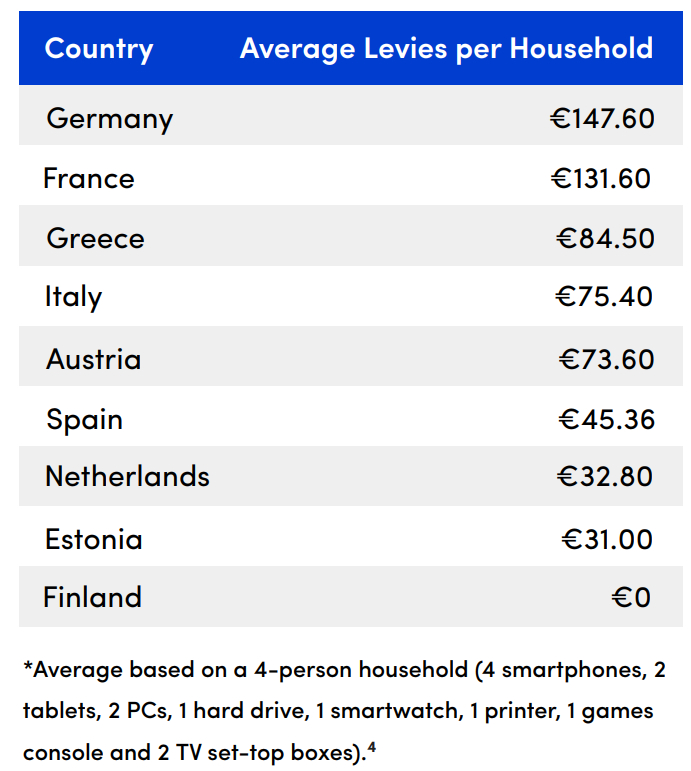
An extension of this levy to cloud storage would create a risk of double compensation, CISPE notes in addition. Moreover, it argues, the InfoSoc directive aims to prevent this. It points to its Recital 35:
In the case where the rights holders have already received payment in another form, for example as part of a licensing fee, a specific or separate payment may not be due.
Rome has also raised Washington’s eyebrows
Statista data on the United States market for recorded music lend credence to the cloud providers’ position. They at least support the idea that with streaming, private copying is on the decline. And that the levy should, at a minimum, be reduced, suggests CISPE.
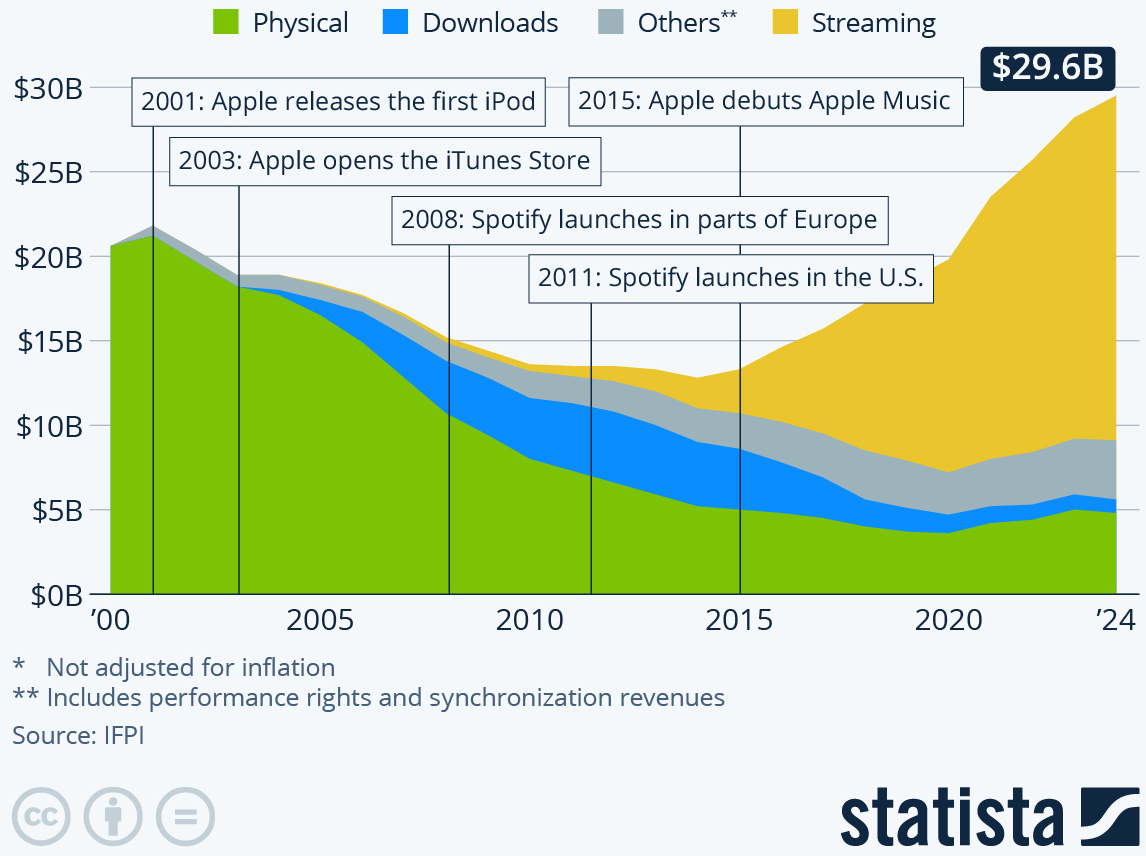
In streaming, the trade association adds modern DRM. Which, in its view, further diminishes private copying. To illustrate this decline, it cites a report from a Finnish market research firm, relayed by the Culture Ministry.
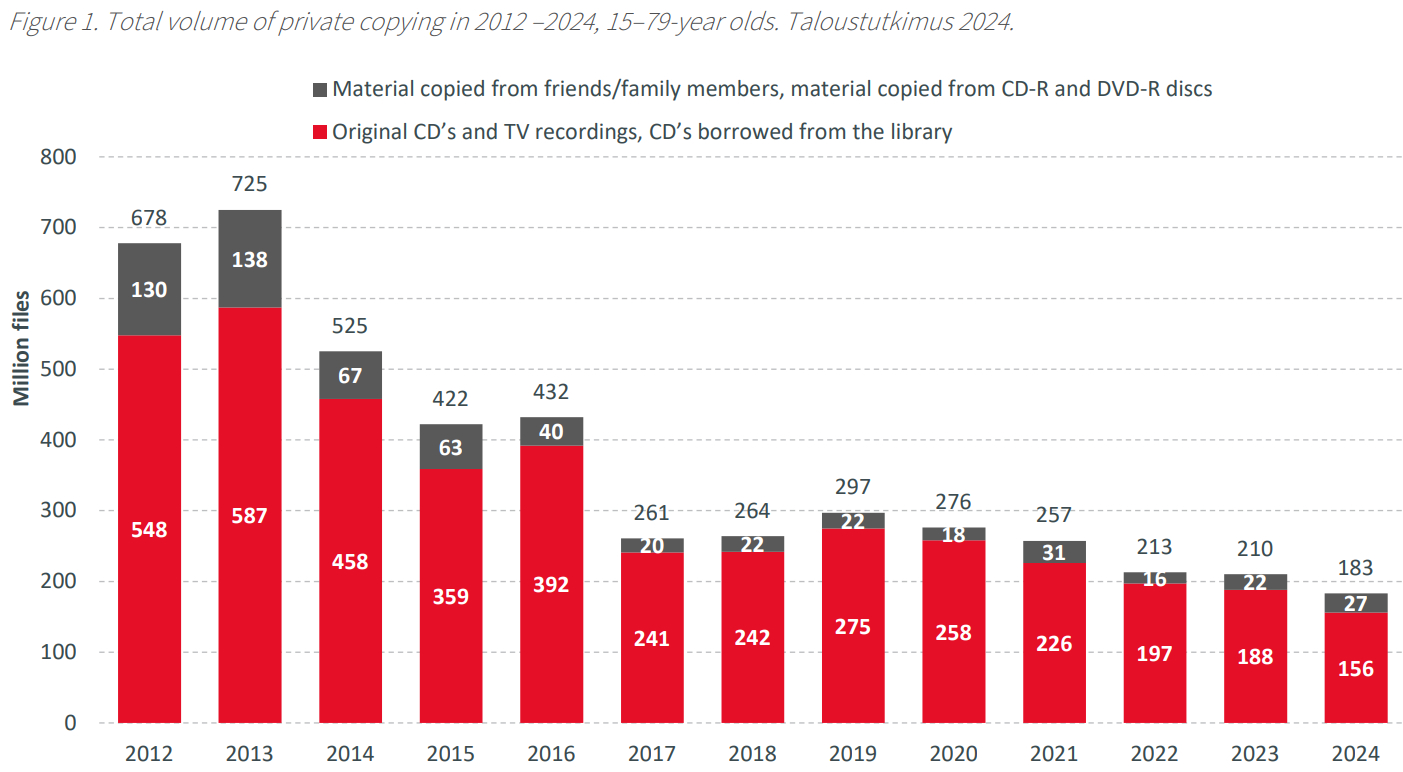
The Italian initiative has resonated beyond Europe. Even Washington sees in it a new discriminatory practice against American companies.
CISPE does not address this aspect. It does, however, insist that extending the levy to cloud providers would undermine the EU’s goals for digitalization and competitiveness…
