
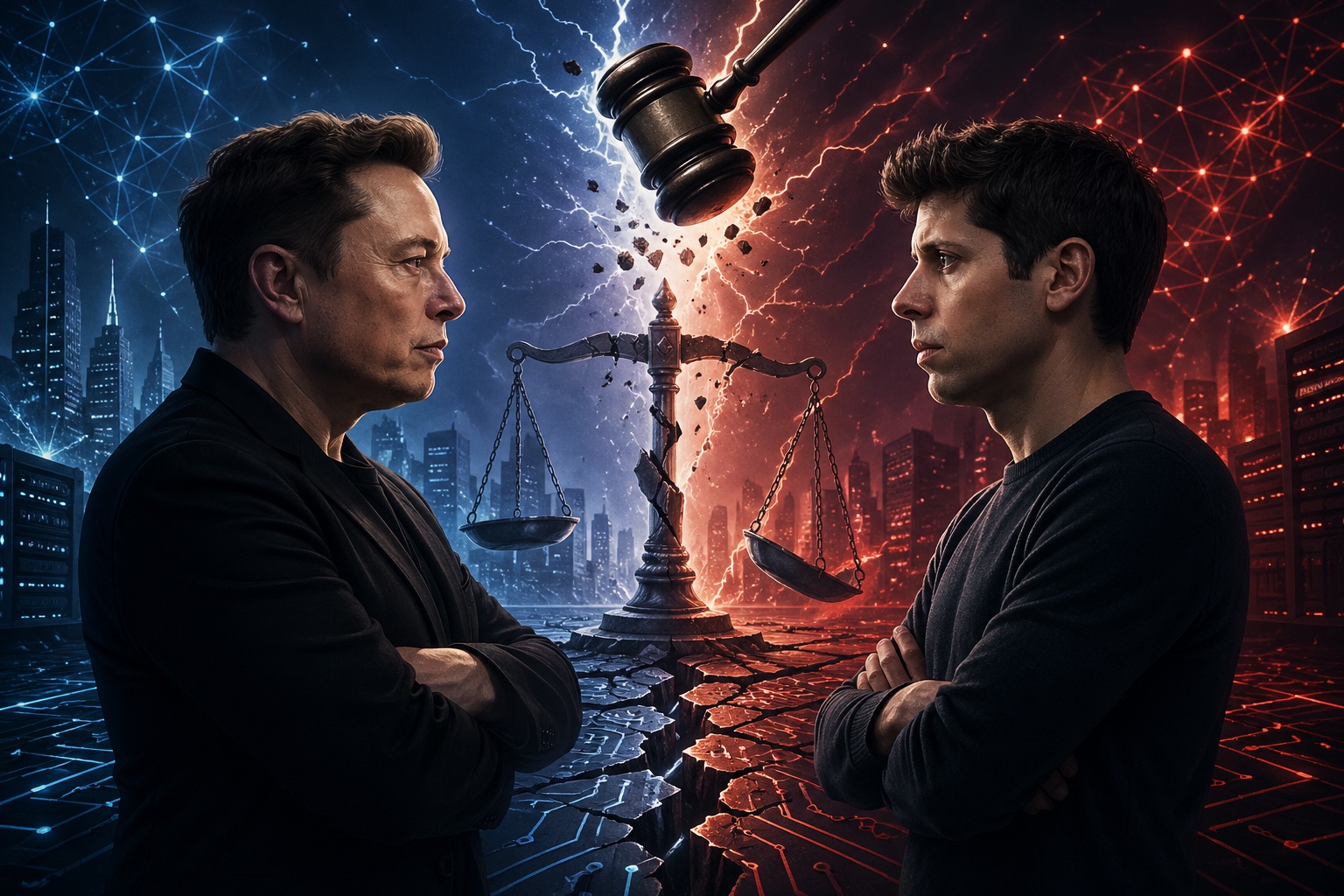
For three days, Elon Musk captured the spotlight. Accustomed to steering his public image from the reach of his sprawling empire—SpaceX, Neuralink, X—he found himself dealing with a terrain far less pliant. “Typically, people in his position fight tooth and nail to avoid being deposed or dragged into a lawsuit,” notes Ann Lipton, a law professor at the University of Colorado, cited by the Washington Post. “This is one of those situations where you can’t really control the narrative.”
And it showed. Elon Musk sometimes appeared irritable, tossing off quips, dropping references to the Terminator film, and drawing repeated rebukes from Judge Yvonne Gonzalez Rogers. When he accused OpenAI’s lead attorney of posing a leading question, the judge interrupted him and asked him to repeat after her: “I am not a lawyer.” Elon Musk complied, adding: “I did nonetheless take the ‘Droit 101’ course, technically.” The audience laughed. The court quickly regained its footing.
The judge also had to rein him in when he repeated, on several occasions, that AI could “kill us all” if developed irresponsibly. “This isn’t a trial about the security risks of artificial intelligence,” she ruled flatly, outside the jury’s presence. “I suspect there are many people who wouldn’t want to place humanity’s future in Mr. Musk’s hands; but regardless, we aren’t going to address those questions.”
Confessions that Make Things Messy
The cross-examination conducted by OpenAI’s lawyers yielded several sharp moments. Elon Musk admitted, not under direct compulsion, that xAI (his AI company recently absorbed by SpaceX) was a “very small company,” roughly ten times smaller than OpenAI. He even offered, spontaneously, a ranking of players in the field: Anthropic at the top, followed by OpenAI, Google, open-source Chinese models, and finally xAI in fifth place.
Even more awkward: when questioned about the practice of “distillation,” a process by which an AI model learns by pushing hundreds of thousands of questions to another model—a technique that the Chinese model DeepSeek has been accused of abusing—Musk acknowledged that xAI had partially used it against rival models. “AI companies generally distill other AI companies’ models,” he said. “So, is that a yes?” pressed OpenAI’s lead attorney, William Savitt. “In part,” conceded Elon Musk.
Among the most damning exhibits is a personal diary of Greg Brockman, obtained during the discovery phase. In 2017, the OpenAI president wrote: “We have thought that perhaps we should simply pivot to for-profit. Making money for ourselves seems great and all.” During a deposition recorded in September, Brockman testified that this note only referred to the need for a “revenue plan to pursue the mission” of OpenAI.
Jared Birchall, Elon Musk’s Man in the Shadows
The case also cast a spotlight on Jared Birchall, Elon Musk’s幕后 operations chief, rarely in the limelight. Text-message exchanges revealed during the hearing show Shivon Zilis (a former OpenAI board member and mother of four of Musk’s children) writing to Jared Birchall: “Heads up. It seems Greg [Brockman], Ilya [Sutskever], Elon are for-profit.” Yet, Musk had asserted that he asked Birchall to file charter documents for a business entity for OpenAI “in case it was needed, but it ultimately never was.” This detail undermines his implication of a backroom, behind-the-scenes shift toward profit.
Outside the courthouse, the spectacle matched the gravity of the case. Journalists and curious onlookers queued before dawn in hopes of snagging one of the 30 unreserved seats. The overflow courtroom, which can seat 100 more spectators, was full each day. Protesters opposed to AI gathered on the sidewalk. Inflatable punching-bags bearing the likenesses of Musk and Altman stood at the entrance.
This week, the trial continues with the anticipated testimony of Greg Brockman, followed in the coming days by Sam Altman, Microsoft CEO Satya Nadella, former OpenAI chief technology officer Mira Murati, and co-founder Ilya Sutskever.
